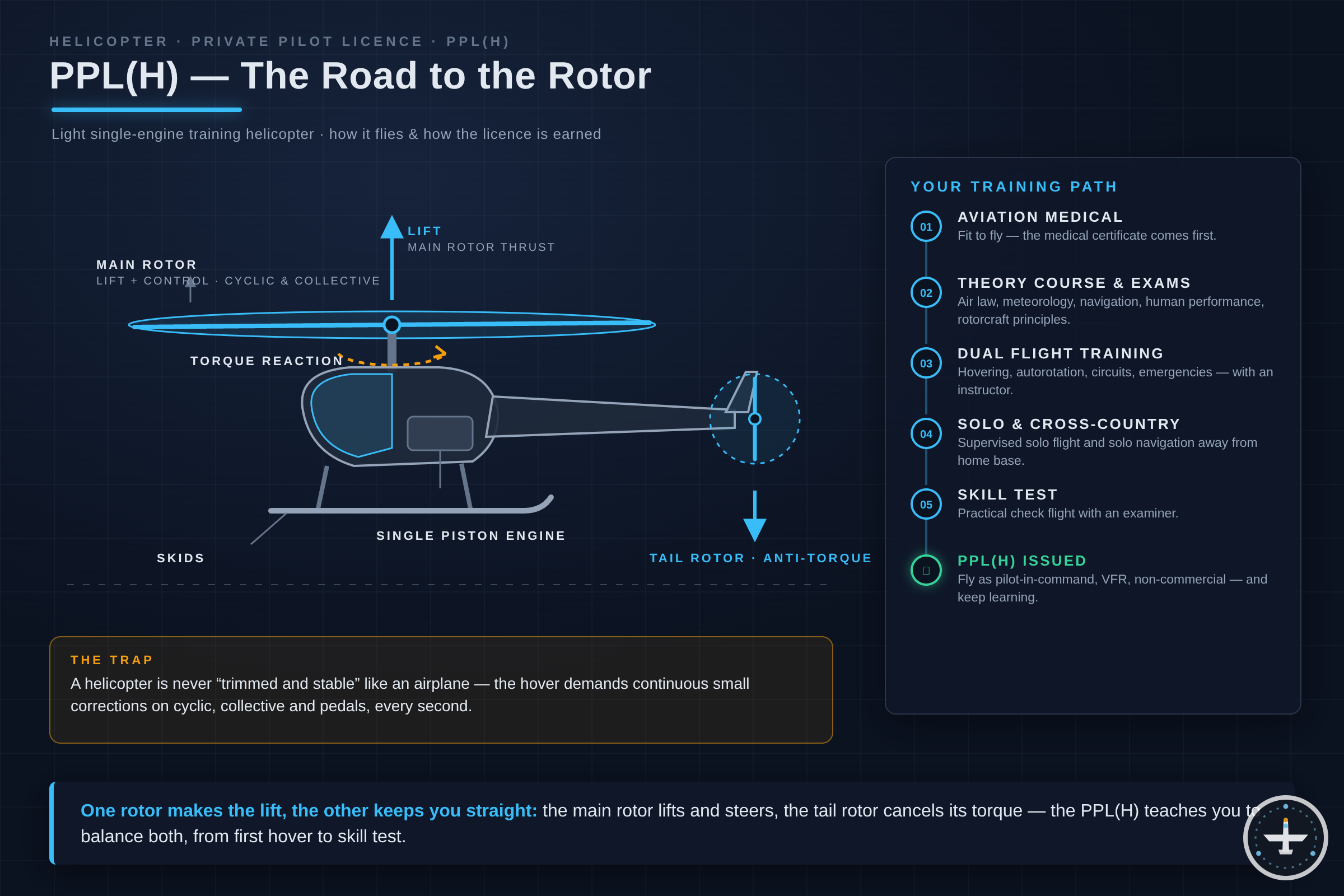
What is the PPL(H)?
The PPL(H) — Private Pilot Licence (Helicopter) — is a non-commercial pilot licence issued under EASA Part-FCL. It allows you to act as pilot-in-command of single-engine helicopters (Single Engine Piston or Single Engine Turbine, depending on your type rating) — but not for remuneration. You may carry passengers; however, you may not be paid for your flying activity.
The licence is valid in all EASA member states and is issued in Germany by the Luftfahrt-Bundesamt (LBA) in Braunschweig. Training itself is conducted through an Approved Training Organisation (ATO) or a Declared Training Organisation (DTO).
An important distinction: the PPL(H) is not to be confused with the PPL(A) for fixed-wing aircraft, or the LAPL(H), a "lighter" licence with restricted privileges. Pilots who later want to fly commercially (CPL/ATPL) often use the PPL(H) as a first building block, but may also enter an integrated CPL course directly.
Who Can Obtain the PPL(H)?
The entry requirements are straightforward:
- Minimum age: 17 years for licence issue. You may begin practical training earlier, but the first solo flight is not permitted before age 16.
- Class 2 Medical Certificate under Part-MED, issued by an Aviation Medical Examiner (AME) or Aeromedical Centre (AeMC) recognised by the LBA. Get this done before starting training — if you are found unfit, you save yourself money and frustration.
- Language Proficiency in English (or German, depending on planned operations). For radio communications in international airspace, English at a minimum of ICAO Level 4 is required.
- Security background check under §7 LuftSiG if you require access to security-restricted areas — not strictly mandatory for PPL training at smaller aerodromes, but de facto standard at many airfields and maintenance facilities.
- Police clearance certificate (Polizeiliches Führungszeugnis) is required by many training schools upon enrolment.
Prior knowledge of mathematics, physics, or English is helpful but not mandatory. If you can think analytically and have the discipline for regular study, you can pass the theory examinations.
What Privileges Does the PPL(H) Carry?
With a newly issued PPL(H), you are permitted to:
- Fly helicopters of the type on which your class or type rating is issued (typically: Robinson R22, R44, Schweizer 300, Cabri G2).
- Carry passengers, but without remuneration.
- Fly under Visual Flight Rules (VFR) by day.
- Share costs with passengers, subject to strict regulations (maximum 4 persons including the pilot; the pilot contributes a proportional share).
Without additional ratings, the following are not permitted: night flight (Night Rating), instrument flight (IR), commercial flights, mountain operations (mountain rating required), or multi-engine helicopters.
The Training: Theory and Practice
Theory
You must study and pass nine EASA theory subjects:
- Air Law
- Human Performance
- Meteorology
- VFR Communications
- Navigation
- Principles of Flight, Airframe & Systems (Helicopter)
- Operational Procedures
- Flight Performance and Planning
- Aircraft General Knowledge
The theory examination is administered by the LBA — currently conducted centrally in electronic format using the ECQB PPL question bank. Multiple choice; pass mark is 75% per subject. You have 18 months from the first passed subject to complete all nine, with a maximum of four attempts per subject.
Practical Training
EASA requires a minimum of 45 flight hours on helicopters, comprising:
- 25 hours dual (with a flight instructor)
- 10 hours solo, of which at least 5 hours must be cross-country solo, including one cross-country flight of at least 185 km (100 NM) with two landings at aerodromes other than the departure point
- Up to 5 hours may be completed in an approved Flight Simulation Training Device (FSTD)
In practice, most candidates require approximately 50–65 hours, as helicopter flying — particularly hovering — is highly demanding in terms of coordination and does not come naturally to everyone from the outset.
The course concludes with a Skill Test conducted by an LBA-authorised examiner. The test covers: pre-flight inspection, hovering, take-off and landing procedures (including steep and shallow approaches), emergency procedures (autorotation!), navigation, and radio communications.
Costs and Duration — Realistically
Helicopter flying is expensive. In Germany, plan for the following:
- Theory (course + materials): €1,500–3,000
- Flight hours: A Robinson R22 typically costs €350–500/h; an R44 €500–750/h, instructor included
- Total PPL(H) cost: realistically €20,000–35,000, depending on aircraft type and school
- Medical, examination fees, LBA licence issue: approximately €500–800 combined
In terms of time, expect 9–18 months if training alongside employment, or approximately 3 months in a full-time intensive course.
Step by Step: How Do You Get Started?
- Obtain a Class 2 Medical — a prerequisite for everything that follows.
- Choose a school — visit an ATO/DTO and arrange a trial lesson.
- Begin theory study — in parallel with, or prior to, practical training.
- Complete practical training, including solo and cross-country flights.
- Pass the LBA theory examinations (required before the Skill Test).
- Complete the Skill Test with an authorised examiner.
- Submit your licence application to the LBA — current processing times are several weeks.
Once licenced: to keep the licence current, you need a valid class rating revalidation (typically every 2 years, with minimum flight hours) and a valid medical certificate.