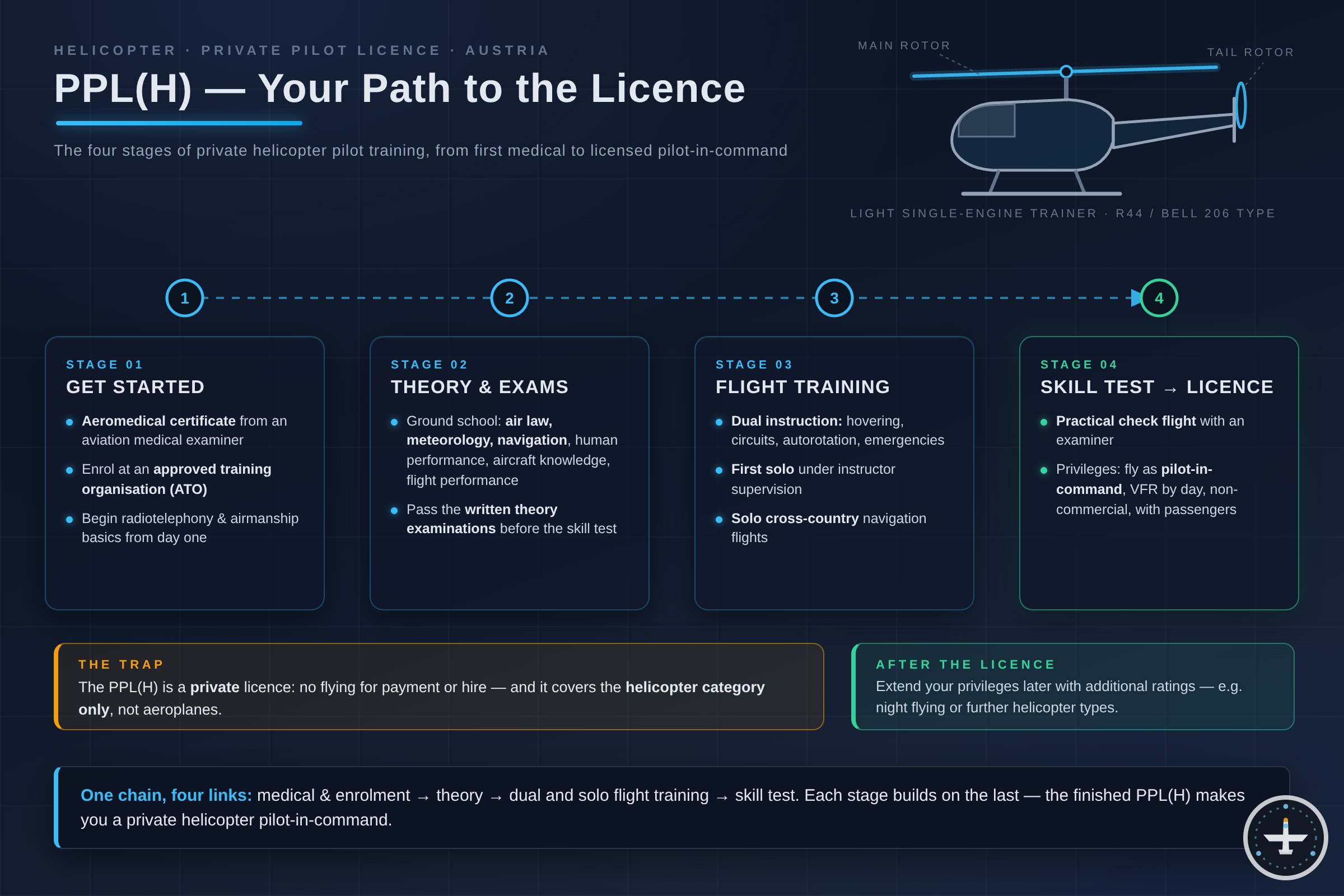
What is the PPL(H)?
The PPL(H) (Private Pilot Licence – Helicopter) is the EASA private pilot licence for helicopters. It allows you to fly helicopters under Visual Flight Rules (VFR) on a non-commercial basis – that is, as a private pilot, without receiving remuneration. It is regulated EU-wide under Commission Regulation (EU) No 1178/2011 (Part-FCL) and administered in Austria by Austro Control GmbH.
With the PPL(H) you are permitted to:
- Act as pilot-in-command of helicopters for which you hold a valid class or type rating (e.g. R22, R44, Cabri G2, EC120).
- Carry passengers – provided you meet the recency requirements (see below).
- Fly VFR by day. Night flight and instrument flight require additional ratings (Night Rating, IR(H)).
What you are not permitted to do: conduct commercial flights for remuneration. For that you need the CPL(H) or ATPL(H).
Who Can Obtain the PPL(H)?
The eligibility requirements are clearly defined in Part-FCL:
- Minimum age: 17 years for licence issue. Solo flight is permitted from age 16 during training.
- Medical Class 2: You need a valid Class 2 medical certificate issued by an Aviation Medical Examiner (AME) recognised by Austro Control. The examination costs approximately 150–250 euros depending on the AME.
- Language proficiency: At least Language Proficiency Level 4 in the language used for radiotelephony (usually English; German is also permitted in Austria for domestic flights).
- Academic background: No formal minimum education is required, but secondary-level mathematics and physics are a significant advantage for the theoretical knowledge subjects.
There is no upper age limit – you can begin the PPL(H) at 50 or 60, provided your medical is valid.
The Path from Zero to Licence
1. School Selection and Enrolment
Training is conducted at an ATO (Approved Training Organisation) or DTO (Declared Training Organisation). Austria has a manageable number of helicopter training schools – a comparison is worthwhile (R22 hourly rates are roughly 380–500 euros/h; R44 is considerably higher).
2. Medical and Application
Obtain your Class 2 medical early. You are not permitted to fly solo until it is in hand. The initial licence application is submitted to Austro Control at a later stage.
3. Theoretical Knowledge Training
You must cover nine subjects:
- Air Law
- Human Performance
- Meteorology
- Communications
- Principles of Flight (Helicopter)
- Operational Procedures
- Flight Performance & Planning
- Aircraft General Knowledge (Helicopter)
- Navigation
The theoretical knowledge examinations are held at Austro Control – typically as multiple-choice computer-based tests. The pass mark is 75% per subject. You have 18 months from the first passed subject to complete all nine, and must complete the practical skill test within 24 months of finishing the theoretical knowledge examinations.
4. Practical Flight Training
A minimum of 45 flight hours is required (Part-FCL.210.H), comprising:
- 25 hours dual instruction (with a flight instructor)
- 10 hours solo, of which at least 5 hours must be solo cross-country
- One solo cross-country flight of at least 185 km (100 NM) with two landings at aerodromes other than the departure aerodrome
In practice, most students require 55–70 hours before they are ready for the skill test. This is normal – budget accordingly rather than assuming the minimum.
5. Skill Test
The practical check is conducted with an examiner (FE(H)) appointed by Austro Control. The test covers normal and emergency procedures, navigation, autorotation, slope landings, quickstops, and more.
6. Licence Application
After passing the skill test, you submit your application to Austro Control together with the test report, logbook copies, medical certificate, and supporting evidence. The licence is then issued – fees are in the low three-digit range.
What Does It All Cost?
Realistic cost range in Austria (as of 2024, R22 as the most affordable platform):
- Flight hours (55 h × approx. 420 €): ~23,000 €
- Ground school course: 1,500–3,000 €
- Examination fees (theoretical + practical): ~500–800 €
- Medical: ~200 €
- Materials, headset, charts: 500–1,000 €
Total: realistically 26,000–35,000 euros. Training on the R44 will be significantly higher.
Validity and Next Steps
The PPL(H) itself has no expiry date. What does expire are the ratings and the medical:
- Helicopter type rating: Valid for 2 years; renewed via a proficiency check.
- Medical Class 2: 5 years (under 40), 2 years (40–50), 1 year (50 and above).
- Recency for carrying passengers: 3 take-offs and landings on the relevant type within the preceding 90 days.
Logical next steps include the Night Rating (H), additional type ratings, or – if you wish to fly professionally – the CPL(H).
How Aero.Academy Helps
Theoretical knowledge is the phase where many candidates lose the most time. Aero.Academy trains you using question banks closely aligned with Austro Control examinations, combined with spaced repetition and gap analysis – so that instead of studying for 200 hours, you target your weak areas efficiently.