The Short Answer
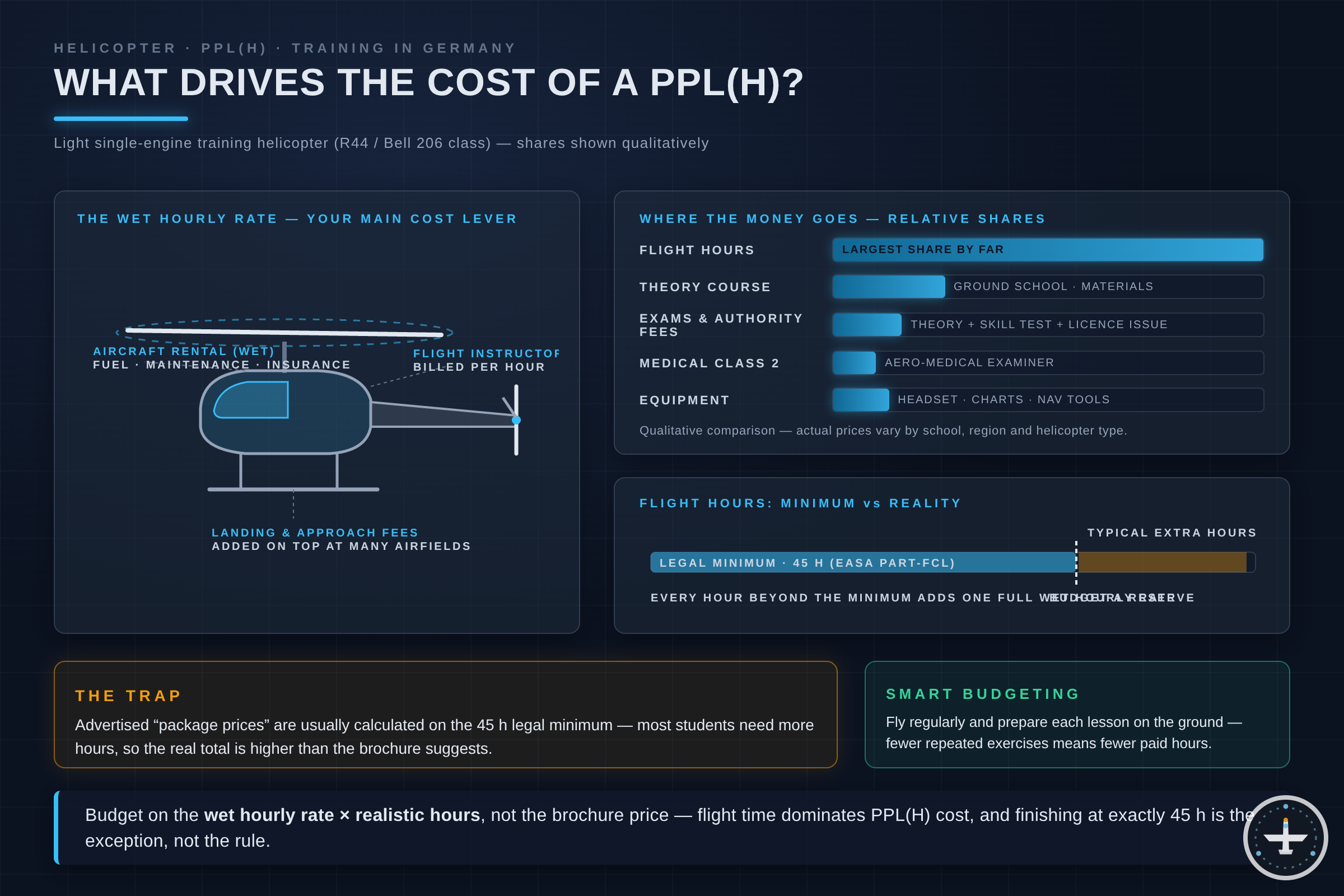
For the PPL(H) in Germany you should budget €18,000 to €30,000, depending on the flight school, helicopter type and how efficiently you progress through training. If you train on a more expensive type (e.g. Bell 206) instead of a Robinson R22, you can easily exceed €35,000.
That is not a typo. Helicopter flight hours cost many times more than PPL(A) hours on a fixed-wing aircraft. The minimum hours requirement under EASA Part-FCL is the same at 45 hours, but the hourly rate is significantly higher.
Cost Breakdown in Detail
1. Medical Certificate (Class 2)
For the PPL(H) you need an EASA Class 2 Medical. The initial examination is carried out by an Aviation Medical Examiner (AME) and costs, depending on the practice:
- Initial Class 2 examination: €150–250
- Renewal: €80–150 (every 5 years up to age 40, then every 2 years, annually from age 50)
- Additional tests (ECG, audiogram, laboratory) may incur extra charges
Tip: Get your medical before enrolling at a flight school. If you are found unfit, you save yourself everything else.
2. Ground Theory Training
The EASA theory syllabus for the PPL(H) covers nine subjects (Air Law, Human Performance, Meteorology, Communications, Principles of Flight – Helicopter, Operational Procedures, Flight Performance & Planning, Aircraft General Knowledge, Navigation).
- Traditional classroom instruction at a flight school: €1,500–2,500
- Online theory / self-study with platforms such as Aero.Academy: €300–800
- Study materials, books, charts: €150–300
Many schools today allow distance learning combined with a short attendance phase. This saves money and time, but requires self-discipline.
3. Flight Hours — the Biggest Item
EASA requires a minimum of 45 flight hours, of which:
- At least 25 hours dual instruction
- At least 10 hours solo, including 5 hours solo cross-country
- One solo cross-country flight of at least 185 km with two intermediate landings
In practice, most candidates require 50–65 hours before they are ready for the skill test. Wet hourly rates (fuel included) in Germany:
- Robinson R22: €320–420/hour
- Robinson R44: €480–650/hour
- Schweizer / Cabri G2: €380–500/hour
- Instructor surcharge: €60–90/hour
Calculation example with R22, 55 total training hours, 30 dual:
- 55 h × €370 = €20,350
- 30 h instructor surcharge × €75 = €2,250
- Total practical training: approx. €22,600
On the R44 the figure would be closer to €30,000–35,000.
4. Examinations and Fees
The theory examination is taken at the LBA (Luftfahrt-Bundesamt), and the practical test is conducted by an officially authorised Flight Examiner (FE).
- LBA theory examination fees: approx. €25–40 per subject, 9 subjects = approx. €250–350 in total
- Practical test (Skill Test): €400–700 examiner fee
- Helicopter for the Skill Test: approx. 1.5–2 hours at the normal hourly rate, i.e. €500–1,300
- Licence issue by LBA: approx. €150–250
- Radiotelephony certificate BZF I or II: €150–300 examination fee plus course (€200–500)
5. Costs That Are Easily Overlooked
- Headset (e.g. Bose A20, David Clark): €400–1,200
- Pilot equipment: kneeboard, flight computer, charts — €100–300
- Travel to the flight school: helicopter schools are less common than PPL(A) schools; you may have a long way to go
- Accommodation during block training
- Insurance / club membership: €100–500/year
- English Language Proficiency test: €150–300, if you also want to communicate in English on the radio
Realistic Overall Cost Estimate
| Item | Low | High |
|---|---|---|
| Medical Class 2 | €150 | €250 |
| Theory + materials | €450 | €2,800 |
| Flight hours (45–60 h) | €16,000 | €32,000 |
| Examinations + licence | €1,200 | €2,500 |
| Radiotelephony certificate | €350 | €800 |
| Equipment | €500 | €1,500 |
| Total | approx. €18,650 | approx. €39,850 |
A candidate who plans ambitiously and completes training on the R22 without exceeding the minimum hours will land at around €20,000. A realistic figure is €25,000–30,000.
Where You Can Save — and Where You Should Not
Sensible savings:
- Online theory instead of expensive classroom instruction
- Buy a second-hand headset
- Choose a flight school with a transparent price list (avoid "package deals" that explode in cost when extra hours are needed)
- Train in a focused, consistent manner: long breaks mean more hours
Do not cut corners on:
- Flight hour quality: a good instructor gets you to the standard faster
- Medical: go to an AME who has experience with helicopter pilots
- Safety-critical equipment
Financing and Funding
There is no direct state funding for the PPL(H) in Germany — the licence is regarded as a private pursuit. Some banks offer training loans, but interest rates are steep. If you subsequently aim for the CPL(H) (commercial licence), part of your PPL(H) hours can be credited towards the requirement — which puts the investment in perspective.
Summary
The PPL(H) is an expensive licence. Anyone who wants to obtain it without going into debt should plan the budget carefully in advance and allow a 15–20 % contingency. With online theory, compact training on the R22 and a school with honest hour-by-hour billing, you can stay towards the lower end of the cost range.