First Things First: What Are We Talking About?
This guide covers the PPL(H) — the private pilot licence for helicopters under EASA Part-FCL, issued by Austro Control in Austria. The training requires a minimum of 45 flight hours on a helicopter (at least 25 dual with an instructor and 10 solo, including 5 solo cross-country) as well as comprehensive theoretical training across 9 subjects.
Total costs in Austria realistically range between €22,000 and €35,000 — depending primarily on the helicopter type used and how efficiently you progress through the training.
The Major Cost Items at a Glance
| Item | Cost Range |
|---|---|
| Flight hours (45 h minimum) | €18,000 – €28,000 |
| Theoretical training | €1,500 – €3,500 |
| Medical Class 2 | €150 – €300 (initial) |
| Examination fees (Austro Control) | €600 – €900 |
| Study materials, headset, equipment | €500 – €1,500 |
| Landing fees, fuel surcharges | €300 – €800 |
| Total | ~€22,000 – €35,000 |
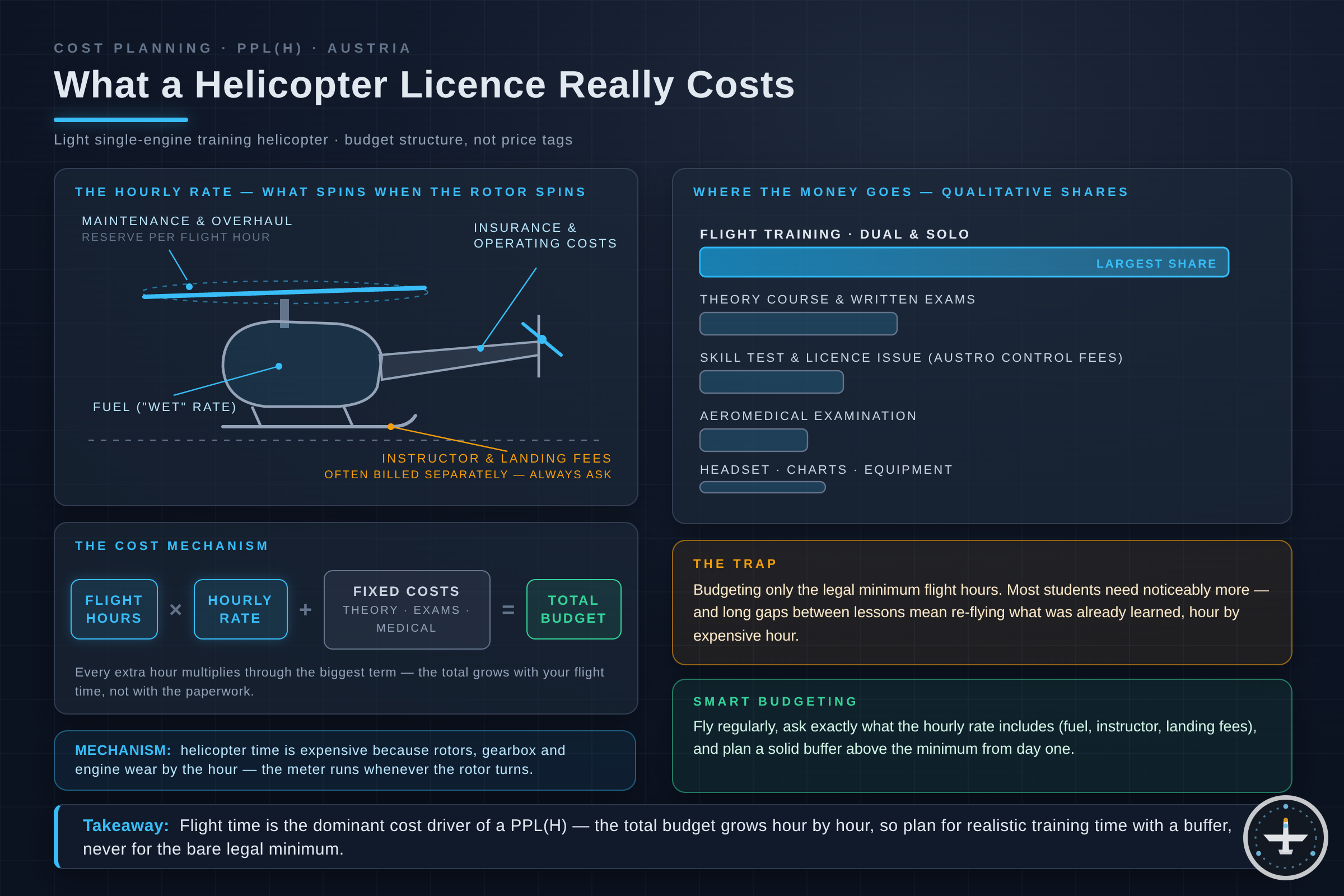
Flight Hours — By Far the Largest Item
One flight hour on a Robinson R22 (the most affordable type commonly used in training schools) in Austria typically costs €400 – €550 per hour gross, including the instructor. On the R44 you are looking at €550 – €700, and on a turbine helicopter such as the Cabri G2 or H120 costs are correspondingly higher.
Sample calculation — R22, 45-hour minimum:
- 45 h × €450 = €20,250
That is the best-case scenario. In practice, most helicopter student pilots need 50 – 60 hours before they are ready for the skill test. Plan realistically with a 10 – 20 % buffer:
- 55 h × €450 = €24,750
Why more than the minimum? Autorotation, hover, pedal turns, and confined-area landings require repetition. Anyone who takes months-long breaks will end up repeating lessons.
Theoretical Training
You must demonstrably complete the 9 EASA subjects (Air Law, Human Performance, Meteorology, Communications, Principles of Flight — Helicopter, Operational Procedures, Flight Performance & Planning, Aircraft General Knowledge, Navigation). In Austria, ATOs (Approved Training Organisations) and DTOs (Declared Training Organisations) offer these in various formats:
- Classroom instruction at a flying school: €2,000 – €3,500
- Distance learning / online course: €800 – €1,800
- Hybrid models: somewhere in between
Platforms such as Aero.Academy help you prepare specifically for the theory examinations — this does not replace the ATO course (which is a regulatory requirement), but it reduces failure rates and therefore repeat examination fees.
Medical Class 2
For the PPL(H) you need a Class 2 medical certificate, issued by an Aeromedical Examiner (AME) recognised by Austro Control.
- Initial examination: €150 – €300
- Renewal: €100 – €200 (every 5 years under age 40, every 2 years from age 40, annually from age 50)
Budget for additional costs if specialist examinations are required (ECG, audiometry, external ophthalmology report).
Examination Fees at Austro Control
Official fees are calculated according to the Austro Control fee schedule and are subject to change. Realistic estimates:
- Theory examination (9 subjects, at an Austro Control site): approx. €250 – €400 in total
- Practical examination (Skill Test) with an examiner: €400 – €600 examiner fee + helicopter charter for the duration of the test (approx. 1.5 h) = an additional €600 – €1,000
- Licence issue by Austro Control: approx. €100 – €150
If you have to resit a theory subject, the subject fee is charged again. Skill Test re-sits are particularly expensive because helicopter charter costs are added.
Equipment and Ancillary Costs
What you should purchase yourself:
- Headset (e.g. David Clark, Bose A20, or Lightspeed Zulu): €300 – €1,200
- Logbook, plotter, navigation compass: €80 – €150
- VFR charts Austria: €30 – €60 per year
- Textbooks / apps: €100 – €300
- Pilot bag, kneeboard: €50 – €150
Variable items also apply: landing fees at other aerodromes during cross-country flights, possibly overnight accommodation on navigation flights, and fuel surcharges depending on market prices.
Hidden Cost Factors
- Weather cancellations: Helicopters are weather-sensitive. If you have a long commute to the school, you may sometimes make the trip for nothing.
- Gaps cost money: Flying once every six weeks means slower progress and more repetition.
- Type rating / class rating: The PPL(H) is type-specific. If you train on the R22 and later want to fly the R44, you will need a Differences Training — no separate skill test, but 5 – 10 additional hours.
- Insurance: During training you are usually covered by the flying school's policy. After licensing, your own liability/hull insurance becomes relevant as soon as you want to hire aircraft yourself.
How to Realistically Reduce Costs
- Push through the theory efficiently: Focused exam preparation rather than dragging it out over years. Every month without a licence is a month without flight practice.
- Fly frequently: Flying twice a week means you can finish in 45 – 50 hours. Flying every three weeks leads to 60+ hours.
- Choose a smaller type: The R22 or Cabri G2 are cheaper than the R44 — for learning purposes they are perfectly adequate.
- Compare schools: Hourly rates in Austria vary by up to 30 % between providers. Check what is included (landing fees, fuel, instructor fee).
Summary
With €25,000 – €30,000 you are in realistic territory in Austria if you train on the R22 and progress at a steady pace. Anyone who keeps postponing training or starts directly on the R44 can easily reach €40,000. Build in reserves — the licence is not an all-inclusive package; it depends heavily on your individual rate of progress.