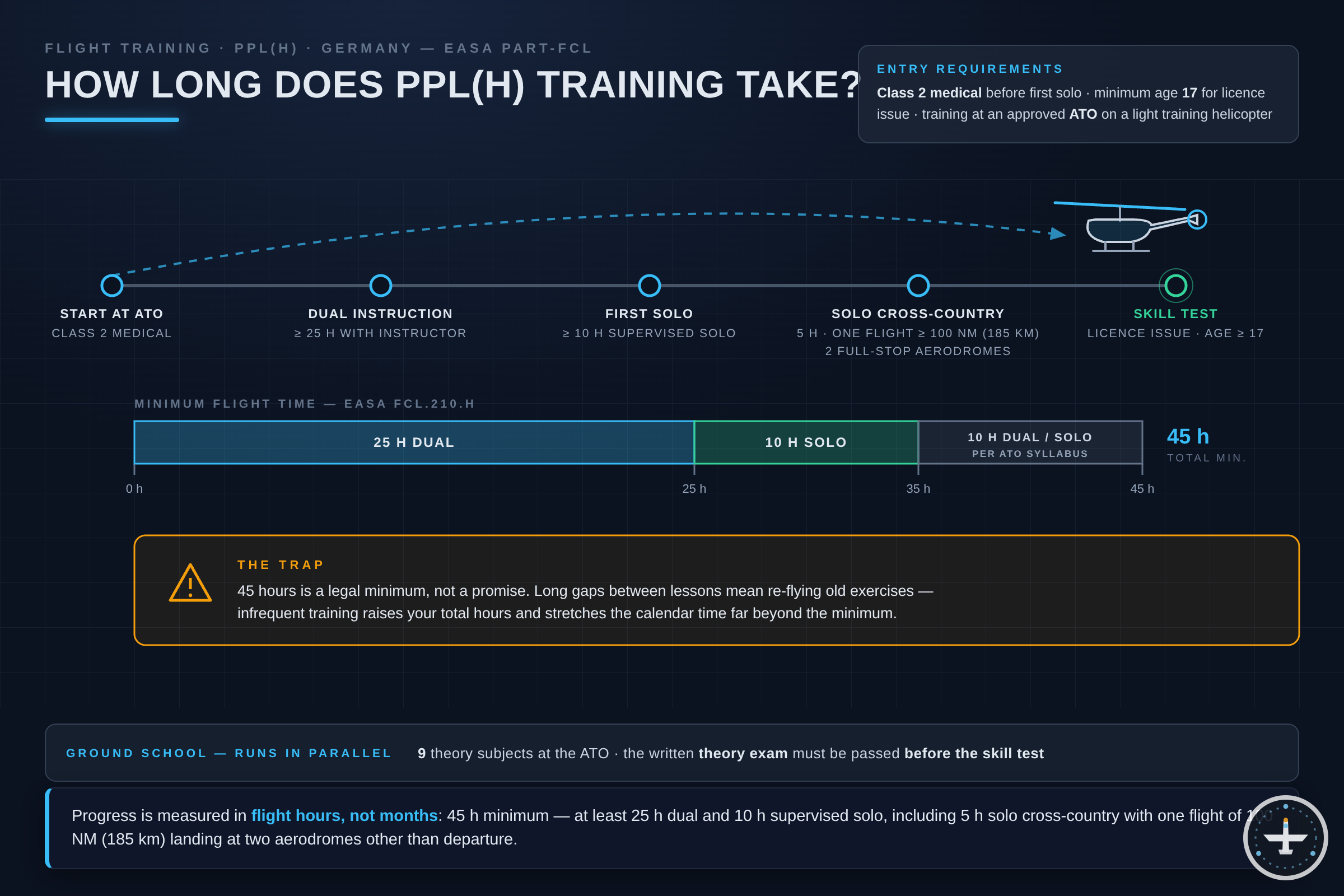
The Legal Minimum Duration Under EASA
For the Private Pilot Licence – Helicopter (PPL(H)), EASA Part-FCL sets a clear minimum flight time: 45 flight hours on helicopters. These are divided as follows:
- 25 hours of dual flight instruction with a flight instructor
- 10 hours of supervised solo flight, of which at least 5 hours must be solo cross-country flight, including one cross-country of at least 185 km (100 NM) with two landings at different aerodromes
In addition, you must complete theoretical training in nine subjects (Air Law, Human Performance, Meteorology, Communications, Helicopter Aerodynamics, Operational Procedures, Flight Performance and Planning, General Aircraft Knowledge, Navigation). In practice, the theory component involves approximately 100 hours of self-study plus contact sessions, depending on the ATO.
If you already hold another licence (PPL(A), LAPL, glider), you may have hours credited – typically up to 6 hours toward the 45.
Minimum Duration Is Not the Same as Realistic Duration
The 45 hours are a lower limit that is rarely sufficient in practice. Helicopters are more demanding to fly than fixed-wing aircraft – hover, autorotation, and pedal coordination all take time. Typical figures from German ATOs:
- Talented and focused: 45–55 hours
- Average: 55–70 hours
- With extended breaks or learning difficulties: 70+ hours
Plan realistically for 60 hours and budget accordingly. Each additional hour on an R22 or R44 currently costs between €350 and €600 in Germany, including the instructor.
Full-Time vs. Part-Time Training
Full-Time Training
An intensive full-time course can be completed in 8 to 12 weeks. Some ATOs offer compact courses where you fly daily and study theory in parallel. Advantages:
- Faster learning progress, less need for revision flights
- Lower overall cost, as you need fewer "refresher hours"
- You can proceed directly to the exam
Disadvantages: You need both the time and the money in one block – roughly €18,000 to €25,000 upfront.
Part-Time Training
This is the standard in Germany. You fly on weekends and take annual leave for cross-country flights. Typical durations:
- 12–18 months with two flights per week
- 18–24 months with one flight per week or with winter breaks
- 24+ months when life gets in the way
Important: The theoretical examination at the LBA must be fully completed within 18 months of the first theory exam sitting. The practical test must be taken within 24 months of passing the theory. If you fall behind, you may have to start over in part.
Factors That Affect Duration
Weather
Germany is not an ideal country for VFR helicopter training from a weather perspective. In winter, low-pressure systems, fog, and short days all take their toll. Expect a success rate of around 50–60% of booked flight hours during the winter months.
Availability of Helicopter and Instructor
Helicopter ATOs are thinner on the ground than fixed-wing flying schools. An R22 is often booked up weeks in advance. Schedule your slots 4–6 weeks ahead.
Your Own Learning Curve
Hover is the first major hurdle for many students – some need 3 hours, others 15. Autorotation, performance calculations, and radio communications in English are further areas that can consume hours.
Theory Examination at the LBA
You must pass all nine subjects in a maximum of four sittings within 18 months, with a minimum score of 75% per subject. You have four attempts per subject. Failing a subject costs time – on average 2–4 weeks per resit due to examination scheduling.
Medical
You need a Class 2 Medical before your first solo flight. Apply early, as findings (ECG, eyesight) can lead to follow-up examinations that block progress for several weeks.
Realistic Timelines
Scenario A – Employed, one flight per week:
- Month 1–2: Registration, Medical, start of theory
- Month 3–12: Dual training, first solos
- Month 13–16: Cross-country flights, theory examinations
- Month 17–18: Exam preparation, practical test
- Total: approx. 18 months
Scenario B – Full-time compact course:
- Week 1–2: Intensive theory block
- Week 3–10: Daily flight training
- Week 11–12: Examinations
- Total: approx. 3 months
How to Speed Up Your Training
- Front-load the theory: With structured study (e.g. adaptive question banks), you can complete the theory within 3–4 months alongside a job. Aero.Academy covers the LBA examination topics for the PPL(H).
- Maintain flight frequency: Two flights per week is more effective than four in one month followed by three weeks off.
- Make use of ground briefings: Ground time with your instructor is cheaper than flight time.
- Take advantage of weather windows: Be flexible when your instructor calls at short notice.
Summary
The EASA minimum of 45 hours is a theoretical figure. Realistically, you will need 55–70 flight hours and, depending on your personal situation, 9 to 24 months. Plan your budget, time, and theory work in a structured way – you will then comfortably meet the 18-month theory deadline and progress smoothly to your practical test.