The Minimum Duration on Paper
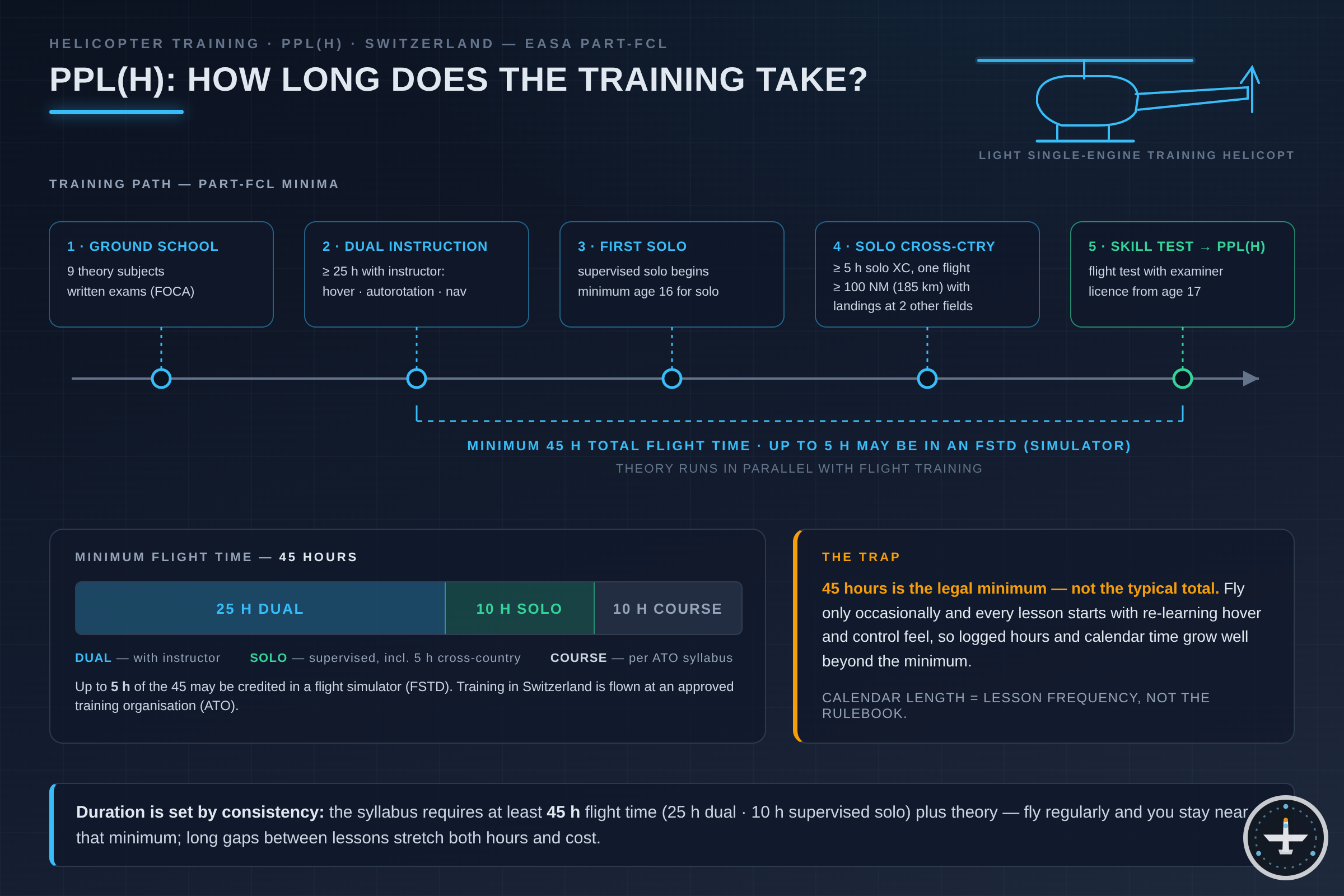
The EASA requirements (Part-FCL) for the PPL(H) — the Private Pilot Licence for helicopters — do not define a fixed calendar duration, but rather minimum requirements for flight hours and theory:
- At least 45 flight hours on helicopters (of which at least 25 hours with a flight instructor and at least 10 hours solo, including 5 hours solo cross-country).
- Theoretical training in nine subjects (Air Law, Human Performance, Meteorology, Communications, Principles of Flight, Operational Procedures, Flight Performance & Planning, Aircraft General Knowledge, Navigation).
- Theory examinations at BAZL in all nine subjects (multiple choice).
- Practical examination (Skill Test) with a BAZL-approved examiner.
If you train full-time, have optimal weather conditions, and encounter no bottlenecks with aircraft or instructor availability, these 45 hours can be achievable in approximately three to four months. You can complete the theory in parallel or in a block beforehand — BAZL requires that all theory examinations are passed before the Skill Test.
The Realistic Duration
Statistics from Swiss flight schools paint a different picture: most PPL(H) candidates require between 55 and 70 flight hours before reaching Skill Test readiness — significantly more than the legal minimum. Reasons include:
- Helicopter flying is more demanding in terms of motor skills than fixed-wing flying. Hovering alone costs most candidates several hours before it becomes consistent.
- Longer gaps between lessons lead to repetition of previously covered material.
- Weather in Switzerland is not consistently suitable for training — especially in winter.
Realistically, you should plan for twelve to twenty-four months total duration if you are training part-time. Full-time programmes (for example as an intensive course) are achievable in six to nine months, but are rare in Switzerland for the PPL(H) because hourly rates are high and few people can finance 45+ hours in one block.
Full-Time vs. Part-Time
Full-Time (Intensive)
- Two to three flights per week, plus theory via self-study or a classroom course.
- Duration: 6–9 months possible.
- Advantage: High retention between lessons, fewer repetition hours, shorter overall duration.
- Disadvantage: High financial burden in a short period (CHF 35,000–50,000), not always plannable due to weather.
Part-Time (Typical Case)
- One flight per week or every two weeks.
- Duration: 12–24 months, occasionally longer.
- Advantage: Costs spread over time, compatible with employment.
- Disadvantage: Longer gaps → more repetition hours → higher cost per effective learning hour.
A mixed approach often works best: start part-time, then increase intensity in the final phase (solo cross-country, examination preparation).
Factors That Influence Duration
1. Weather
Helicopters fly lower and slower than fixed-wing aircraft, but are equally weather-dependent. On the Swiss Plateau, numerous flights are cancelled in winter due to fog, precipitation, or wind. Plan for a cancellation rate of 30–40% for weekend slots.
2. Training Frequency
Studies in flight training show that candidates who fly at least once per week require on average 15–20% fewer hours than those who fly only every two to three weeks. Schedule your slots tightly.
3. Theory Strategy
You can sit the nine BAZL theory examinations in a staggered sequence. Candidates who run theory and practice in parallel learn more efficiently, because practical flying contextualises the theoretical content. Leaving theory until late creates a bottleneck — the Skill Test is only possible after all theory examinations have been passed.
4. Prior Experience
- Fixed-wing licence (PPL(A)): Theory subjects may be partially credited; flight hours are not directly transferable — you still have to fly the 45 hours on helicopters, but typically with less additional effort.
- Gliding, model aircraft, drone: Helps with airspace awareness, but does not replace any required hours.
5. School, Helicopter Type, and Availability
Small schools operating one or two helicopters (typically Robinson R22 or R44) have waiting lists. Ask specifically before enrolling: how many slots per week are realistically available? How quickly can you get a replacement slot after a weather cancellation?
6. Individual Learning Curve
Some candidates hover stably after eight hours; others need fifteen. This is normal. What matters is that you do not try to force the minimum — the Skill Test leaves no room for gaps.
Typical Timeline — Swiss Reality
A realistic roadmap for a working professional:
| Phase | Duration | Content |
|---|---|---|
| Theory start | Months 1–3 | Self-study, first BAZL examinations |
| Practical fundamentals | Months 2–8 | Hovering, circuit flying, emergency procedures |
| Solo flights | Months 8–14 | First solo, solo exercises |
| Navigation & cross-country | Months 14–20 | Cross-country flying, solo cross-country |
| Examination preparation | Months 20–24 | Remaining theory, Skill Test preparation |
| Skill Test | Months 22–24 | BAZL-approved examiner |
Conclusion
The legal minimum of 45 flight hours is a lower bound, not a benchmark. Plan realistically for twelve to twenty-four months for your PPL(H) if you are training part-time, and six to nine months for an intensive full-time programme. Candidates who fly regularly, approach theory in a structured way, and choose their school carefully will stay at the lower end of that range.