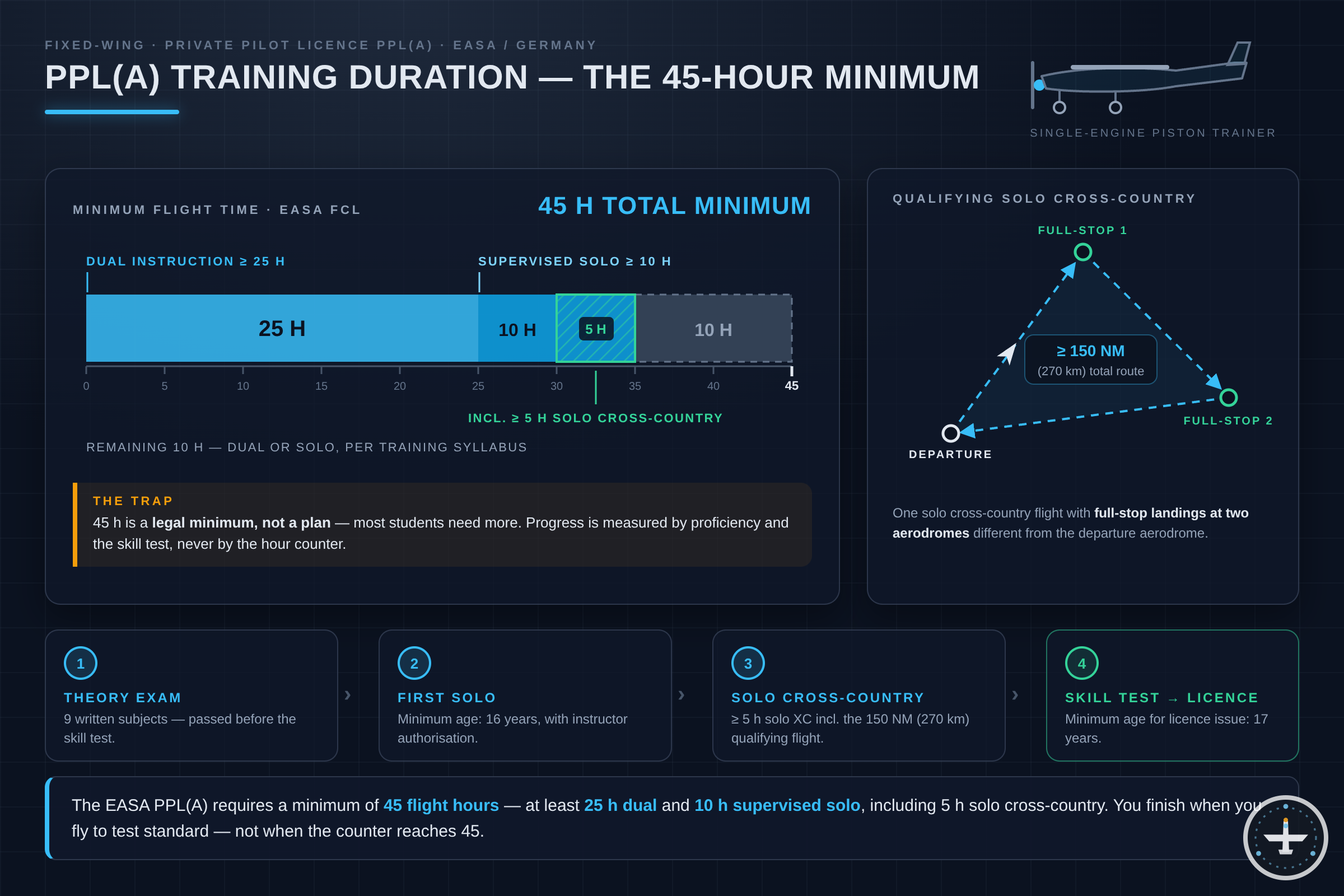
The Legal Minimum Duration
The PPL(A) under EASA Part-FCL has clear minimum requirements:
- 45 flight hours total time, of which at least 25 hours dual instruction and 10 hours solo (including 5 hours solo cross-country, with one flight of at least 150 NM).
- Theoretical knowledge instruction in nine subjects (Air Law, Navigation, Meteorology, Aircraft General Knowledge, Aerodynamics, Human Performance, Operational Procedures, Communications, Flight Planning).
- Radio telephony licence (BZF I or BZF II) – in Germany issued separately by the Bundesnetzagentur.
- Medical Class 2 before the first solo flight.
In theory, you could complete the PPL(A) in roughly two to three months full-time. In practice, almost nobody achieves this.
Realistic Duration: 9 to 18 Months
The average PPL student in Germany takes between 9 and 18 months and logs 55 to 70 flight hours instead of the 45-hour minimum. Why the discrepancy?
- Weather: Depending on the region, 30–50 % of planned flight sessions in Germany are cancelled due to wind, cloud, fog or precipitation – particularly during the winter months.
- Aircraft and instructor availability: Weekend flying at a club is popular – you are competing with other students for the same slots.
- Learning curve: Certain exercises (landings, radio navigation, emergency procedures) require more repetitions than the minimum hour framework allows for.
- Breaks: Holidays, illness, university exam periods or work commitments create gaps. After three weeks without flying, you effectively need to spend one to two extra hours getting back up to speed.
Full-Time vs. Part-Time
Full-Time Training (ATO, Intensive Course)
At an Approved Training Organisation (ATO) on a full-time basis, you can complete the PPL(A) in 6 to 12 weeks. This works because:
- You fly daily, often twice a day.
- Theory is delivered as a block course – typically 2–4 weeks of intensive study.
- Bad-weather days are bridged with ground school, simulator sessions or briefings.
- Some ATOs relocate to southern Europe (Spain, Portugal) for the practical phase – where weather availability is significantly higher.
Cost: typically €12,000 to €18,000. You need full-time availability and sufficient financial reserves so you do not have to work in between.
Part-Time at a Club or DTO
The classic route in Germany runs through an aviation sports club or a Declared Training Organisation (DTO). Advantages:
- Considerably cheaper (often €8,000–€12,000 total cost).
- You fly at your own pace, usually at weekends or on summer evenings.
- Theory is often delivered as a weekend or evening course over several months.
Disadvantages: it typically takes 12–24 months. Students who fly only every two weeks risk a flat learning curve and will ultimately need more hours.
Factors That Determine Your Timeline
- Flight frequency: Flying once or twice a week is the most efficient pace. Anything less than once a fortnight extends training disproportionately.
- Season at the start: If you begin in spring (March/April), you make full use of the stable weather season. Starting in October often means months of enforced breaks.
- Theory strategy: Whether you complete the theoretical knowledge exam early and then focus on practical training, or run both in parallel, affects both pace and stress levels. At the LBA, the eight (or nine) subjects are examined in a single session or in stages – you have 18 months from passing the first subject to pass all of them.
- Learning style and prior experience: Pilots who already hold a glider or UL licence have a head start in aerodynamics and procedures. Complete beginners often need 30–50 attempts at landings before they are consistently proficient.
- School/club and instructor changes: Frequent changes between flight instructors introduce inconsistencies. A dedicated instructor measurably accelerates progress.
- Medical and administration: Medical Class 2 can generally be obtained within 1–2 weeks from an AME. The BZF takes 2–5 days depending on the radio telephony school. Both should be arranged early – not shortly before the exam.
Realistic Timeline: Two Scenarios
Scenario A – Full-time, spring start at an ATO:
- March: Theory course (3 weeks), Medical, BZF.
- April: Theoretical knowledge exam at the LBA.
- April–June: Practical training in block format, 4–5 flights per week.
- July: Skill test.
- Total: approx. 4–5 months.
Scenario B – Part-time at a club:
- March: Enrolment, Medical, first flight hours.
- March–November: average of 1 flight per week, theory in parallel via evening course.
- October/November: Theoretical knowledge exam.
- Following year, March–June: Solo flights, cross-country navigation, exam preparation.
- June/July: Skill test.
- Total: approx. 15–18 months.
What You Can Influence
You can actively shorten your training duration by:
- flying consistently at least once a week,
- completing theory early,
- taking briefings and debriefs seriously (each flight hour costs approx. €200–€280 – ground preparation is free),
- counteracting longer breaks actively with simulator or procedure training,
- planning a weather backup: reserve two slots per week – at least one will hold.
Students who fly only sporadically risk not only a longer training period but also significantly higher overall costs – every repeat session after a break adds up immediately.