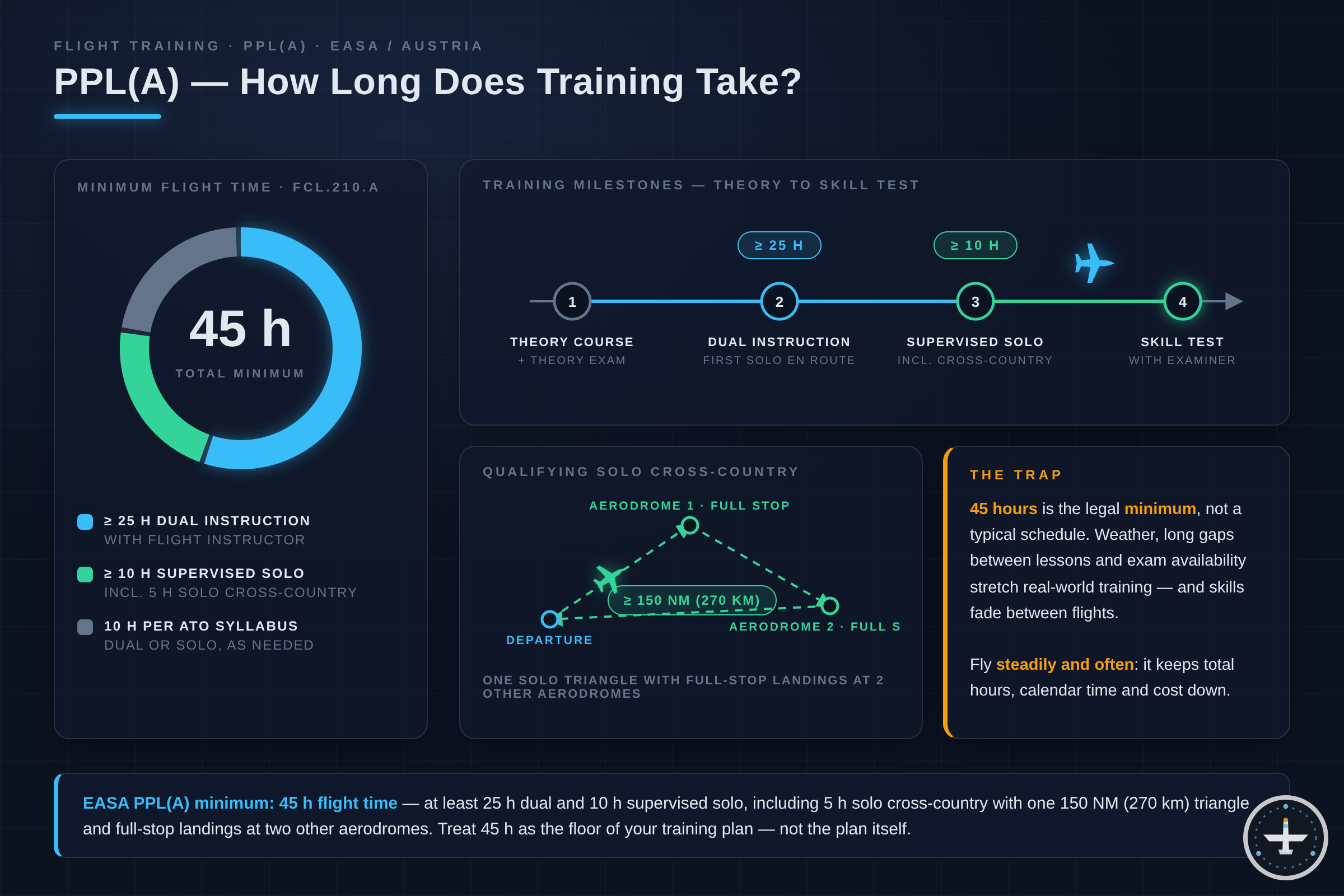
The EASA Minimum Duration for the PPL(A)
The legal basis for your Private Pilot Licence – Aeroplane training is Part-FCL of EASA, specifically FCL.210.A. This regulation defines what you must demonstrate as a minimum before you are permitted to sit the practical test with Austro Control:
- At least 45 flight hours on aeroplanes (up to 5 hours may be completed on an approved FNPT/FSTD simulator)
- Of which at least 25 hours dual (with a flight instructor)
- Of which at least 10 hours solo, including 5 hours solo cross-country
- A solo cross-country flight of at least 270 km (150 NM) with two full-stop landings at aerodromes other than the departure aerodrome
- 9 theoretical examination subjects with Austro Control
- Language Proficiency check (minimum Level 4)
- Class 2 Medical (mandatory before your first solo flight)
In theory you could complete these 45 hours in 6 to 8 weeks if you train full-time. In practice, very few applicants achieve this.
Realistic Duration: Full-Time vs. Part-Time
Full-Time Training (Intensive Course)
If you can clear your schedule for several months, PPL training is achievable in 3 to 6 months. Some ATOs (Approved Training Organisations) and DTOs (Declared Training Organisations) in Austria offer such intensive courses. You fly 4 to 6 days per week, often with two flights per day, and complete the ground school in parallel via block instruction or e-learning.
Advantages:
- Faster learning progress, less repetition
- Better consistency in aircraft handling
- Theory and practical training reinforce each other
Disadvantages:
- High cost concentrated in a short period (total approx. €12,000–€18,000)
- Difficult to combine with full-time employment
- Weather dependency can derail your schedule
Part-Time Training (the Standard Case)
The large majority of Austrian PPL applicants train part-time at weekends. Realistic timelines are:
- 12 to 18 months with two flights per month
- 18 to 24 months with one flight per month or fewer
- More than 24 months if you take extended breaks
Keep in mind: flying less frequently than every two weeks results in a measurable loss of proficiency, requiring additional hours to maintain the required standard. The 45-hour minimum is rarely achieved in practice — the average is approximately 55 to 70 flight hours before an applicant is ready for the Skill Test.
Factors Affecting Duration
1. Training Frequency
The most important factor. Two flights per week will advance your training faster than four flights per month, even if the total hours are identical. Extended breaks cost you half to a full flight hour in recurrency each time you return.
2. Weather
In Austria, the reliably flyable months are April through October. During winter, many VFR flights are cancelled due to low cloud bases, fog, or snowfall. Applicants who start in autumn often face a forced pause and effectively restart in spring.
3. Theory Progress
The 9 theoretical subjects (Air Law, Human Performance, Meteorology, Communications, Principles of Flight, Operational Procedures, Flight Performance & Planning, Aircraft General Knowledge, Navigation) must be passed before the practical test with Austro Control. The theoretical examinations are held in Vienna (Schnirchgasse), each subject individually, in a multiple-choice format. From the date you pass your first subject you have 18 months to complete all 9, with a maximum of 4 attempts per subject. Falling behind on theory blocks your progress on the practical side.
4. Medical
You must hold a Class 2 Medical Certificate no later than before your first solo flight. Allow two to four weeks' lead time to book an appointment with an Aviation Medical Examiner (AME). If additional medical reports need to be submitted, the process can take several months.
5. Personal Factors
- Learning speed: Some applicants are check-ready after 45 hours; others need 80.
- Prior experience: A glider licence, UL licence, or simulator experience is helpful but does not replace the minimum hour requirement.
- Budget: Applicants who have to pause due to financial constraints automatically extend their training.
- Flight school and instructor changes: Frequent changes of instructor or aircraft type cost time.
Typical Timeline at a Glance
| Phase | Duration (part-time) |
|---|---|
| Enrolment, Medical, Training Agreement | 1–2 months |
| Ground school self-study + instruction | 4–9 months (in parallel) |
| Practical training to first solo | 3–6 months |
| Solo phase, cross-country flights | 4–8 months |
| Theoretical examinations with Austro Control | 2–6 months |
| Practical test (Skill Test) | after theory completion |
| Total | 12–24 months |
Recommendation
Plan realistically for 15 to 18 months and a budget of approximately €14,000. Start the ground school early — ideally before your active flight training begins — to avoid the classic bottleneck where practical training is complete but theory is still outstanding. Fly as regularly as possible; one hour every week is more effective than four hours once a month.