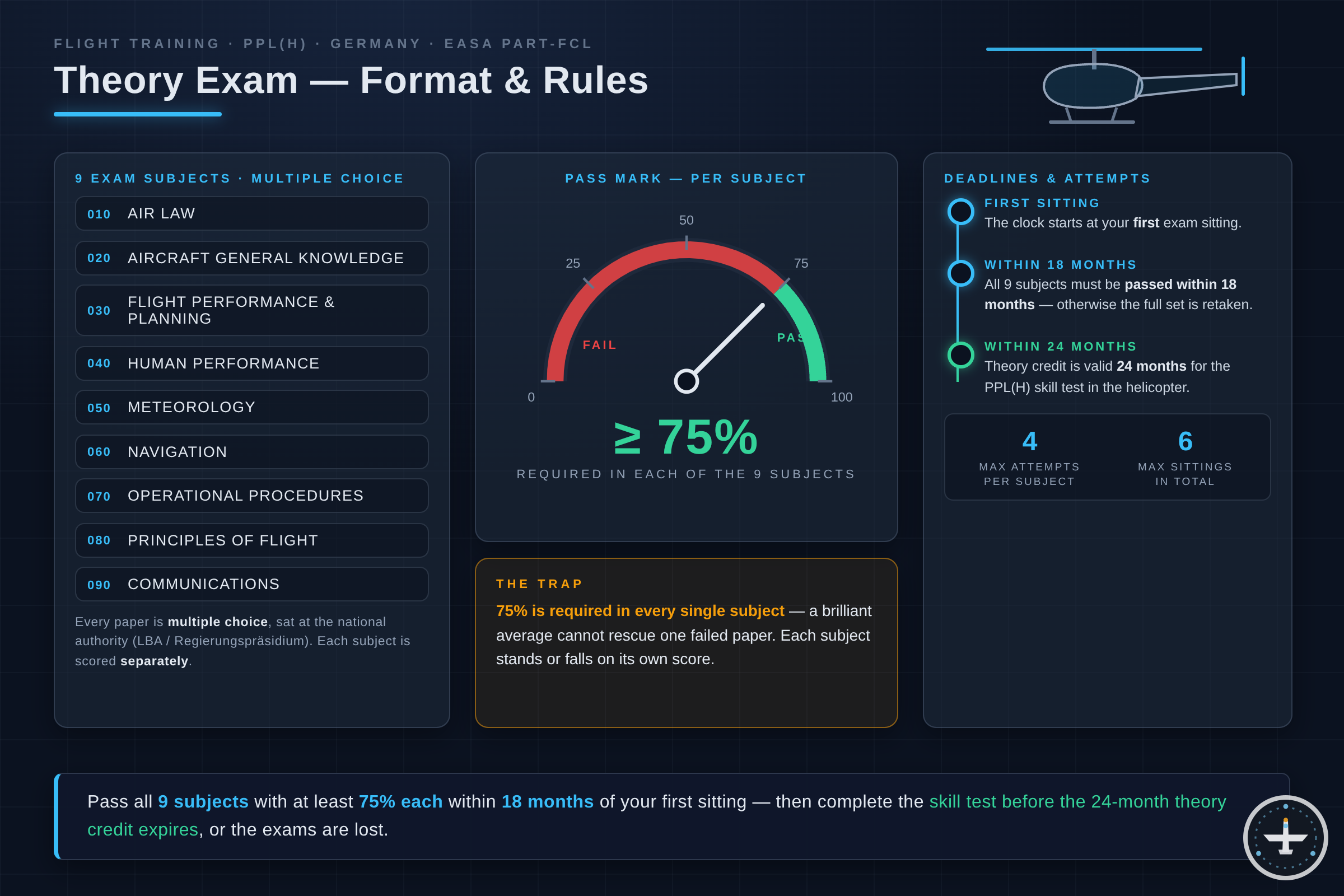
Overview: Nine Subjects, Multiple Choice, 75 % Pass Mark
For the PPL(H) — the Private Pilot Licence for helicopters under Part-FCL — you must sit theory examinations in nine subjects in Germany. The examinations are administered by the Luftfahrt-Bundesamt (LBA) at authorised examination venues (typically at state aviation authorities or approved ATOs/DTOs) and are taken on computer.
The nine subjects are:
- Air Law
- Aircraft General Knowledge — helicopter-specific
- Flight Performance & Planning
- Human Performance & Limitations
- Meteorology
- Navigation
- Operational Procedures
- Principles of Flight — Helicopter
- Communications (VFR)
Each subject is passed individually. The pass mark is 75 % correct answers per subject. There is no overall grade — you cannot compensate for a weak subject with a strong one.
Format: Multiple Choice with Four Answer Options
All questions are multiple choice with four answer options (A–D), of which exactly one is correct. There is no negative marking, so: leave no question unanswered — even a guessed answer can score points.
The questions are drawn from the ECQB (European Central Question Bank), a central question database maintained by EASA. The LBA uses a German-language version of this pool. Key points to know:
- Questions are updated regularly (typically several times per year).
- The ECQB is not publicly available — question catalogues circulating online are often outdated or inaccurate.
- Some questions include attachments (charts, diagrams, performance charts) that you open on screen.
Number of Questions and Time Limits per Subject
The requirements are based on AMC1 FCL.025 and are implemented by the LBA. The following approximate values apply for PPL(H):
| Subject | Questions | Time |
|---|---|---|
| Air Law | 16 | 30 min |
| Aircraft General Knowledge (H) | 12 | 30 min |
| Flight Performance & Planning | 12 | 45 min |
| Human Performance | 12 | 30 min |
| Meteorology | 16 | 45 min |
| Navigation | 12 | 45 min |
| Operational Procedures | 12 | 30 min |
| Principles of Flight (H) | 12 | 30 min |
| Communications (VFR) | 12 | 30 min |
Total: approx. 120 questions, spread across typically one to two exam days. The exact split is determined by your examination centre.
Procedure on Exam Day
Before the exam:
- Arrive 30 minutes before the start at the examination venue.
- Bring: a valid photo ID (national identity card or passport), your examination invitation/confirmation, and if applicable a Class 2 Medical Certificate.
- Permitted aids: non-programmable calculator, navigation equipment (plotter, navigation square), flight computer (CRP-1 or equivalent). Check with your examination centre in advance what is specifically permitted.
During the exam:
- You sit at an individual workstation in front of a PC. The software displays questions, a timer, and an overview of open/flagged questions.
- You can flag questions and return to them as long as time permits.
- Early submission is possible.
- Toilet breaks are only permitted accompanied by the invigilator — plan accordingly.
After the exam:
- Your result per subject is usually available immediately after the exam or in writing within a few days.
- A detailed breakdown with learning feedback is generally not provided — only the percentage score per subject.
Resits and Deadlines
- You have a maximum of 4 attempts per subject.
- You may use a maximum of 6 examination sittings in total to pass all 9 subjects.
- From the first examination sat, an 18-month period begins within which you must pass all 9 subjects. If this deadline lapses, all results are invalidated and you start from scratch.
- After passing all subjects, you have 24 months to complete the practical test.
Fees
The LBA charges a fee per subject and per attempt. The exact rates can be found in the LuftKostV (Luftfahrtkostenverordnung — Aviation Costs Ordinance). Expect a low two-digit euro amount per subject; the total cost for all 9 subjects typically falls in the range of €150–250 without resits. Always check the current LBA fee schedule.
Tips for Exam Day
- Get enough sleep. Fatigue costs more points in multiple choice than gaps in detailed knowledge.
- Answer the easy questions first. Flag difficult ones and return to them later. This secures the easy points before you spend time on harder items.
- Read each question twice. ECQB questions are often precisely worded — a "NOT" or "EXCEPT" is easily overlooked.
- Eliminate wrong answers. Even if you cannot immediately identify the correct option: ruling out two clearly wrong choices raises your hit rate when guessing from 25 % to 50 %.
- Watch your units. Knots/km/h, feet/metres, hPa/inHg — performance and navigation questions are full of unit traps.
- Allow buffer time. You do not have to use the full time, but do not rush. In a 45-minute subject you have approximately 3–4 minutes per question.
What Aero.Academy Offers You
We train you specifically on the ECQB question format — with current, helicopter-specific questions, explanations for every answer, and an adaptive algorithm that identifies your weak areas. Instead of blindly memorising question catalogues, you build genuine understanding — which will serve you far better in the cockpit than any 75 % pass mark.