Was ist der Skill Test überhaupt?
Der Skill Test PPL(A) ist die abschliessende praktische Prüfung gemäss Part-FCL (Anhang zur Verordnung (EU) Nr. 1178/2011, Appendix 7). Geprüft wird durch einen Flight Examiner (FE), der von Austro Control autorisiert ist. Du fliegst mit ihm einen vorher vorbereiteten Flug, der alle relevanten Lizenzanforderungen abdeckt.
Voraussetzungen, bevor du antreten darfst:
- Mindestens 45 Stunden Flugzeit (davon mindestens 25 Dual und 10 Solo, inklusive 5 Stunden Solo-Überland und ein Solo-Überlandflug von mind. 270 km mit Vollstopps an zwei anderen Flugplätzen).
- Alle 9 Theorieprüfungen bei Austro Control bestanden.
- Tauglichkeitszeugnis Klasse 2 gültig.
- Empfehlung deines Fluglehrers (Course Completion Certificate der ATO/DTO).
- Sprachprüfung (Language Proficiency) absolviert.
Ablauf am Prüfungstag
Plan rund 4–5 Stunden ein. Typischer Tagesablauf:
- Briefing & Papierkram (ca. 30–45 min): Der Prüfer kontrolliert Logbuch, Medical, Theoriebestätigungen, Sprachvermerk und das Aircraft Documentation Set.
- Flugvorbereitung (60–90 min): Du bekommst ein Routing (typisch ca. 100–150 NM mit zwei bis drei Wendepunkten). Du machst Wetterbriefing, NOTAM-Check, Mass & Balance, Performance, Flugplanung mit aktuellem Wind, Spritberechnung, Flugplanaufgabe.
- Pre-Flight mit Aircraft Inspection — vom Prüfer beobachtet.
- Flug (ca. 90–120 min, je nach Wetter und Route).
- Debriefing mit Ergebnis pro Sektion.
Die sechs Sektionen
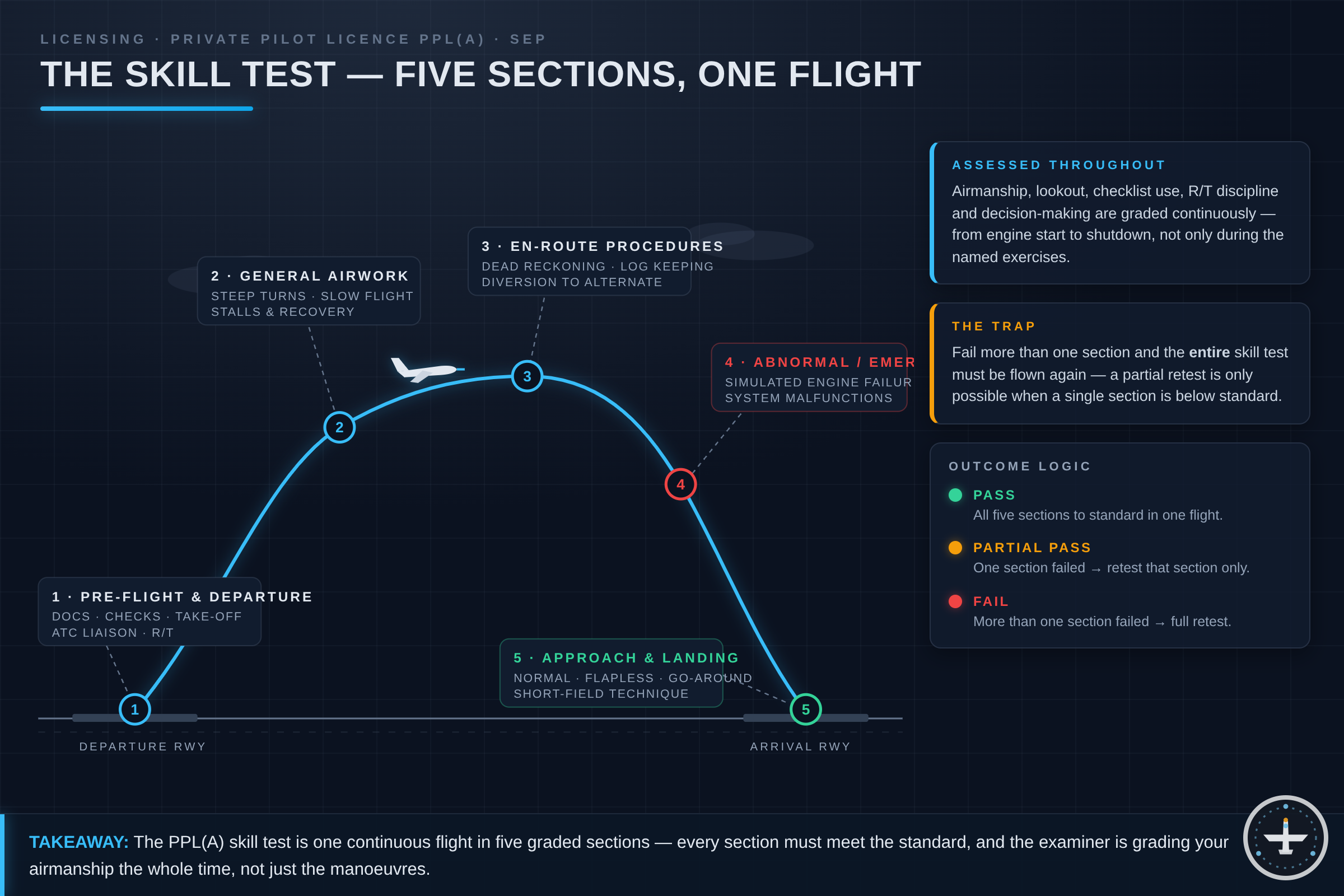
Der Skill Test ist in sechs Sektionen aufgeteilt. Jede wird separat bewertet:
- Sektion 1 — Pre-flight Operations und Departure: Dokumentenprüfung, Mass & Balance, Wetter, Flugplanung, Pre-flight Inspection, Engine Start, Taxi, Takeoff, Climb, Funk.
- Sektion 2 — General Airwork: Steilkurven (45°), Stalls (Clean, Landeconfig, Approach Stall), Slow Flight, Recovery from Unusual Attitudes, Steig- und Sinkflug, eventuell unter Foggles für Basic Instrument Flying.
- Sektion 3 — En-route Procedures: Navigation nach Plan, ETA-Schätzung, Pilotage, Dead Reckoning, Funknavigation (VOR/GPS), Diversion zu einem Ausweichflugplatz, Höhen- und Kursführung, Funkverkehr mit FIS.
- Sektion 4 — Approach and Landing Procedures: Anflug nach Standardplatzrunde, normale Landung, Short Field, Soft Field, Touch and Go, Go-around, Seitenwindlandung wenn möglich.
- Sektion 5 — Abnormal and Emergency Procedures: Simulierter Triebwerksausfall (EFATO und in Reisehöhe mit Forced Landing), Feuer, elektrische Probleme, Vergaservereisung, andere Systemausfälle nach POH.
- Sektion 6 — Basic Instrument Flight: Mindestens 180°-Kurve unter Haube, Geradeausflug, Steig- und Sinkflug nur nach Instrumenten.
Bewertung: Bestanden, teilweise, nicht bestanden
Jede Sektion wird einzeln mit „pass" oder „fail" bewertet. Mögliche Resultate:
- Komplett bestanden: Alle sechs Sektionen pass. Der Prüfer schickt das Skill Test Form an Austro Control, du beantragst die Lizenz.
- Partial Pass: Eine Sektion nicht bestanden → du musst nur diese eine Sektion nachfliegen, innerhalb von 6 Monaten ab dem ersten Versuch.
- Mehr als eine Sektion gefailt oder Re-Test gefailt: kompletter Re-Test (alle Sektionen). Ab dem zweiten Fehlversuch kann zusätzliches Training durch die ATO/DTO vorgeschrieben werden.
- Sicherheitsrelevanter Fehler: Bricht der Prüfer ab (z. B. Verletzung von Lufträumen, gefährliche Aktion), gilt der Test als nicht bestanden.
Toleranzen, an denen du dich orientieren kannst (laut AMC zu Appendix 9):
- Höhe ±150 ft im Normalflug
- Kurs ±10°
- Geschwindigkeit +10 / −5 kt
- Steilkurven: Höhe ±100 ft, Querneigung ±5°
Vorbereitung — was wirklich hilft
- Check-Flug mit Senior-Lehrer ein bis zwei Wochen vor dem Termin. Ehrliches Feedback, kein Wohlfühlflug.
- Routing übe in beide Richtungen. Der Prüfer wählt das Ziel, aber Diversions kommen oft in eine unerwartete Richtung.
- POH auswendig: V-Speeds, Emergency Checklists (Memory Items), Limitations. Das wird in Frage-und-Antwort-Form abgefragt.
- Funk auf Englisch oder Deutsch — je nach Plätzen. Phraseologie sitzen lassen, vor allem Notruf (MAYDAY) und PAN-PAN.
- Mass & Balance mit echten Zahlen, nicht aus dem Schulflugzeug-Standardprofil. Bring deinen eigenen Rechenweg mit.
- Mentale Simulation: Geh den Flug zu Hause Schritt für Schritt durch. Was sagst du beim Engine Failure auf 800 ft AGL nach Takeoff?
Häufige Stolperfallen
- Luftraumverletzung bei Diversion, weil man die Karte zu spät anschaut.
- Falsche oder vergessene Checklist bei Touch and Go (Carb Heat, Flaps, Trim).
- Forced Landing zu hoch oder zu kurz — das Feldauswahl-Pattern ehrlich üben.
- Funk-Patzer bei Frequenzwechsel während Workload-Spitzen.
- Stall Recovery mit Höhenverlust >100 ft statt sauberem Andrücken und Power.
Wenn du durchfällst
Kein Drama, aber ernst nehmen. Du bekommst vom Prüfer schriftlich, welche Sektion(en) gefailt sind und meist eine konkrete Begründung. Nächste Schritte:
- Debriefing mit deinem Fluglehrer — am besten gleich am Folgetag.
- Gezieltes Nachtraining (1–3 Flüge reichen meist bei Partial Fail).
- Neuer Termin mit demselben oder einem anderen Examiner. Die Examiner-Gebühr (typisch 300–500 € in Österreich, je nach Examiner) fällt erneut an, ebenso die Flugzeugmiete.
- Innerhalb von 6 Monaten den Re-Test absolvieren, sonst kompletter Skill Test von vorn.
Wer beim Skill Test einmal durchfällt, ist nicht der schlechtere Pilot. Wichtiger ist, dass du den identifizierten Schwachpunkt sauber aufarbeitest, bevor du wieder antrittst.