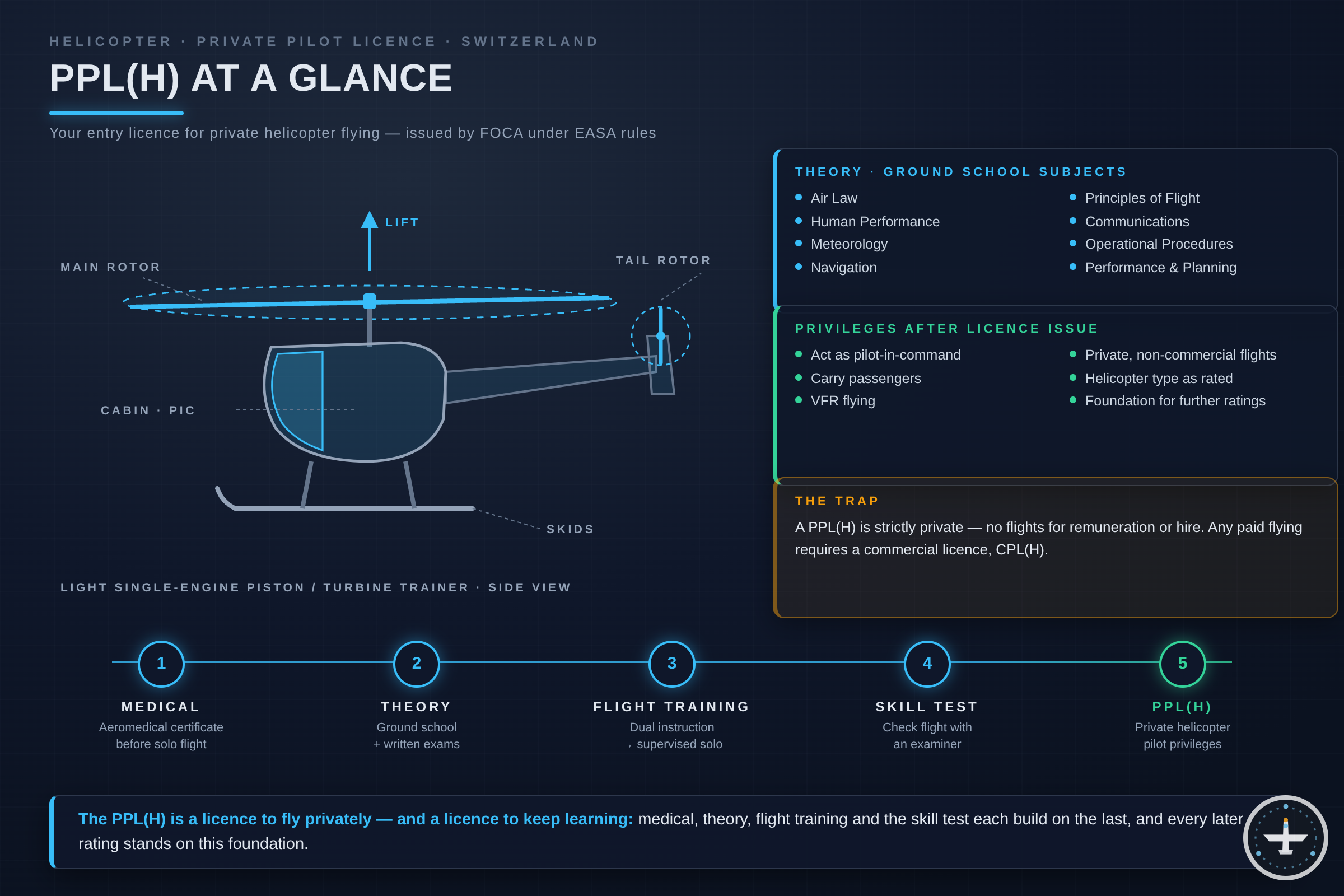
What is the PPL(H)?
The Private Pilot Licence (Helicopter) is a European licence issued under EASA Part-FCL. It entitles you to act as pilot-in-command of helicopters in non-commercial operations — private flights with friends and family, but no paid passenger or cargo transport. In Switzerland it is issued by the Federal Office of Civil Aviation (BAZL), but is based entirely on EASA regulation and is therefore valid in all EASA member states.
With the PPL(H) you are permitted to:
- Fly helicopters under Visual Flight Rules (VFR) by day
- Carry passengers (once you meet the required passenger-carrying recency conditions)
- Fly registered aircraft types for which you hold a valid class or type rating
What you are not permitted to do: charge money for flying (except proportional cost-sharing under clearly defined rules), conduct instrument flight without an IR(H), or fly at night without a Night Rating.
Who Can Obtain the PPL(H)?
The entry requirements are manageable:
- Minimum age: 17 years for licence issue. You can start theory training and flight training earlier; the first solo flight is permitted from age 16.
- Medical Class 2: You need a valid medical certificate of fitness for flight, issued by a BAZL-recognised Aeromedical Examiner (AME). Cost: typically CHF 300–500 for the initial examination.
- Language proficiency: Language Proficiency in English (minimum ICAO Level 4) is required for radio communications abroad. For flights within Switzerland, German/French/Italian is sufficient depending on the FIR.
- Criminal record extract: Required by BAZL at the time of licence issue.
No specific educational background is prescribed. However, mathematics and physics at upper secondary (Sek II) level will help you in subjects such as Navigation, Performance, and Principles of Flight.
The Path from Zero to Licence
1. Theory Training
You must complete nine EASA theory subjects:
- Air Law
- Human Performance
- Meteorology
- Communications (VFR)
- Principles of Flight (Helicopter)
- Operational Procedures
- Flight Performance and Planning
- Aircraft General Knowledge (Helicopter)
- Navigation
Theory instruction is delivered through an approved training organisation (DTO or ATO). A minimum of 100 hours of theory instruction is required in total, a portion of which may be completed through self-study. Aero.Academy covers these subjects with adaptive question banks and AI-assisted practice.
2. BAZL Theory Examination
In Switzerland, the examination is conducted by BAZL as a computer-based test (ECQB-PPL-H). It consists of nine separate subject papers with multiple-choice questions. Pass mark: 75% per subject. You have 18 months from the first passed subject to complete all nine. Within that period, a maximum of four attempts per subject are permitted. Once all subjects are passed, you have 24 months to complete the practical test.
Current BAZL fees: approximately CHF 60 per subject paper as of 2024 — verify this on bazl.admin.ch before registering.
3. Practical Flight Training
Minimum requirements under FCL.210.H:
- 45 total flight hours on helicopters
- Of which 25 hours dual (with a flight instructor)
- Of which 10 hours solo, including 5 hours solo cross-country with one cross-country flight of at least 185 km (100 NM) and intermediate landings at two different aerodromes
- Up to 5 hours may be completed in an approved FSTD (simulator)
Training is conducted through an ATO (Approved Training Organisation) or DTO (Declared Training Organisation). Switzerland has a small number of helicopter schools, primarily in the Mittelland and Valais regions. Common training types: Robinson R22, Cabri G2, and occasionally the Schweizer 300.
4. Skill Test
The final step is the practical Skill Test conducted by an examiner appointed by BAZL. The test covers flight planning, pre-flight inspection, manoeuvres (hovering, autorotation, quickstops, confined area operations, etc.), navigation, emergency procedures, and radio communications.
Cost Overview
Realistically, you should budget CHF 35,000 to 55,000 in Switzerland, depending on the school, aircraft type, and how efficiently you progress. The R22 is cheaper per hour than the Cabri, but tends to be more demanding to fly. Candidates who need more than the minimum hours — which is common — will quickly find themselves at the upper end of the range.
Main cost components:
- Dual flight hours: CHF 600–800/h
- Solo flight hours: CHF 400–600/h
- Theory: CHF 1,500–3,000
- Medical, BAZL examination fees, licence issue: approximately CHF 1,000–1,500
After the Licence
With a freshly issued PPL(H), you are rated on the type on which you were examined. Additional type ratings (e.g. Bell 206, AS350) can be added subsequently. Extensions such as the Night Rating, Mountain Rating (particularly relevant in Switzerland), or later the IR(H) and CPL(H) all build on the PPL(H).
Important for currency: rolling recency for passenger-carrying (3 take-offs and landings within the preceding 90 days on the relevant type), a valid medical, and every two years a Proficiency Check or fulfilment of the flight experience requirements for type rating revalidation.