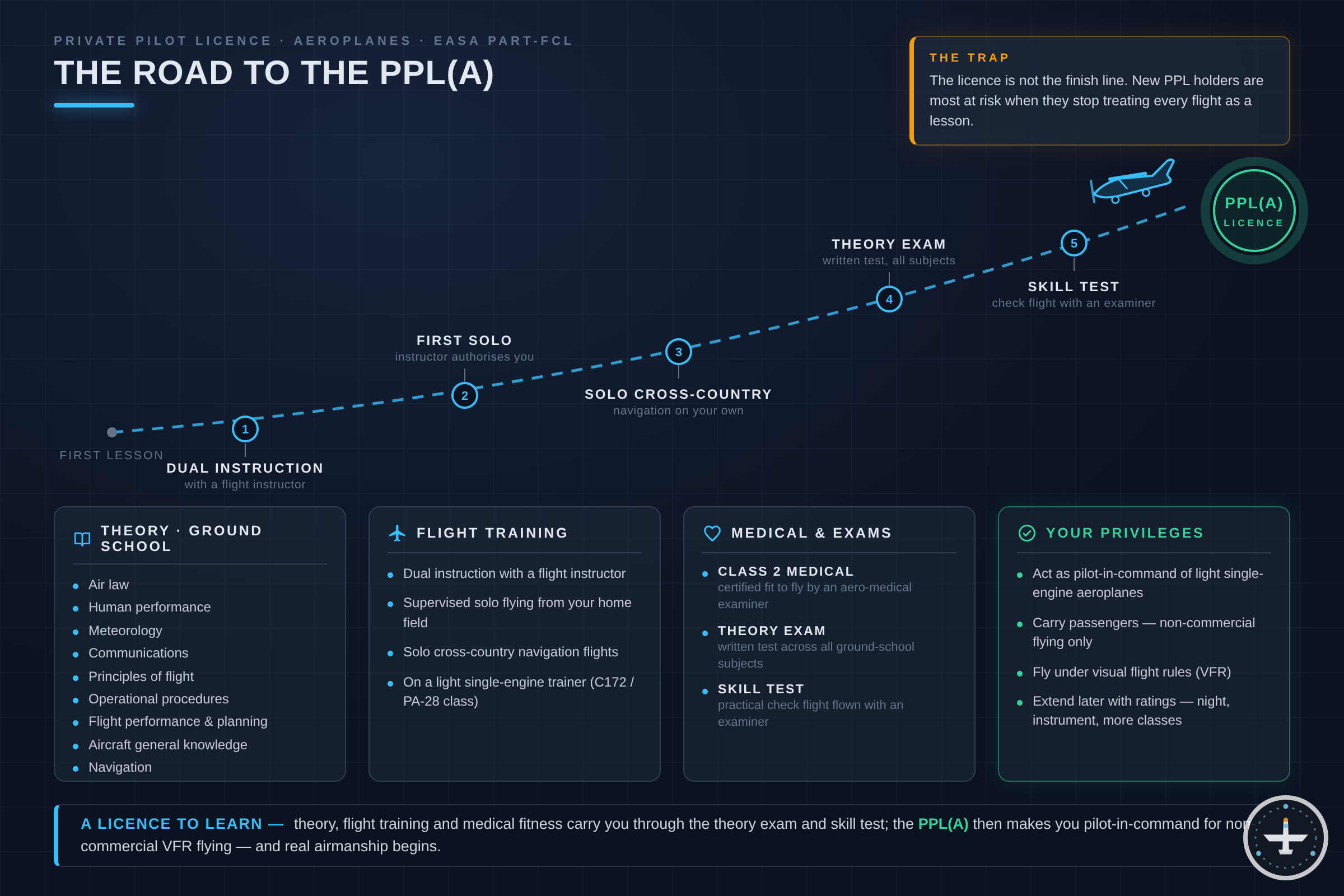
What is the PPL(A)?
The PPL(A) – Private Pilot Licence (Aeroplane) – is an EASA licence that authorises you to act as pilot-in-command (PIC) of single-engine fixed-wing aircraft in non-commercial operations. It is regulated by Commission Regulation (EU) No 1178/2011, Annex I (Part-FCL). In Germany, the licence is issued by the Luftfahrt-Bundesamt (LBA).
With the PPL(A) you are permitted to:
- Fly aircraft in the SEP (Single Engine Piston) land or TMG class, provided the corresponding class rating is entered in your licence
- Carry passengers
- Fly by day under Visual Flight Rules (VFR)
- Operate within European airspace; the licence is ICAO-recognised and also valid outside the EASA area under national rules
What you are not permitted to do: fly for remuneration (cost-sharing with passengers is allowed under strict conditions), fly at night without an NVFR rating, fly under instrument flight rules without an IR/EIR/BIR, or fly multi-engine aircraft without a MEP rating.
Who can obtain the PPL(A)?
The entry requirements are manageable:
- Age: Theory examination from age 16, first solo flight from age 16, licence issued from age 17
- Medical: Class 2 medical certificate (a LAPL medical is sufficient for the LAPL, but not for the PPL). Examination by an AME (Aero-Medical Examiner); the LBA publishes a list of approved examiners
- Language: Language Proficiency Endorsement (LPE), minimum Level 4 in English or German
- Background check: Extended certificate of good conduct and security vetting in accordance with §7 LuftSiG
Prior knowledge of mathematics or physics is helpful but not a formal requirement. If you can do basic arithmetic and understand English, you will get through the theory.
The path from zero to licence
1. Choose a flying school
The PPL(A) must be trained at an EASA-approved training organisation – either a DTO (Declared Training Organisation) or an ATO (Approved Training Organisation). Both are authorised to train for the PPL(A). The difference: DTOs are leaner in structure and generally less expensive; ATOs additionally cover CPL/ATPL training.
When making initial contact, ask specifically about: hourly rates including instructor fees, the fleet (age and maintenance status), average training duration, and a realistic estimate of total costs.
2. Confirm your medical fitness
Before investing money in training, complete the Class 2 medical. If the AME finds a disqualifying condition, you have lost nothing. Cost: approximately €150–250 for the initial examination.
3. Ground school (theory training)
Nine subjects under Part-FCL:
- Air Law
- General Aircraft Knowledge
- Flight Performance and Planning
- Human Performance
- Meteorology
- Navigation
- Operational Procedures
- Principles of Flight
- Communications (VFR)
Ground school comprises a minimum of 100 hours of instruction. Many schools combine classroom sessions with e-learning. Platforms such as Aero.Academy cover the LBA question banks and train you specifically for the examination.
4. Practical flight training
A minimum of 45 flight hours, comprising:
- 25 hours dual instruction with a flight instructor
- 10 hours solo flight, of which at least 5 hours must be solo cross-country
- One solo cross-country flight of at least 270 km, with two landings at aerodromes other than the home aerodrome
Up to 5 hours may be completed in an approved FSTD (simulator). In practice, many students require 50–60 hours, as weather conditions and individual learning curves play a significant role.
5. Theory examination at the LBA
The theory examination is taken at the LBA in Braunschweig or at a decentralised examination centre. The format is multiple-choice, computer-based, with each of the nine subjects examined separately. The pass mark is 75% per subject. You have 18 months from passing the first partial examination to complete all subjects, followed by 24 months to complete the practical test.
LBA examination fees: currently approximately €100 per examination session, plus a licence issuance fee.
6. Practical test (Skill Test)
The Skill Test is conducted with a Flight Examiner (FE). It covers flight preparation, navigation, procedures, emergency procedures, circuit flying, and general airmanship. Duration: approximately two hours of flight time plus briefing and debriefing.
7. Licence application
After passing the test, you submit your application to the LBA – including the test report, medical certificate, language proficiency endorsement, logbook extract, and security vetting certificate. Processing time: typically several weeks based on experience.
What does it all cost?
Realistic total costs in Germany for 2024/2025: €10,000 to €15,000. Approximate breakdown:
- Flight hours (45–55 h at €200–280 per hour): €9,000–14,000
- Theory training and learning materials: €500–1,500
- Medical, examination fees, licence: €500–800
- Headset, charts, equipment: €300–600
Training through an aero club is often less expensive than at a commercial school, though training duration is usually longer.
How long does training take?
Full-time (e.g. an intensive course abroad), 6–10 weeks is achievable. Part-time, with weekend and evening flying, allow for 12–24 months. The most common obstacle is not aptitude, but weather, scheduling, and budget.
After the PPL: What comes next?
The PPL(A) is the foundation. Common next steps include:
- Night Rating (NVFR) – night flying
- MEP – multi-engine piston aircraft
- IR(A)/BIR/EIR – instrument flight
- Mountain Rating, Aerobatic Rating – depending on interest
- CPL/ATPL – if a professional flying career is the goal
To maintain SEP class rating currency, within the 24 months preceding expiry you need 12 flight hours, of which 6 as PIC, 12 take-offs and landings, and a one-hour refresher flight with an instructor.