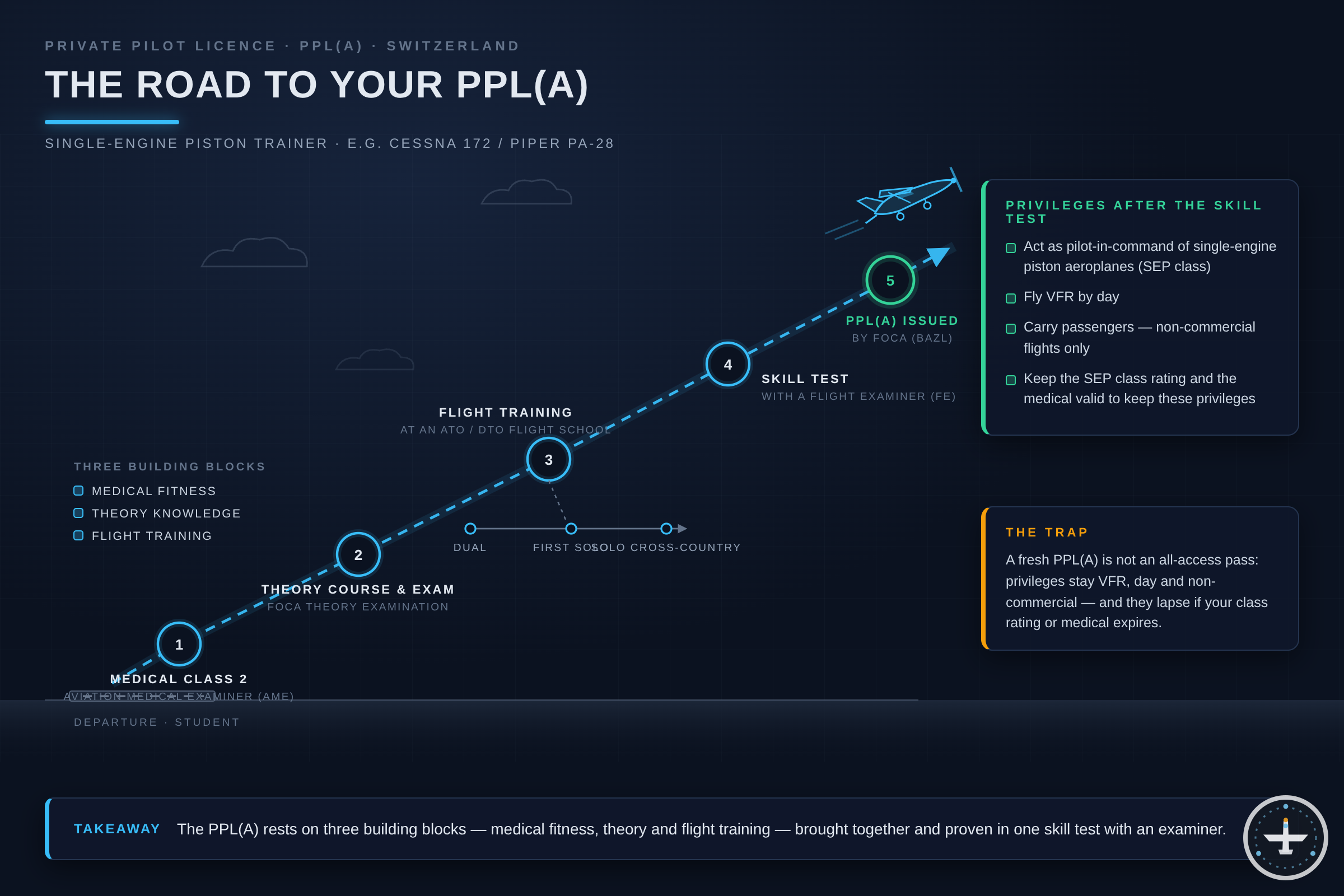
What is the PPL(A)?
The Private Pilot Licence (Aeroplane) is an EASA licence under Part-FCL. It allows you to act as pilot-in-command (PIC) of single-engine piston (SEP) aeroplanes in non-commercial operations. You may carry passengers, but you may not charge for doing so — cost-sharing within the narrow EASA framework is permitted.
The licence is valid across all EU/EASA member states. With a PPL(A) issued in Switzerland, you can legally fly in Germany, France, or Spain as well. Outside the EASA area (e.g. the USA), you will need a validation or conversion.
The competent authority in Switzerland is the BAZL (Federal Office of Civil Aviation), located in Ittigen near Bern.
What are you allowed to do with a PPL(A)?
- VFR flights (visual flight rules) by day in SEP aeroplanes up to 5,700 kg MTOM
- Carry passengers (after 10 h of solo experience as PIC following licence issue — note: recency requirements apply)
- Fly domestically and internationally within the EASA area
- With additional ratings: night flying (NIGHT), aerobatics (AERO), mountain aerodromes (MOU), aerotowing, instrument flying (IR/EIR/BIR)
Not permitted: commercial air transport, charging passengers beyond cost-sharing, IFR without an instrument rating.
Who can obtain the PPL(A)?
The requirements are straightforward:
- Minimum age: 16 years for the first solo flight, 17 years for licence issue
- Medical Class 2: aviation medical certificate issued by an AME (Aeromedical Examiner) recognised by the BAZL
- Language proficiency: Language Proficiency in English or German/French/Italian, minimum ICAO Level 4
- Criminal record: clean background check (the BAZL verifies this as part of the licence application process)
- Training costs: realistically CHF 18,000 – 25,000 for the complete training in Switzerland
No specific educational qualification is required. A solid basic understanding of mathematics and physics is helpful for the theory subjects, however.
The path from zero to licence
1. Introductory flight and Medical
Before you invest time and money, take an introductory flight at a flying school. If it feels right, obtain your Medical Class 2 from an AME. Without a valid Medical, no solo flight is permitted. The list of AMEs is available on the BAZL website.
2. Enrolment at an ATO or DTO
You need an approved training organisation:
- ATO (Approved Training Organisation) — the classic route, often based at regional aerodromes
- DTO (Declared Training Organisation) — a leaner structure, frequently used by flying clubs
Both are permitted for PPL(A) training. There are dozens in Switzerland — from Birrfeld and Grenchen to Bern-Belp, Lausanne, and Locarno.
3. Theoretical knowledge training
Nine subjects under the EASA syllabus:
- Air Law
- Human Performance
- Meteorology
- Communications
- Principles of Flight
- Operational Procedures
- Flight Performance and Planning
- Aircraft General Knowledge
- Navigation
Theory training can be completed through classroom instruction, distance learning, or a learning platform such as Aero.Academy. Minimum hours are defined by the ATO/DTO syllabus; in practice, expect 100+ hours of self-study.
4. Theoretical knowledge examinations at the BAZL
You sit the examinations electronically at the BAZL (Ittigen). Each subject is multiple choice with a pass mark of 75 %. You have a maximum of four attempts per subject, and all nine subjects must be passed within 18 months of your first attempt. Once all subjects are passed, the theoretical knowledge credit is valid for 24 months for the purpose of scheduling the Skill Test.
5. Practical flight training
A minimum of 45 flight hours in total, comprising:
- 25 h dual (with a flight instructor)
- 10 h solo, of which 5 h solo cross-country, including one cross-country flight of ≥ 150 NM with landings at two aerodromes other than the aerodrome of departure
In practice, most students require 50–60 hours before they are ready for the Skill Test. Hours are typically logged on a Cessna 152/172, Piper PA-28, or Diamond DA20/40.
6. Skill Test (practical examination)
You complete the test flight with a Flight Examiner (FE) designated by the BAZL. The test covers flight planning, normal and emergency procedures, navigation, and landings. Upon passing, you submit your licence application to the BAZL.
7. Licence issue
The BAZL issues the PPL(A) with an SEP rating entered. BAZL fees: approximately CHF 200–400 for licence issue, plus examination fees per theory subject. The licence itself has no expiry — the SEP rating must be revalidated every 24 months (12 h of flight time, of which 6 h as PIC, 1 h training flight with an FI, or a Proficiency Check).
How long does it take?
Full-time commitment on an intensive programme: 6–9 months. Part-time alongside employment, which is the norm: 1–2 years. The limiting factors are weather (particularly in winter), instructor and aircraft availability, and your available time for theory study.
What does the PPL(A) cost in Switzerland?
Approximate figures for 2024:
- Dual flight hours: CHF 350–450/h
- Solo hours: CHF 250–350/h
- Theory course: CHF 500–2,500
- Medical Class 2: CHF 250–400 (initial examination)
- BAZL examination fees and licence: approx. CHF 1,000 total
- Skill Test: CHF 500–800
Realistic total: CHF 20,000–25,000. Flying club members can often complete training at significantly lower cost.
After the PPL — what comes next?
The PPL is the entry point, not the destination. Useful next steps include:
- Night Rating (minimum 5 h night flying training)
- Mountain Rating (MOU) — particularly relevant in Switzerland
- Instrument Rating (IR, EIR, or BIR) for weather independence
- Multi-engine Piston Rating (MEP)
- On the path to a professional licence: CPL, ATPL
For each of these steps, solid PPL foundations pay dividends.