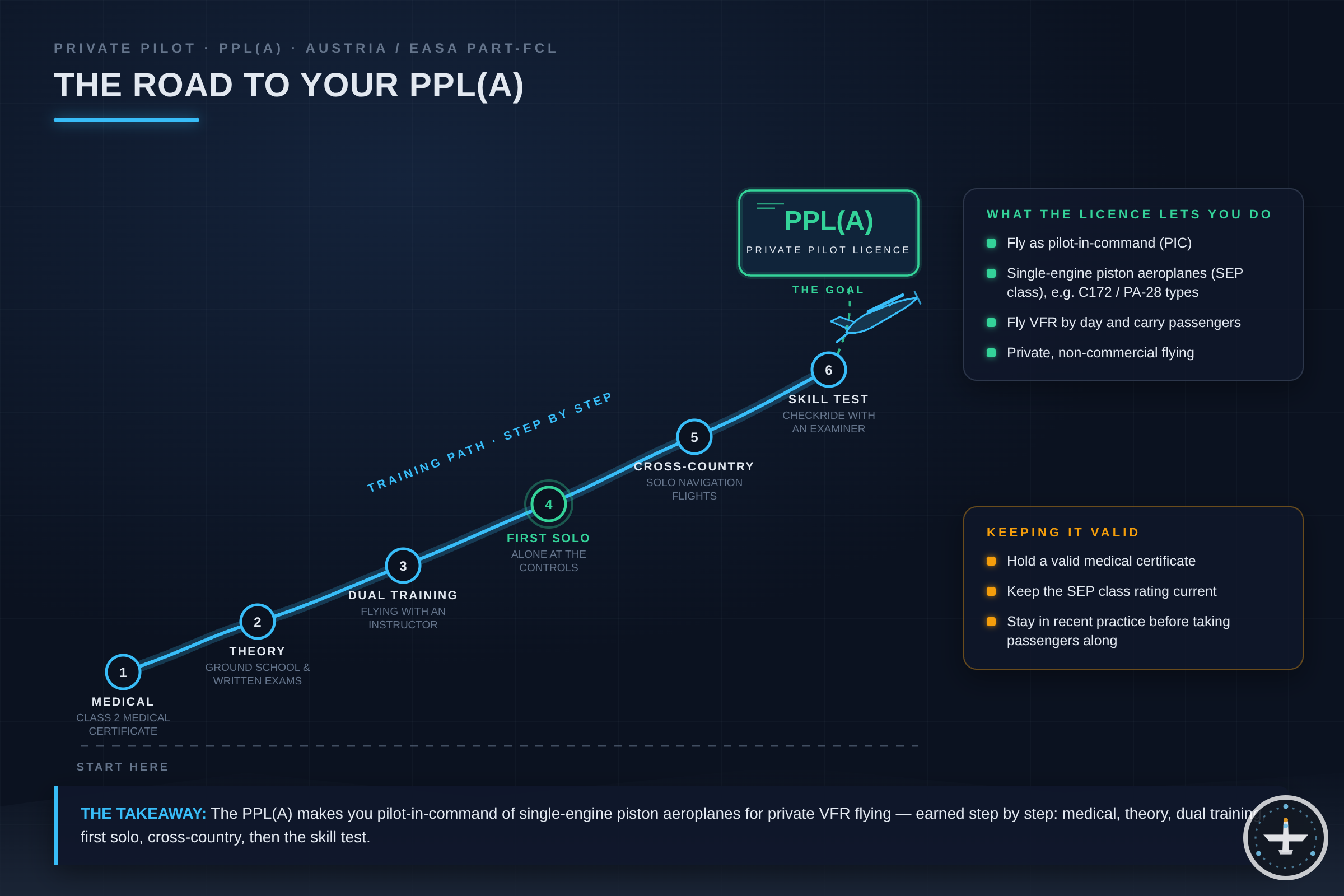
What is the PPL(A)?
The PPL(A) is an EASA licence that authorises you to act as Pilot-in-Command (PIC) of single-engine aeroplanes in non-commercial operations. "Non-commercial" means you may take friends and family along, but you may not be remunerated for doing so. The licence is valid throughout the EU and is based on Commission Regulation (EU) No 1178/2011 (Part-FCL).
In Austria, Austro Control is the competent authority responsible for issuing the licence and conducting the theoretical knowledge examinations.
Who can obtain the PPL(A)?
The formal requirements are straightforward:
- Minimum age: 16 years for the first solo flight, 17 years for licence issue.
- Medical certificate: Class 2 Medical, issued by an Aeromedical Examiner (AME) recognised by Austro Control. Obtain this before enrolling at a flying school — no Medical means no solo flight.
- Language proficiency: You must demonstrate German or English at a minimum of ICAO Level 4 (Language Proficiency). German alone is sufficient for purely domestic flights; English is required for international operations.
- Educational background: No formal requirements, but you should be comfortable with physics, mathematics and English at least at secondary-school level.
A criminal record extract is generally not required for the licence application with Austro Control, but may be requested by the flying school upon registration.
What are you allowed to do with the PPL(A)?
- Fly single-engine piston aeroplanes (SEP land) up to 5,700 kg MTOM.
- Carry passengers (provided you meet the Recent Experience requirement: 3 take-offs and landings within the preceding 90 days).
- Conduct VFR flights by day.
Not included are: night flying, instrument flight (IR), multi-engine aeroplanes, aerobatics, mountain flying, and towing. These are separate ratings that you can add after obtaining the PPL.
The path from zero to licence
1. Obtain your Medical
Book an appointment with an AME and complete your Class 2 examination. Costs in Austria: approximately 150–250 EUR for the initial examination.
2. Choose a flying school
You need an approved training organisation — either an ATO (Approved Training Organisation) or a DTO (Declared Training Organisation). A list of Austrian ATOs/DTOs is available on the Austro Control website.
3. Theoretical knowledge
Nine subjects in accordance with EASA standards:
- Air Law
- Human Performance
- Meteorology
- Communications
- Principles of Flight
- Operational Procedures
- Flight Performance and Planning
- Aircraft General Knowledge
- Navigation
You can study the theory through an in-person course, a distance-learning programme, or an online platform such as Aero.Academy. Examinations are sat at Austro Control — computer-based, multiple choice. Pass mark: 75% per subject. You have 18 months from the first passed examination to complete all nine subjects, and must convert your theoretical knowledge credit into a practical test within 24 months of passing.
4. Practical training
A minimum of 45 flight hours in total, comprising:
- at least 25 hours dual instruction (with a flight instructor)
- at least 10 hours solo, of which:
- at least 5 hours solo cross-country
- one cross-country flight of at least 270 km (150 NM) with full-stop landings at two aerodromes different from the departure aerodrome
In practice, most students require 50–70 hours before reaching examination standard. This is entirely normal.
5. Practical test (Skill Test)
Conducted with an examiner appointed by Austro Control. Duration: approximately 2 hours of flight plus briefing/debriefing. Assessed areas include navigation, emergency procedures, circuit flying, slow flight, Stalls, steep turns, and more.
6. Licence application
Following a successful Skill Test, Austro Control issues the licence. Processing time: typically a few weeks. Fees are in the range of approximately 150–300 EUR.
What does the PPL(A) cost in Austria?
Realistic total costs: EUR 12,000 to 18,000. The range is explained by:
- Hourly rate at the flying school (often 200–280 EUR/hour for a C152 or PA-28, including instructor)
- Theoretical knowledge course (500–2,000 EUR)
- Medical, examination fees, study materials, headset, radio licence
- How quickly you progress (more hours = higher costs)
Budget generously. Students who start with too tight a budget drop out more frequently.
How long does it take?
- Intensive (full-time): 3–6 months
- Part-time alongside employment: 1–2 years
Weather is the biggest limiting factor in Austria — build in contingency time, especially in winter.
What comes after the PPL(A)?
Typical next steps:
- Night Rating
- SEP class rating revalidation (every 2 years)
- Mountain flying rating (particularly relevant in Austria)
- IR(R) or IR (instrument flying)
- CPL/ATPL, if you want to fly professionally
The PPL(A) is the foundation — it opens the door to almost all further ratings in general aviation.