What the Class 2 Medical is required for
For the Private Pilot Licence Helicopter — PPL(H) under EASA Part-FCL — a Class 2 Medical Certificate is mandatory. You need it:
- Before your first solo flight during training (not yet for enrolment at a flight school, but practically speaking it makes sense to get it done almost immediately after).
- Continuously valid throughout your entire training and, of course, as a licensed pilot.
- At every licence revalidation and for solo flights as a student pilot.
The LAPL Medical (a less stringent standard) is not sufficient for PPL(H). If you think you might pursue PPL(H) later on, go straight for the Class 2 Medical.
Where to get your medical
You must visit an Aero-Medical Examiner (AME) recognised by the LBA. A current list of AMEs in Germany is available on the Luftfahrt-Bundesamt (LBA) website, where you can filter by postcode or federal state.
Tip: Appointments are often booked weeks in advance. As soon as you start theory training, book your AME appointment in parallel.
What is examined?
The initial Class 2 examination takes 60 to 120 minutes depending on the AME. The assessment covers, among other things:
- General medical history: Pre-existing conditions, medications, surgeries, family history.
- Vision test: Visual acuity (corrected and uncorrected), colour vision (Ishihara plates), stereoscopic vision, visual field.
- Hearing test: Whisper test or audiometry.
- Cardiovascular: Blood pressure, resting ECG (mandatory from a certain age, otherwise at the examiner's discretion).
- Lung function: Auscultation; spirometry if indicated.
- Urine sample: Glucose, protein, blood.
- Neurology and mental status: Reflexes, balance, orientation.
- Physical examination: Abdomen, spine, musculoskeletal system.
For the initial examination, depending on your age, the following may also be required: blood tests (cholesterol, full blood count), extended ECG, and a hearing curve if indicated.
Validity
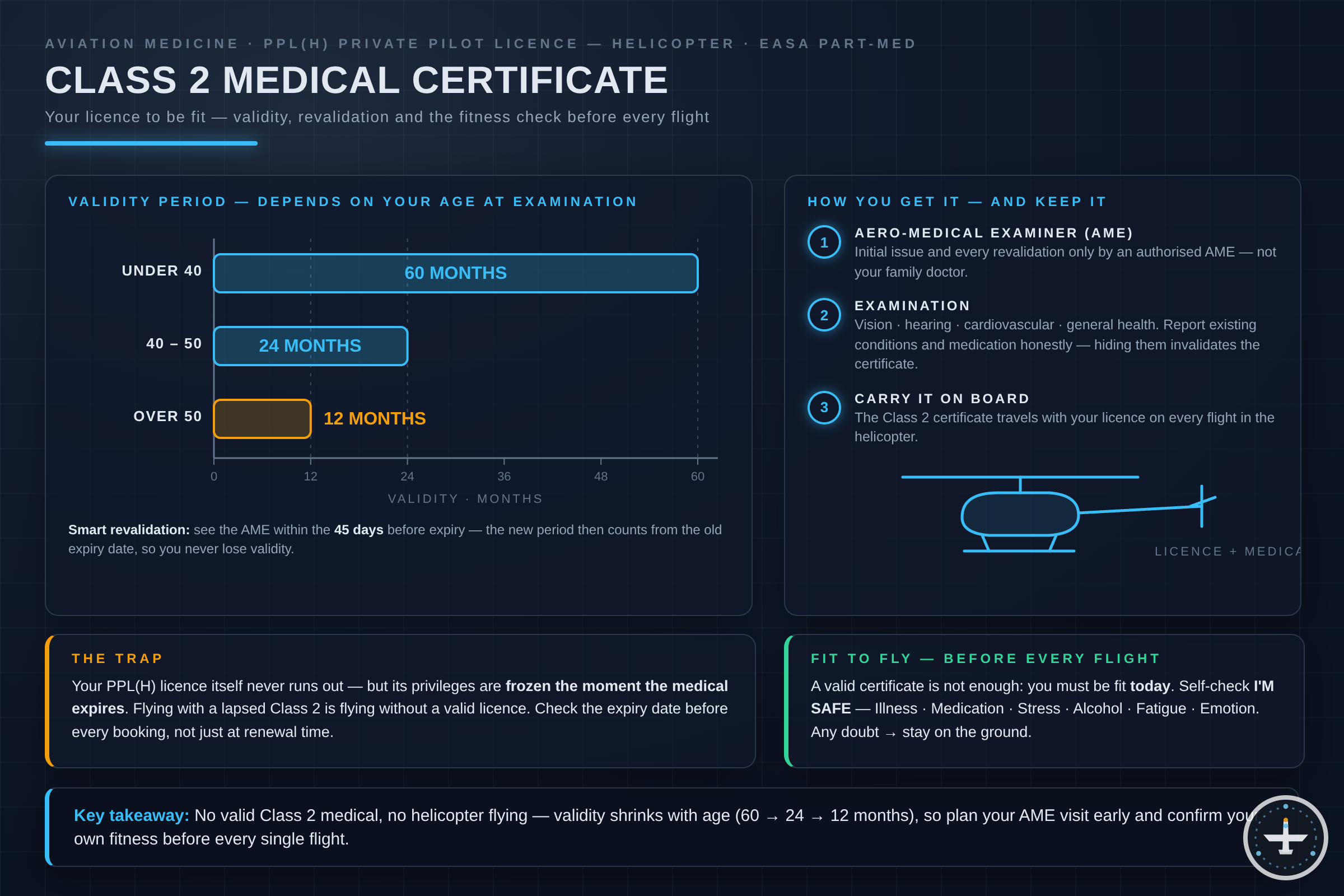
The validity period depends on your age at the time of examination:
- Under 40 years: 60 months (5 years).
- 40 to 50 years: 24 months (2 years) — if the medical was issued before your 40th birthday and you turn 40 during its validity, it expires no later than your 42nd birthday.
- Over 50 years: 12 months (1 year).
If you renew your medical within the last 45 days before it expires, the original date remains the reference point — you do not lose any time.
Costs
There is no standardised fee in Germany; AMEs bill privately. Realistic ranges (as of 2024):
- Initial Class 2 examination: approx. €150 to €250.
- Renewal examination: approx. €80 to €150.
- Additional services (extended ECG, audiometry outside mandatory scope, blood tests): €30–€100 extra depending on requirements.
Health insurance does not cover this — it is an aviation medical, not a curative examination. Keep your receipt: in some cases it may be deductible as a professional expense on your tax return (e.g. if you go on to become a commercial pilot).
What if you need glasses?
Glasses or contact lenses are not a disqualifying factor. Class 2 permits corrections within defined limits:
- Visual acuity: With correction, at least 1.0 (6/6) in each eye for distance. Near vision is also tested.
- Refraction: Up to approximately ±5 dioptres spherical is generally unproblematic. Higher values require an ophthalmological assessment, but are often still certifiable.
- Limitation entry: Your medical will include an entry such as "VDL" (Visual Correction Limitation) — you are then required to wear your glasses while flying and to carry a spare pair.
- Colour vision: Impaired colour vision may result in limitations (e.g. no night flying). Full colour vision is required for an unrestricted licence including a night flying rating.
- Refractive surgery (LASIK, PRK): generally accepted once stable results are confirmed — bring your ophthalmologist's report.
If you are unsure whether a pre-existing condition (cardiac, ocular, ADHD, diabetes, history of depression) might affect your certification, call the AME before your appointment. Many offer a free preliminary assessment so you do not arrive with missing documentation.
What to bring to your appointment
- National ID card or passport.
- Glasses/contact lenses plus a spare pair, if applicable.
- Current ophthalmological reports if you use optical correction.
- Vaccination record (some AMEs may ask for it).
- Existing medical records for pre-existing conditions, surgical reports, list of medications.
- For a renewal examination: your current medical certificate.
Beforehand: no alcohol the day before, get enough sleep, eat and drink normally. Avoid excessive caffeine immediately before the appointment — it will unnecessarily elevate your pulse and blood pressure.
What happens after the examination
If findings are unremarkable, the AME issues your medical on the spot. If borderline or unclear values are found, the AME may:
- Request additional investigations (exercise ECG, ophthalmologist, cardiologist).
- Refer the case to the LBA — in that case it may take several weeks before you receive your certificate.
- Enter limitations (e.g. VDL for glasses, OML for "only with a second qualified pilot", no night flying, etc.).
A refused medical is rare but possible. In that case, you are entitled to a second opinion examination and access to your records at the LBA.