What the Class 2 Medical Is Required For
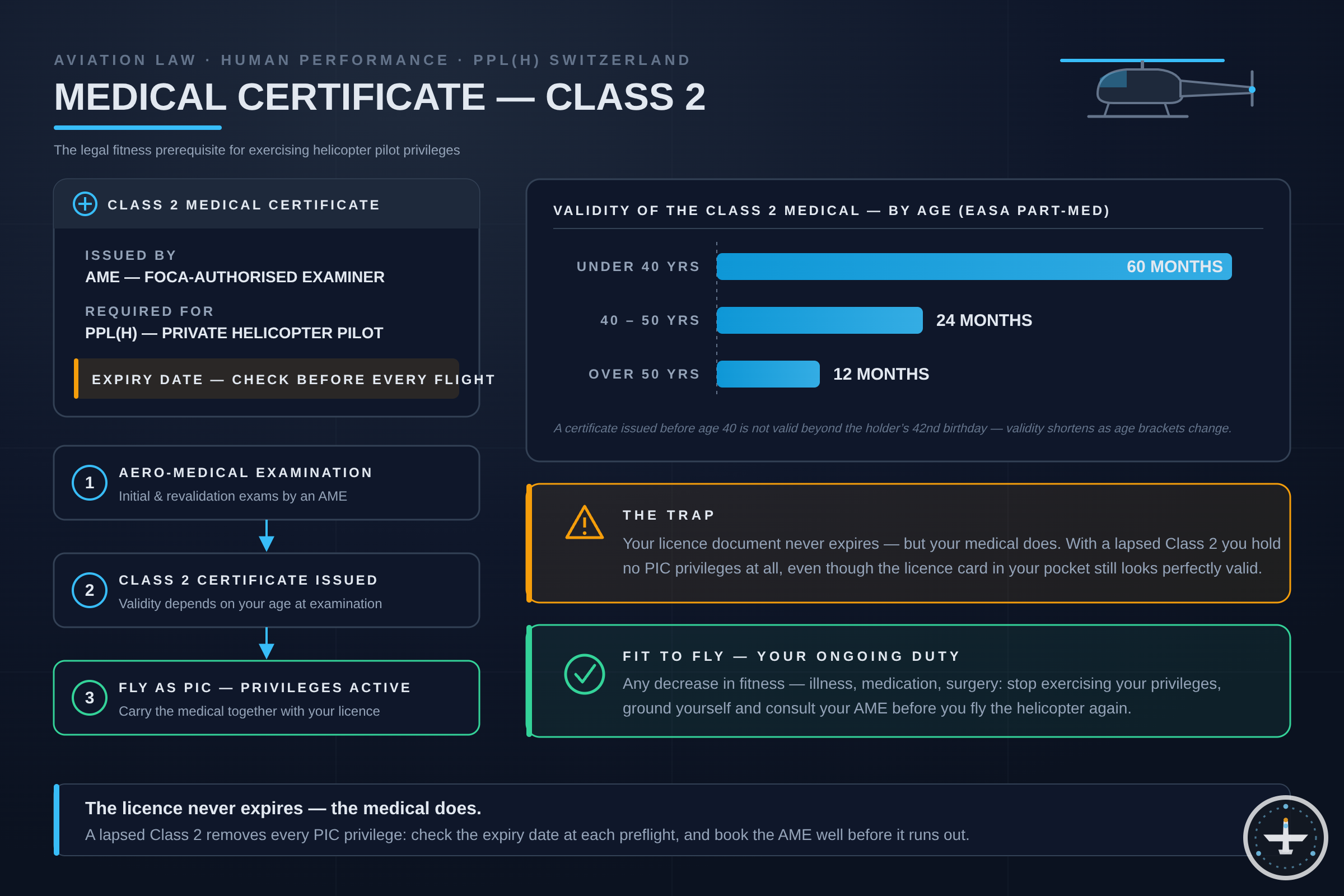
The Class 2 medical is the fundamental medical prerequisite for the private pilot licence — in the case of helicopters, for the PPL(H). Without this certificate, you are not permitted to conduct any solo flight in Switzerland. The first solo is typically planned after 10–15 flight hours, which is why you should complete the medical before or at the very start of your training. Otherwise you risk discovering after several hours of dual instruction that a medical disqualification exists.
The legal basis is Part-MED of EASA (Regulation (EU) No. 1178/2011, Subpart B). In Switzerland, BAZL (Federal Office of Civil Aviation) is the competent authority and maintains the list of approved aviation medical examiners (AME — Aeromedical Examiner).
Where to Have the Examination Carried Out
The initial Class 2 examination can be performed by any AME accredited in Switzerland. An up-to-date list is available on the BAZL website under "Aeromedical Center / AME". You do not need to attend an AeMC (Aero-Medical Centre) — that is only mandatory for Class 1.
Tip: Choose an AME in your region, as follow-up examinations will involve the same person over the course of years. Book an appointment at least 2–3 weeks in advance; some AMEs have longer waiting times.
What Is Examined
The initial Class 2 examination takes approximately 45–90 minutes. The examination includes, among other things:
- Medical history (Anamnesis): Pre-existing conditions, surgical history, medications, family history. Be honest — false statements can later result in licence revocation.
- General physical examination: Height, weight, blood pressure, pulse, reflexes, musculoskeletal system.
- Vision test: Distance and near visual acuity, colour vision (usually Ishihara plates), stereoscopic vision, visual field.
- Hearing test: Whisper test or audiometry. Class 2 does not require a pure-tone audiogram at the initial examination, but the AME may order one.
- Resting ECG: Mandatory at the initial examination. Follow-up measurements depending on age.
- Urine sample: Glucose, protein, blood.
- Lung function and brief neurological examination depending on findings.
A stress ECG is not standard for Class 2 but may be required if abnormalities are found.
Validity
The validity period depends on age (calculated from the date of issue):
- Under 40 years: 60 months (5 years)
- 40 to under 50 years: 24 months
- 50 years and older: 12 months
Special case: If the certificate is issued before the 40th birthday and would extend beyond it, it expires no later than the 42nd birthday. Renewals may be carried out up to 45 days before expiry without loss of remaining validity.
Costs
Prices in Switzerland are not regulated and vary by AME:
- Initial Class 2 examination: approx. CHF 350–550
- Extension/renewal: approx. CHF 200–350
- Additional examinations (e.g. audiometry, stress ECG, ophthalmological consultation): additional cost depending on the practice
Health insurance does not cover the medical — it is an aviation-specific fitness assessment, not a medical treatment.
Glasses, Contact Lenses, and Refractive Errors
Glasses or contact lenses are not an obstacle to the Class 2 medical. The requirement is that with correction you achieve a visual acuity of at least 1.0 (distance vision) in each eye or combined. Uncorrected visual acuity may be relatively poor, provided the correction is effective.
Consequences of a vision correction requirement:
- The limitation VDL (Visual Correction — wear corrective lenses and carry a spare pair) will be entered in your medical certificate.
- You must wear your glasses while flying and carry a spare pair.
- Refractive surgery (LASIK, PRK) is generally accepted after healing and with stable refraction. Bring the surgical report and an ophthalmological confirmation to the AME.
Colour vision deficiency is more complex: candidates who do not pass the Ishihara test may still be classified as "colour safe" via further testing (e.g. the CAD test). Otherwise, a restriction to VFR by day applies — which is in any case the standard for PPL(H) initially.
What Happens If Something Is Found
If the AME identifies a finding that he or she cannot decide independently, the case is referred to the Medical Section of BAZL. There, a decision is made as to whether the certificate is issued with limitations, on a time-limited basis, or not at all. Common issues include:
- Hypertension: usually acceptable if controlled with medication
- Type 2 diabetes: possible with limitations
- Cardiac conditions, epilepsy, severe psychiatric conditions: often problematic
- Medications such as antidepressants: assessed on a case-by-case basis
Important: Do not proceed with a pre-assessment at the AME before consulting your training school if you have pre-existing conditions. A medical that has once been refused remains in the system and can also block other licences. In cases of uncertainty, an informal preliminary conversation with an AME or directly with the BAZL Medical Section is worthwhile.
Practical Step-by-Step Plan
- Select an AME from the BAZL list and book an appointment.
- Bring your glasses/contact lenses and most recent prescriptions, your ID, and your AHV number (Swiss social security number).
- If prior medical records exist: obtain the relevant reports in advance.
- Complete the examination — if the findings are clear, you will receive the certificate to take home on the same day.
- Keep the original in a safe place; store a copy in your pilot logbook or digitally.
With a valid Class 2 medical certificate in hand, you can complete the theoretical and practical training for the PPL(H) without any medical obstacles.