Why You Need the Class 2 Medical
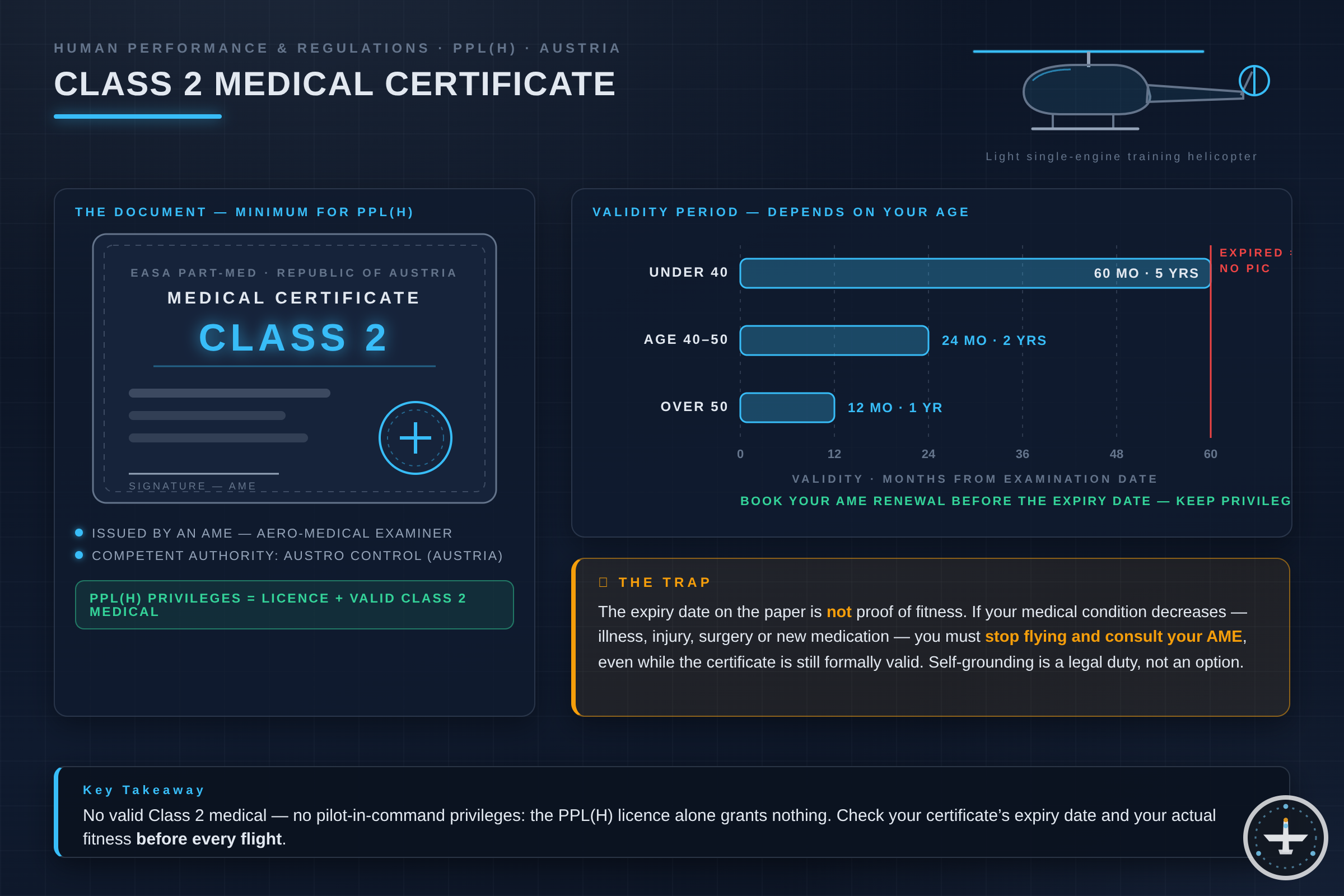
For the Private Pilot Licence Helicopter — PPL(H) — EASA requires a valid Medical Class 2. This applies before your first solo flight. In practice: you may complete an introductory flight with an instructor and log initial training hours, but the medical certificate must be in place before your first solo. Many helicopter candidates therefore take care of the medical right at the start — it would be a shame to invest hundreds of euros in ground school and flight hours, only to be disqualified by a medical finding.
The legal basis is Part-MED (Regulation (EU) No 1178/2011). In Austria, Austro Control GmbH is the responsible aviation authority overseeing compliance.
Where to Get Your Medical: AME and AeMC
A Class 2 certificate may only be issued by an Aeromedical Examiner (AME) recognised by Austro Control — a physician with additional aviation medicine training. An official list of approved AMEs is available on the Austro Control website. AMEs are available throughout Austria, including Vienna, Graz, Linz, Salzburg, Innsbruck, and smaller cities.
For Class 2, a single AME is sufficient — you do not need an Aeromedical Centre (AeMC), which is only mandatory for Class 1 (professional pilots).
What Is Examined at the Initial Assessment
The initial examination typically takes 60 to 90 minutes. The following are assessed:
- Medical history: Pre-existing conditions, surgeries, medications, family history. Fill this in honestly — the AME will cross-check, and false statements can cost you your licence.
- General physical examination: Blood pressure, pulse, reflexes, abdomen, lymph nodes, musculoskeletal system.
- Vision test: Visual acuity (distance, intermediate, near), colour vision (usually Ishihara plates), stereoscopic vision, phoria, intraocular pressure if indicated.
- Hearing test: Whispered voice test or audiometry.
- Urine sample: Glucose, protein, blood.
- Resting ECG: Standard from the initial examination onward.
- Lung function: If indicated or above a certain age.
A stress ECG is not required for Class 2 at the initial examination — unlike Class 1. Blood tests (cholesterol, haemoglobin) are also not mandatory for Class 2, though some AMEs offer them.
Costs in Austria
Fees are freely negotiable between the AME and the applicant. Realistic ranges:
- Initial examination Class 2: approx. €150 to €250
- Revalidation: approx. €100 to €180
- Additional services (audiometry, ECG for older candidates, ophthalmology referral) are charged separately.
There is also an Austro Control fee for the initial issue of the medical certificate — this is in the low double-digit euro range; check the current tariff at austrocontrol.at.
Health insurance does not cover the medical; it is a private-pay service.
Validity — How Long the Certificate Lasts
The validity period depends on your age at the time of examination:
- Under 40 years: 60 months (5 years)
- 40 to 49 years: 24 months; if you are still 39 on the examination date, validity extends until you turn 42
- 50 years and over: 12 months
Note: If you are 39 at your initial medical and renew at 40, the 24-month cycle begins. Plan renewals early — you can renew up to 45 days before expiry without the new validity period being reduced.
What to Do If You Need Glasses
Refractive errors are not a disqualifying factor. What matters are your corrected values:
- Distance visual acuity: 1.0 (100 %) in each eye separately or binocularly, with or without glasses/contact lenses.
- Refractive error: Hyperopia up to +5.0 D, myopia up to −6.0 D are generally accepted without difficulty. Higher values are possible but usually require a specialist ophthalmological assessment.
- Colour vision: Ishihara test. If you fail, additional tests (e.g. anomaloscope, lantern test) may still establish fitness — potentially with a limitation of "no night flying".
If you wear glasses, the certificate will be issued with the endorsement VDL (wear corrective lenses) or VML (wear multifocal lenses, plus spare glasses). You must then carry a spare pair of glasses in the cockpit.
LASIK/PRK surgery is generally accepted but requires a waiting period post-operation and an ophthalmological report.
What to Bring to Your Appointment
- Photo ID
- Glasses or contact lenses, plus current prescription from your optician or ophthalmologist
- List of all medications
- Medical records for pre-existing conditions (cardiac, pulmonary, psychiatric, previous surgeries)
- Your current medical certificate for revalidations
- Hearing aid, if applicable
If Something Is Found
If the AME identifies a finding, there are three possible outcomes: fit, fit with limitation (e.g. VDL, OML — Operational Multi-pilot Limitation rarely applies to Class 2) or unfit. If declared unfit, you may request a review by Austro Control or demonstrate fitness through additional investigations. Diabetes, coronary artery disease, epilepsy, and severe psychiatric disorders are the most common obstacles — but even in these cases, an individual assessment often makes a solution possible.
Practical Tip
Get your medical before making any significant investment in ground school or flight hours. If you have pre-existing conditions, call the AME beforehand and describe the situation — in most cases they can already indicate over the phone whether it will be complicated and which records you should bring.