What the Class 2 Medical Is Required For
For the PPL(A) — the private pilot licence for aeroplanes — EASA (Regulation (EU) No 1178/2011, Part-MED) mandates a Class 2 medical certificate. For the LAPL, a LAPL medical is sufficient, but if you are aiming for a PPL, go straight for Class 2. Without this certificate you will not receive student solo authorisation and will not be admitted to the practical skills test.
Important: the medical is independent of the licence in the sense that it must be in place before your first solo flight authorisation. You can begin ground school and sit the theoretical knowledge examinations without a medical — but you need it no later than before your first solo flight.
Where to Get the Medical
A Class 2 certificate may only be issued by an AME (Aero-Medical Examiner) — an aviation medical examiner recognised by the LBA (Luftfahrt-Bundesamt). An official list is available on the LBA website under "Medical Personnel / AME List". General practitioners and occupational health physicians are not authorised to issue an EASA medical certificate.
Tips for choosing an AME:
- An AME close to you saves travel time — many examinations take 1.5 to 2.5 hours including waiting time.
- If you have pre-existing conditions (cardiac, ophthalmic, diabetes, psychiatric), look for an experienced AME familiar with the applicable standards. Some AMEs are also designated as an AeMC (Aero-Medical Centre) — these are authorised to decide more complex cases directly.
- Book early: waiting times of 2–6 weeks are normal.
What Is Examined?
The initial examination (Initial Class 2) is more extensive than renewal examinations. Allow approximately two hours. The examination covers, among other things:
- Medical history: you complete a multi-page questionnaire covering pre-existing conditions, medications, operations, and family history. Be honest — false statements are a criminal offence and result in licence revocation.
- General physical examination: height, weight, blood pressure, pulse, auscultation of heart and lungs, reflexes, abdominal examination.
- Vision test: distant visual acuity, near visual acuity, intermediate distance (cockpit distance), colour vision (usually Ishihara plates), ocular motility, rough visual field assessment.
- Hearing test: whispered voice or audiometry. Class 2 standards are less strict than Class 1.
- Urine sample: glucose, protein, blood.
- ECG: mandatory at the initial examination, then age-dependent (every 2 years from age 40, annually from age 50).
- Lung function / spirometry: not always required for Class 2, but sometimes part of routine initial checks.
A blood test is generally not required for Class 2 (unlike Class 1).
What Does It Cost?
Fees are not uniformly regulated in Germany; each AME bills according to their own fee schedule (GOÄ-based). Realistic ranges:
- Initial Class 2 examination: €150–250
- Renewal Class 2 examination: €80–150
- Additional services (audiometry, lung function, supplementary reports): €20–80 extra
Health insurance does not cover this — the medical is a privately funded service (IGeL). Bring cash or a debit card; many practices collect payment on the spot.
Validity
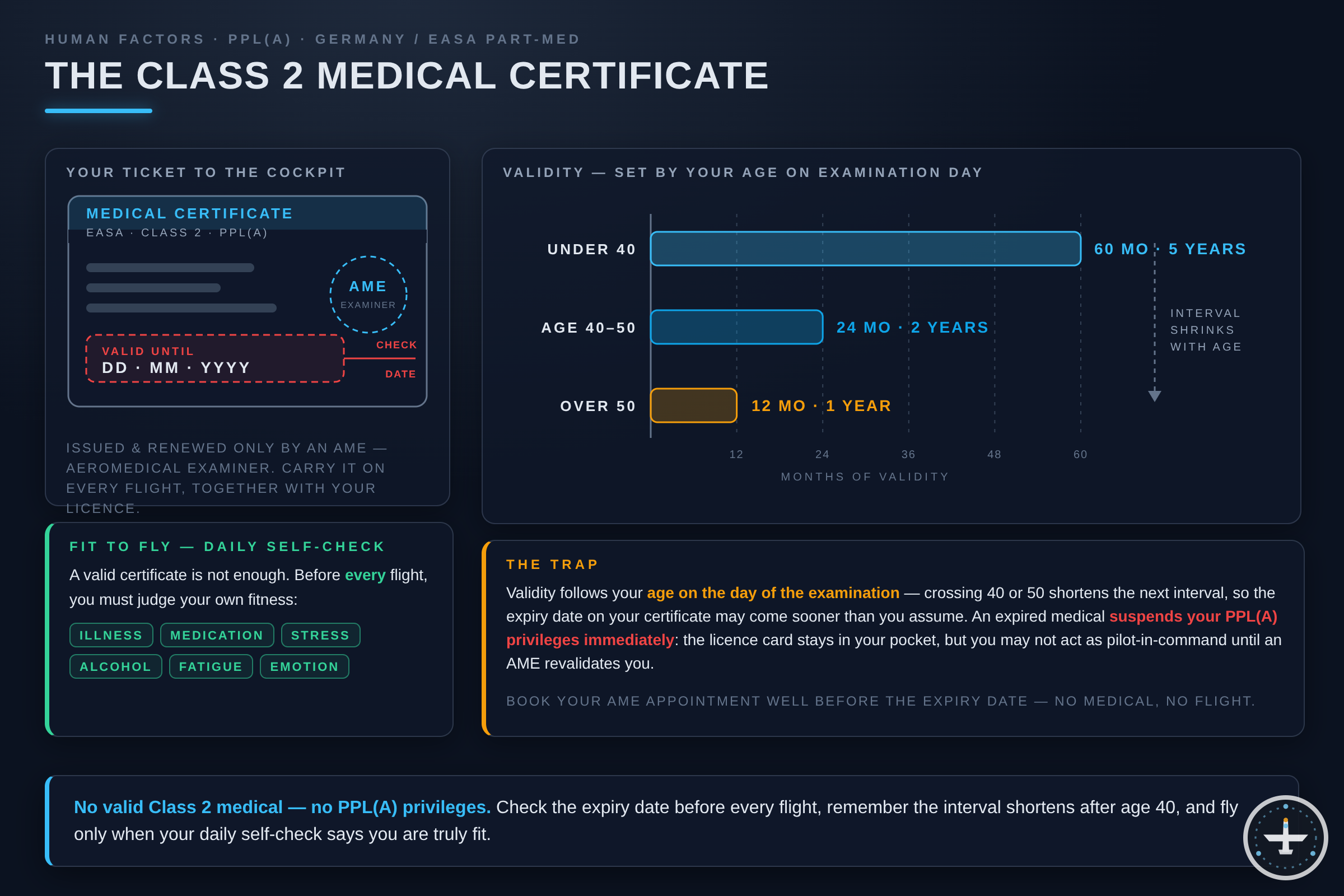
Validity depends on age (Part-MED.A.045):
- Under 40 years: 60 months (5 years)
- 40 to 50 years: 24 months (renewal according to ECG schedule)
- Over 50 years: 12 months
Note: if you turn 40 during a 5-year validity period, the medical is automatically valid only until your 42nd birthday — validity is reduced automatically. You may renew up to 45 days before expiry without losing the remaining validity period.
Glasses, Contact Lenses, and Visual Impairment
One of the most common concerns — and usually an unfounded one. Flying with a visual aid is entirely possible, provided that you meet the required visual acuity values with correction:
- Distant visual acuity: 0.7 per eye, 1.0 binocular (with correction)
- Near visual acuity: N5 at 30–50 cm, N14 at 100 cm
You will then receive a limitation entered on your medical certificate:
- VDL ("shall wear corrective lenses"): wearing glasses/contact lenses is mandatory when flying.
- VNL ("shall have available spare set"): a spare pair of glasses must be carried in the cockpit.
Class 2 is also possible after LASIK/PRK surgery, generally three months after the procedure, provided refraction is stable and the ophthalmological report is unremarkable.
Colour vision deficiency: if you fail the Ishihara plates, follow-up tests are available (anomaloscope, lantern test). In the worst case you may receive the limitation "not at night and not using light signals" — you can still fly.
What Happens If Something Is Found?
If the AME identifies a finding, there are three possible outcomes:
- Fit — certificate issued immediately: you receive your certificate on the spot, often printed directly from the EASA medical portal.
- Deferral: for inconclusive findings (e.g. elevated blood pressure, ECG abnormality) you obtain additional reports and submit them subsequently.
- Referral to the LBA: in complex cases the LBA decides on fitness, potentially with limitations (OML — "valid only with a qualified co-pilot"; generally not relevant for PPL holders).
Important: even if a chronic condition is present (asthma, well-controlled hypertension, history of ADHD), this does not automatically mean "unfit". Speak to an AME beforehand — a preliminary enquiry costs little and avoids unpleasant surprises.
What to Bring to Your Appointment
- National identity card or passport
- Glasses and/or contact lenses (if worn)
- List of current medications
- Reports relating to pre-existing conditions or operations
- Previous medical certificate if applicable (for renewal examinations)
- Cash or card for the fee