Why do you need the Class 2 Medical?
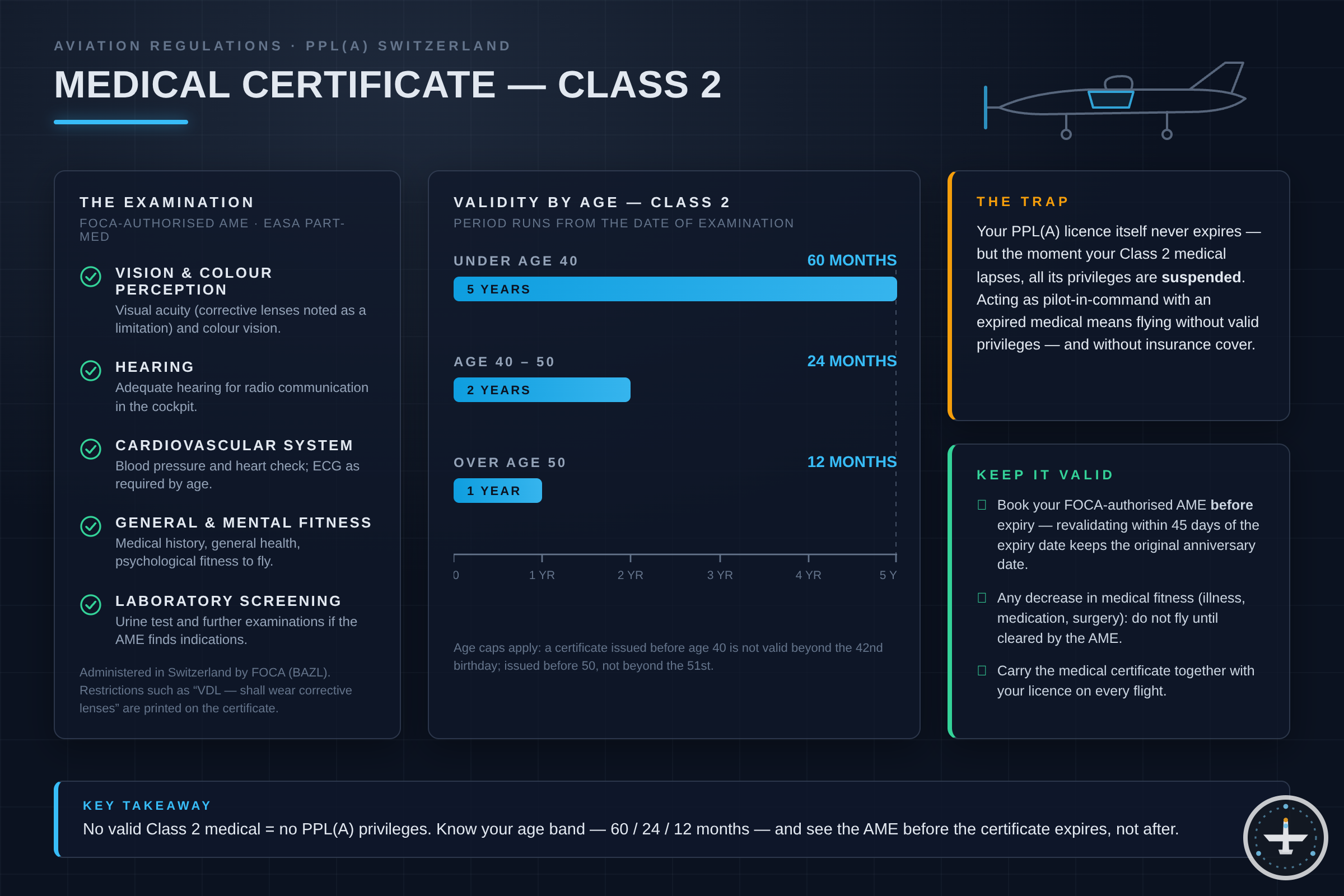
The Class 2 medical certificate (Medical Class 2) is the legal prerequisite for exercising the privileges of a private pilot licence on fixed-wing aircraft. It is governed by EU Regulation (EU) No 1178/2011 (Part-MED) and is valid throughout EASA member states — including Switzerland, where BAZL (Federal Office of Civil Aviation) supervises the Aviation Medical Examiners (AME).
Important: For the PPL(A) you require Class 2. An LAPL Medical would suffice for the LAPL (slightly less stringent), while professional pilots require Class 1. You must hold a valid Class 2 certificate before your first solo flight — no Medical means no solo, no solo means no licence.
Where do you obtain the Medical?
Class 2 examinations may only be conducted by an AME (Aviation Medical Examiner) authorised by BAZL. The current list of AMEs in Switzerland is available on the BAZL website under "Fliegerärzte" (aviation medical examiners). There are approximately 80–100 authorised physicians distributed across Switzerland, mostly near major aerodromes (Zurich, Geneva, Bern, Basel, Lugano, St. Gallen).
You arrange an appointment directly with the AME. Allow at least 60–90 minutes. For the initial examination you must appear in person; renewal examinations may take place with the same or a different AME.
What exactly is examined?
The initial Class 2 examination covers a broad range of assessments:
- Medical history: detailed questionnaire covering pre-existing conditions, medications, surgeries, family history, alcohol/drug use
- General physical examination: height, weight, blood pressure, heart, lungs, abdomen, reflexes, musculoskeletal system
- Vision: visual acuity (distance/near/intermediate), colour vision (usually Ishihara plates), visual field, ocular alignment
- Hearing: whisper test, audiogram if required
- Urine: dipstick test for glucose, protein, and blood
- Resting ECG: mandatory at initial examination, thereafter age-dependent
- Lung function: standard at initial examination
- Haemoglobin determination: at initial examination
If abnormalities are found, the AME may request further investigations (exercise ECG, ophthalmologist, ENT, etc.) or refer the decision to the BAZL Aeromedical Section.
Costs in Switzerland
Fees are not regulated and vary by AME and region. Realistic ranges for 2024/2025:
- Initial Class 2 examination: approx. CHF 350–550
- Renewal/Revalidation examination: approx. CHF 200–350
- Additional services (audiogram, exercise ECG, ophthalmologist report): billed separately, approx. CHF 80–250 each
A BAZL fee for issuance or renewal of the certificate applies on top of this (often not included in the AME fee — check in advance). Health insurance does not cover the costs — this is an occupational/aviation fitness assessment, not a medical treatment.
Validity
Validity depends on your age at the time of examination:
- Under 40 years: 60 months (5 years)
- 40 to 49 years: 24 months — note: if you renew before your 40th birthday and the certificate would otherwise run for 5 years, it will nonetheless expire no later than your 42nd birthday (simplified rule)
- 50 years and above: 12 months
As a rule of thumb: the older you are, the shorter the intervals. Renewal examinations are generally less extensive than the initial examination, provided no new findings arise.
What if you need glasses?
Glasses or contact lenses are not an obstacle. Thousands of PPL pilots fly with corrective lenses. Three points are key:
- Corrected visual acuity: With glasses/lenses you must achieve 1.0 (distance) in each eye and 0.5 at 30–50 cm for near vision. Current refractive limits are approximately ±6 dioptres spherical (higher values are possible but require an ophthalmological assessment).
- Entry in the Medical certificate: You will receive an endorsement such as VDL ("shall wear corrective lenses and carry a spare set of spectacles") — meaning you must wear your glasses while flying and carry a spare pair.
- Colour vision: Red-green deficiency can be an issue. If you fail the Ishihara test, secondary tests are available (e.g. CAD test). If these are also failed, restrictions such as "day flying only" may be imposed.
Eye surgery (LASIK, PRK) is accepted after a waiting period (typically 3 months without complications and with stable refraction) and with an ophthalmological report.
The process in practice: your roadmap
- Select an AME from the BAZL list and arrange an appointment
- Beforehand: complete the BAZL online form (eMED / Application Form) — the AME will tell you what is required
- Bring your ID, glasses (if applicable), and any previous medical records
- Attend fasting if required (some AMEs require this for blood values — ask in advance)
- After a successful examination: the certificate is usually issued on the spot or delivered within a few days
Common pitfalls
- High blood pressure on the examination day: anxiety drives values up. Arrive well-rested, without excessive caffeine.
- ADHD medication, antidepressants: must be disclosed; they are not an automatic disqualifier, but typically require a case-by-case review by BAZL.
- Undisclosed pre-existing conditions: false declarations can render the Medical certificate invalid retrospectively — honesty is always the better approach.
If you have doubts (chronic condition, previous surgery, medications), book a brief preliminary consultation with the AME before committing to the full examination. This saves money and frustration.