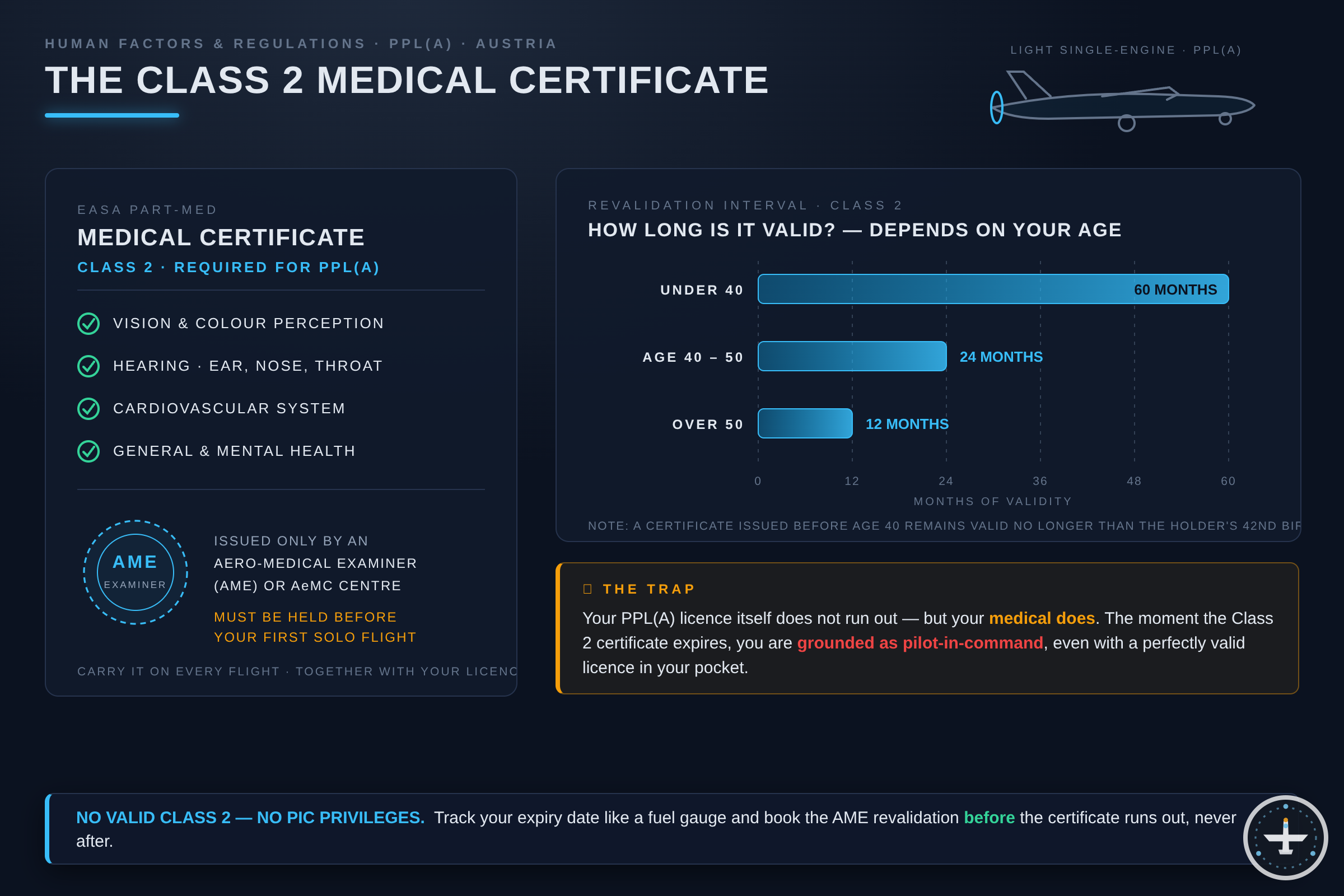
What is the Class 2 Medical?
The Class 2 medical is the medical fitness certificate required to hold a Private Pilot Licence for aeroplanes (PPL(A)). It is regulated under EASA Part-MED and is recognised uniformly across the EU. For the LAPL (Light Aircraft Pilot Licence), a slightly less stringent LAPL Medical suffices — however, both are issued by the same physician. In practice it is almost always worth obtaining the Class 2 directly, since it covers both licence types.
Important: you need the medical before your first solo flight. Studying theory and flying dual instruction with a flight instructor is possible without it — but no responsible Head of Training will let you fly solo without the medical being at least underway. Get it done early.
Who may issue the Medical?
In Austria, only an aviation medical expert recognised by Austro Control — an AeMC (Aero-Medical Centre) or AME (Aero-Medical Examiner) — is authorised to issue a Class 2 medical certificate. An up-to-date list of approved physicians is available on the Austro Control website under aviation medical examiners.
You are free to choose any AME — geographic proximity is usually the only deciding factor. Book your appointment directly with the physician by phone or online, not through Austro Control.
What is assessed at the initial examination?
The initial application is considerably more thorough than subsequent renewals. Allow 2 to 3 hours for this appointment.
The following are examined:
- Medical history: detailed questionnaire covering pre-existing conditions, operations, medications, allergies, and family history
- Eyes: visual acuity (distance and near vision), colour vision (usually Ishihara plates), visual field, ocular alignment
- Hearing: audiogram (pure-tone audiometry) and whisper test
- Cardiovascular: resting ECG, blood pressure, auscultation
- Lungs: spirometry (pulmonary function), auscultation
- Urine: standard dipstick test (glucose, protein, blood)
- Neurological/orthopaedic: reflexes, coordination, range of motion
- Blood: at initial application, haemoglobin and blood glucose are commonly assessed
- General status: height, weight, BMI
If any findings are abnormal, the AME may order additional investigations — such as an exercise ECG, an ophthalmological assessment, or an ENT consultation. This delays the issue of the certificate and incurs additional costs.
What to bring
- Photo ID (passport or national identity card)
- Glasses or contact lenses, plus a current prescription
- List of all medications you take
- Medical records relating to chronic conditions or previous operations
- If you already hold a pilot licence: your previous medical certificate
Be honest. Providing false information is not a minor offence — it can result in revocation of the medical and the licence. Many conditions are fully compatible with certification, either with limitations or following additional investigation; undisclosed diagnoses are not.
Validity
Validity depends on your age at the time of examination:
- Up to 39 years: valid for 5 years (but expires no later than your 42nd birthday)
- 40 to 49 years: valid for 2 years, except when issued before age 40 → valid until your 42nd birthday, thereafter 1 year
- 50 years and over: valid for 1 year
To be precise: if you obtain your medical at age 39 and fly at 40, it remains valid until the original expiry date — but no longer than 2 years after issue or until your 42nd birthday. The transitions at the age boundaries are somewhat nested; if in doubt, your AME can calculate the exact dates for you.
Renewals are shorter and less expensive than the initial application, as a full initial examination is no longer required. You may renew up to 45 days before expiry without losing any validity from the new period.
Costs
Fees are not regulated; each AME sets their own rates. Realistic ranges in Austria (as of 2024):
- Initial application, Class 2: approximately €180 to €280
- Renewal: approximately €100 to €180
- Additional investigations (exercise ECG, ophthalmologist, etc.): charged separately, typically €80–€200 each
Health insurance does not contribute — this is a private medical service. Ask about the fee when booking your appointment.
Glasses, contact lenses, and visual acuity
Wearing glasses is neither unusual nor a problem. The medical certificate is issued with the limitation VDL (Visual Correction Required — "shall wear corrective lenses"). You must wear your glasses or contact lenses while flying and carry a spare pair of glasses.
Key thresholds for Class 2, summarised:
- Distance visual acuity: corrected to at least 1.0 in each eye; binocular acuity also 1.0
- Refraction: up to ±5 dioptres spherical is unproblematic; above this, individual assessment applies
- Colour vision: must be "safe". Failing the Ishihara test does not necessarily disqualify you — further tests (e.g. Farnsworth Lantern) are available. In the case of permanent failure, the limitation "day VFR only" (OCL) may be applied
- Refractive surgery (LASIK etc.) is permitted but must be documented and the result must be stable (typically ≥12 months post-op)
The process in practice
- Select an AME from the Austro Control list and book an appointment
- Complete the application form in advance (provided by the AME or available from Austro Control)
- Examination — usually completed in a single appointment unless additional findings are required
- If fit, the AME issues the certificate directly to you; the application is submitted digitally to Austro Control
- Keep your medical certificate — paper or digital — accessible whenever you fly
A practical tip: obtain your medical before enrolling at a flying school. If a finding requires additional investigation, you will know before making any financial commitments.