The Legal Minimum Duration
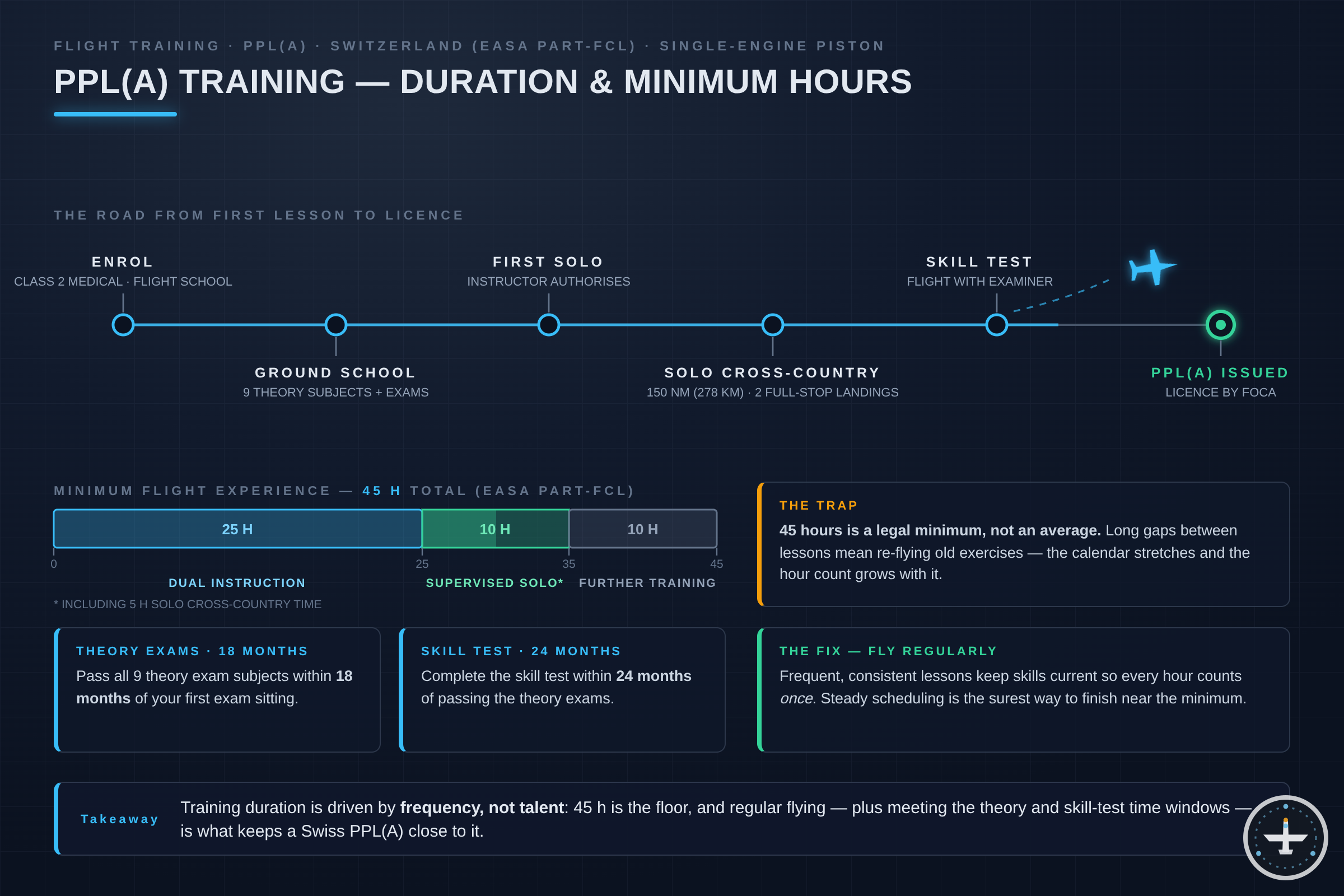
The legal basis for the PPL(A) is EU Regulation (Reg. (EU) No. 1178/2011, Part-FCL), which has been adopted in Switzerland by BAZL. The specific requirements are:
- 45 flight hours total flight time on aeroplanes, of which:
- at least 25 hours dual instruction
- at least 10 hours solo, of which 5 hours solo cross-country
- one solo cross-country flight of at least 270 km (150 NM) with two full-stop landings at two different aerodromes
- at least 100 hours of theoretical instruction (in practice usually self-study combined with classroom or online modules)
- 9 theoretical knowledge examinations with BAZL (Air Law, Human Performance, Meteorology, Communications, Principles of Flight, Operational Procedures, Flight Performance & Planning, Aircraft General Knowledge, Navigation)
- a passed Skill Test with a BAZL examiner
If you already hold a LAPL(A), hours will be credited. In theory you could complete the 45 hours in two to three months. In practice, almost no one achieves this.
The Realistic Duration in Switzerland
Plan for 55 to 70 flight hours rather than the statutory 45. This is not a failure — it is the average: weather, the learning curve, and gaps between lessons all extend the journey. In calendar time this means:
- Full-time intensive course (rare in Switzerland): 3 to 6 months, often including a block abroad (e.g. Spain, USA) for weather reliability.
- Part-time, ambitious (2–3 lessons per week): 9 to 14 months.
- Part-time, normal pace (1 lesson per week): 18 to 24 months.
- Casual, weekends only, weather-dependent: 24 to 36 months is not unusual.
BAZL sets no maximum training duration, but all theoretical knowledge examinations must be completed within 18 months of the first passed examination, and the Skill Test must take place within 24 months of the last theoretical knowledge examination. Those who progress too slowly risk having to retake theoretical examinations.
Full-Time vs. Part-Time
Full-Time
Advantages: shorter overall duration, fewer revision lessons because knowledge stays fresh, often cheaper per hour through package pricing. Disadvantages: difficult to combine with employment, only feasible for half the year in Switzerland due to weather, a training block abroad requires theory validation and potentially additional checks.
Part-Time
Advantages: compatible with work or studies, more manageable financially, more time to absorb the theory. Disadvantages: every gap costs — if you have not flown for three weeks, the next lesson often requires half an hour to get back up to speed. Long winter breaks add up.
If you are training part-time, schedule at least one lesson every 10 to 14 days. Flying less frequently is inefficient.
Factors That Genuinely Affect Duration
- Lesson frequency. The single biggest lever. Two lessons per week will advance you disproportionately faster than one.
- Weather. Switzerland has approximately 100 to 140 usable VFR fair-weather days per year, varying significantly by region. Many lessons are cancelled in winter.
- Flying school and fleet availability. A school with three aircraft and 30 students has long waiting times. Ask specifically about slot availability.
- Theory discipline. Studying the 9 subjects in parallel with practical training and sitting examinations early avoids a lengthy theory block at the end. With a structured learning platform such as Aero.Academy, the subjects can be completed alongside work in 4 to 8 months.
- Learning curve and prior experience. Gliding, model aircraft, or simulator experience realistically saves 5 to 15 flight hours. Difficulties with radio telephony (R/T in English or German) add time.
- Budget. If you can only afford 1–2 hours per month, you will fly correspondingly rarely. Budget for CHF 18,000 to 25,000 in total costs.
- Medical Class 2. You must hold a Class 2 medical certificate before your first solo. Delaying this blocks your own progress.
- Radio telephony certificate (BZF/RTF). In Switzerland this must be obtained separately (Sprechfunkzeugnis VFR) and is often underestimated in the timeline.
Realistic Example Timeline (Part-Time)
- Months 1–2: Introductory flight, training contract, Class 2 medical, begin theory.
- Months 2–8: Practical lessons — circuit training and airwork, theory modules in parallel, sit first theoretical knowledge examinations.
- Months 8–10: First solo (typically after 15–25 hours dual), consolidate solo flying.
- Months 10–14: Navigation, cross-country flights, solo cross-country.
- Months 14–16: Final theoretical knowledge examinations, Skill Test preparation.
- Months 16–18: Skill Test with BAZL examiner, licence issue.
What You Can Accelerate — and What You Cannot
Theory progress and lesson frequency are the main areas where you can make gains. The weather, examiner availability, and BAZL processing times (typically 2 to 6 weeks for licence issue after a passed Skill Test) are fixed. Do not plan too tightly — scheduling your Skill Test on the last possible day of the 24-month window leaves no buffer for weather cancellations.