What This Is About
Before you take to the skies for practical helicopter training, you must pass the theory exam for the Private Pilot Licence Helicopter — PPL(H) for short. In Austria, this exam is administered by Austro Control and is based on the EASA's European Central Question Bank (ECQB). In terms of content, format, and procedure, the exam is largely identical to the PPL(A) — the differences lie in the helicopter-specific content within the subjects Principles of Flight, Aircraft General Knowledge, and Performance.
The Nine Exam Subjects
You sit nine individual subject papers. Each paper can be taken and passed separately:
- Air Law
- Aircraft General Knowledge (helicopter-specific)
- Flight Performance and Planning
- Human Performance and Limitations
- Meteorology
- Navigation
- Operational Procedures
- Principles of Flight — Helicopter
- Communications (VFR)
Some schools and authorities split Communications into VFR and IFR parts — for PPL(H), only the VFR part is relevant.
Format: Multiple Choice with ECQB Questions
All questions are multiple choice with four answer options, exactly one of which is correct. The questions are drawn from the ECQB, which EASA maintains centrally and updates on a regular basis. Austro Control selects a question set from this pool for each exam session.
The number of questions per subject and the allotted time are defined in the EASA Annex (Part-FCL, AMC1 FCL.025). For PPL(H), the approximate figures are:
| Subject | Questions | Time |
|---|---|---|
| Air Law | 12 | 30 min |
| Aircraft General Knowledge | 12 | 30 min |
| Flight Performance & Planning | 12 | 60 min |
| Human Performance | 12 | 30 min |
| Meteorology | 16 | 60 min |
| Navigation | 12 | 60 min |
| Operational Procedures | 12 | 30 min |
| Principles of Flight (H) | 12 | 30 min |
| Communications VFR | 12 | 30 min |
These figures may vary slightly depending on the current regulatory version — the binding reference is always the current specification published by Austro Control. Check austrocontrol.at under "Licences and Ratings → Theory Examinations".
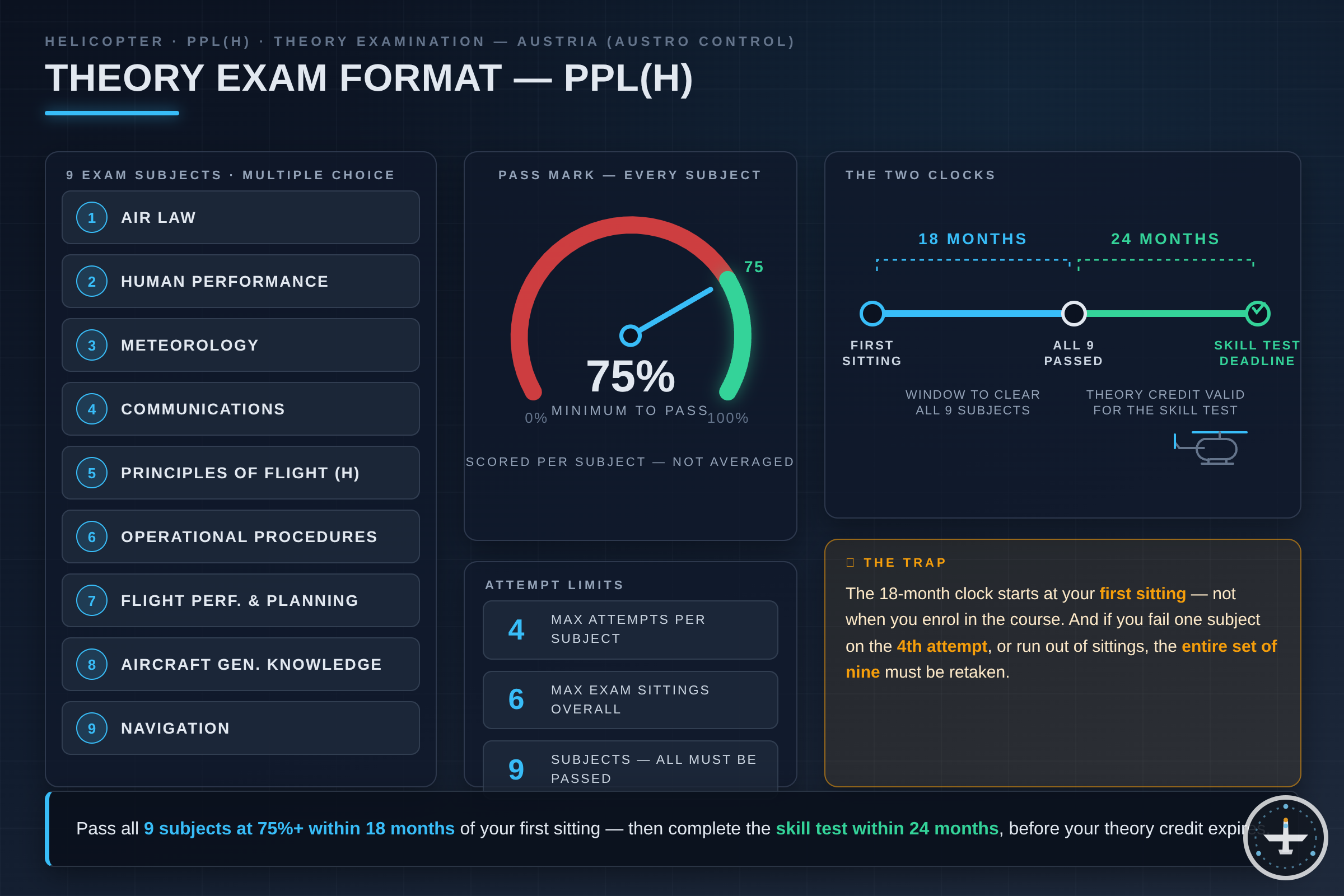
Pass Mark: 75 % Per Subject
You must answer at least 75 % of the questions correctly in each individual subject. There is no averaging across subjects: a 95 % in Meteorology will not save you if you score 70 % in Air Law.
Key points to be aware of:
- Maximum 6 attempts per subject. Per examination period, up to 4 sessions are generally available in which you can retake failed subjects.
- 18-month window: Once you sit your first subject paper, an 18-month period begins within which you must pass all 9 subjects.
- Validity of passed theory: Once all subjects are passed, the theory credit is valid for 24 months — you must complete the practical test within that period.
If you fail to pass all subjects within the 18 months or exhaust your 6 attempts in any subject, you must start over completely — all 9 subjects.
Registration and Prerequisites
Registration is handled through Austro Control. Before registering, you need:
- A recommendation from your ATO (Approved Training Organisation) confirming that you have completed the theoretical training portion
- A valid photo ID
- English (or German) language proficiency Level 4 is not strictly required before the theory exam, but must be demonstrated before the practical test at the latest
Exam fees are charged per subject and are due at the time of registration. Current rates are listed in Austro Control's schedule of charges.
Exam Day Procedure
The exam is taken on computer at Austro Control's premises (Vienna, Schnirchgasse) or at accredited examination centres. In practice, this means:
- Check-in approximately 30 minutes before the start, with photo ID.
- Briefing by the invigilator — rules, conduct, and how to operate the system.
- Permitted aids: Navigation equipment (plotter, compass, navigation computer such as the CRP-1 or non-programmable electronic equivalent), calculators without memory functions, headphones for the Communications paper. Personal notes, smartphones, and smartwatches are prohibited.
- Exam software: You work through the questions one by one, can flag questions, navigate back, and change answers.
- Result: Typically visible immediately after submission — percentage score per subject. An official certificate follows subsequently.
Tips for Exam Day
- Time management: With 16 questions in 60 minutes you have 3.75 minutes per question — it is not tight overall, but Performance calculations can become time-consuming. Flag difficult questions and return to them.
- Sleep beats last-minute studying: The night before the exam, sleep will do more for you than working through another 200 questions.
- Read each question twice. ECQB questions frequently use negations or compound conditions. "Which statement is not correct?" is a classic example.
- Check your units. Knots vs. km/h, feet vs. metres, °C vs. K — many errors originate here.
- Answer everything. There is no negative marking. Unanswered questions count as wrong — so make your best guess if necessary.
- Practising with realistic questions based on the current ECQB is essential. That is exactly what Aero.Academy is built for.
If You Fail
No need to panic. You register again and resit only the failed subjects. Keep the 4-session and 6-attempt rule as well as the 18-month window in mind. Targeted review of weak topic areas is more effective than starting from scratch.