What is the Skill Test?
The Skill Test is the practical examination at the end of your PPL(H) training. It is regulated in Part-FCL.235 and the associated AMC. It is conducted by an FE(H) (Flight Examiner Helicopter) authorised by the LBA. At the time of the examination you must be at least 17 years old, hold a Class 2 Medical, have passed the theoretical examinations, and be able to demonstrate the required flight hours (at least 45 hours on helicopters, of which 25 dual and 10 solo, including 5 hours solo cross-country).
Your flight instructor must approve you for the examination — without this recommendation (Course Completion Certificate from the ATO/DTO) you will not be granted an appointment.
Procedure on Examination Day
Plan for a full day. Typical schedule:
- Briefing and document check (approx. 30–60 min): The examiner verifies your logbook, Medical, theory confirmation, licence application, helicopter documents, weather, and NOTAMs.
- Flight preparation: You plan a cross-country segment yourself — route, fuel, Mass & Balance, Performance. The examiner provides weather data and the destination.
- Oral examination: Questions on the helicopter's systems, limitations, emergencies, air law, aerodynamics (in particular Vortex Ring State, Settling with Power, Retreating Blade Stall).
- Flight: approx. 1.5–2 hours, depending on type and section.
- Debriefing: Result, strengths, weaknesses.
The Five Sections of the Skill Test
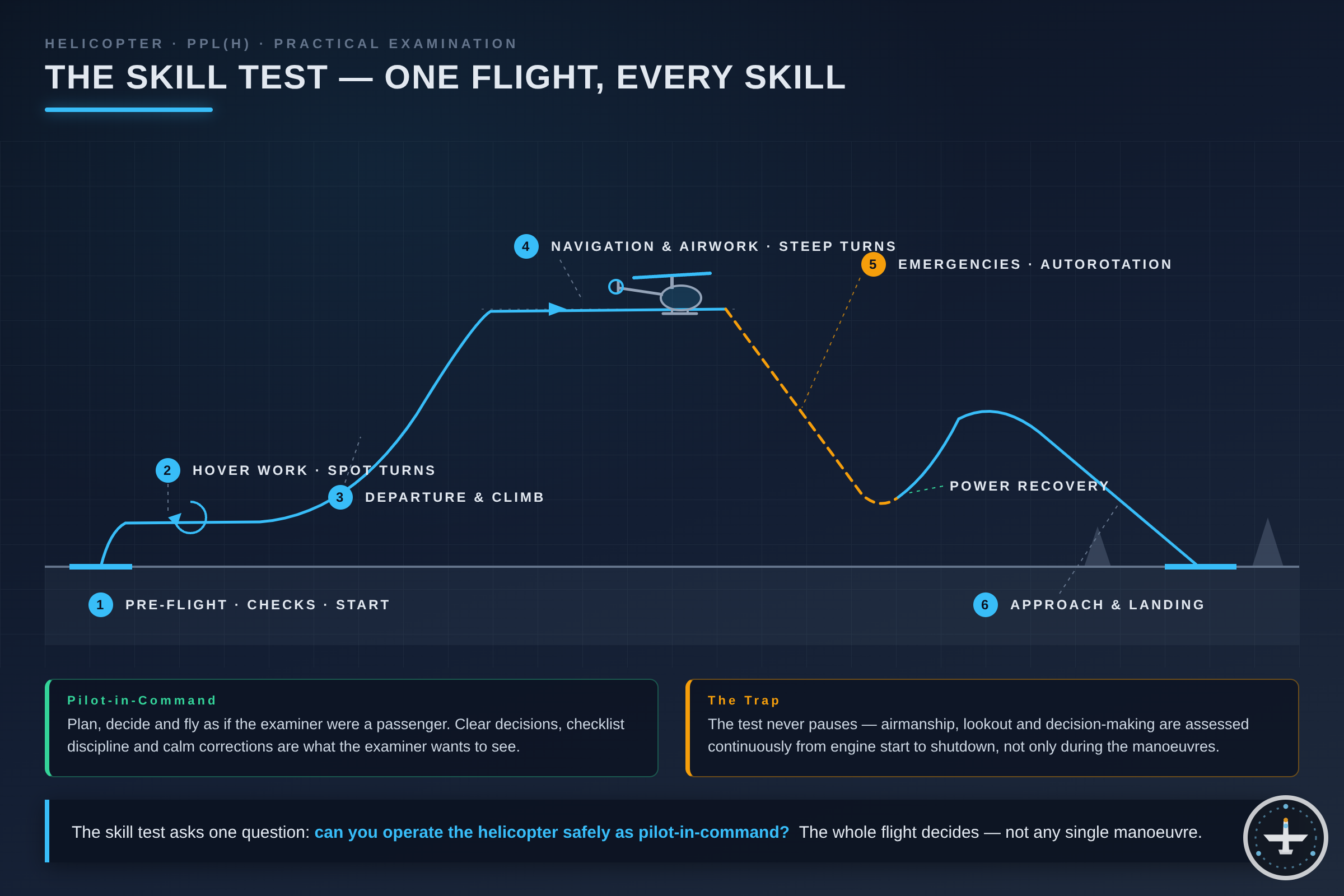
The PPL(H) Skill Test is divided into five sections (Appendix 4 to Part-FCL):
- Section 1 — Pre-flight Preparation: Flight planning, documents, weather, Mass & Balance, pre-flight inspection, engine start.
- Section 2 — Airwork: Hover (in/out of ground effect), hover taxi, spot turns, take-off and landing procedures, steep approach, limited power, sloping ground, quick stop.
- Section 3 — Navigation: Cross-country flight with at least one planned routing, map navigation (Pilotage/DR), radio navigation, radio communication, diversion to an alternate aerodrome.
- Section 4 — Flight Procedures and Manoeuvres: Steep turns, flight in reduced visibility (if required), recovery from unusual attitudes.
- Section 5 — Abnormal and Emergency Procedures: Autorotation (straight-in, with 180° and power recovery or touchdown depending on type), engine failure in the hover, hydraulic failure, tail rotor malfunctions (simulated), stuck pedals, engine restart.
In each section the examiner assesses performance against fixed tolerances. Typical values (normal flight):
- Altitude: ±100 ft
- Heading: ±10°
- Speed: ±10 kt (cruise), ±5 kt on approach
- Hover height: ±2 ft, position ±3 ft
In emergencies the tolerances are somewhat wider; however, the touchdown spot during autorotation must be hit accurately.
Preparation — What Really Helps
- Practise to tolerances: Not "approximately 1,000 ft" but precisely. Trim, scan, anticipation.
- Emergencies cold in your sleep: Memory items for every scenario. Say out loud what you are doing ("Lower collective, airspeed 60 knots, identify landing area …").
- Simulate the oral examination: Have your flight instructor quiz you. POH/RFM limitations by heart.
- Use standard calls — the examiner wants to see structure, not creativity.
- Mock check with a second instructor or senior instructor. An external eye finds blind spots.
- Weather and fuel planned conservatively. If the weather is marginal, say "No Go" — that is a valid answer, not a mistake.
What Does the Skill Test Cost?
In Germany you pay at several points:
- Examiner fee: typically €400–700, depending on the FE(H).
- Helicopter charter for the duration of the examination (approx. 1.5–2 flight hours): varies considerably depending on type (R22/R44/H120), roughly €500–1,500.
- LBA fee for licence issue: under the LuftKostV, currently approximately €150–250 for the initial issue of the PPL(H).
Exact amounts vary — check with your ATO/DTO and refer to the current LuftKostV.
What Happens if You Fail?
Three scenarios (FCL.235):
- Passed in all sections → Licence application to the LBA.
- One section not passed → Partial Pass: You repeat only that one section. On the second attempt you may also lose already passed sections if performance no longer meets the standard.
- More than one section not passed or repeat not passed → complete re-test, all sections.
After two failed attempts you must complete additional training sessions defined by your ATO/DTO before you may attempt the test again. After four failed attempts the situation becomes formally complex — the way forward is agreed individually between the ATO and the authority.
A discontinuation (interruption due to weather, technical issue, or illness) does not count as a failure. You resume the examination at the next appointment where you left off, provided it is completed within 6 months.
After the Examination: Licence Application
With the signed examination report you submit the application for initial issue of the PPL(H) to the LBA in Braunschweig. Current processing time is 4–8 weeks. You may only fly as PIC under PPL privileges once the licence has been issued — not immediately after passing the test.
In Brief: Skill Test Mindset
The examiner is not your adversary. They are assessing whether you fly safely and with good airmanship, not whether you are perfect. Small corrections are permitted — actively correcting yourself shows that you have the helicopter under control. Interrupt yourself when you make a mistake, correct it, and fly on. Silent resignation is the worst signal you can send.