When Are You Ready for the Skill Test?
Before your flight instructor puts you forward for the Skill Test, the requirements under Part-FCL (FCL.235) must be met:
- At least 45 flight hours on helicopter, of which at least 25 with an instructor and 10 solo (including 5 h solo navigation with a cross-country flight of ≥ 185 km / 100 NM with landings at two different aerodromes).
- All theoretical examinations passed at BAZL (valid for 24 months from passing the last theory exam).
- Valid Class 2 Medical, valid language certificate (Language Proficiency, minimum Level 4).
- Recommendation from your flight instructor (Recommendation Letter) — without it, no FE(H) will examine you.
Registration is handled by the flight school with BAZL or directly with the accredited examiner. The BAZL fee for licence issuance after a passed test is currently around CHF 110–150 (plus examiner fee and helicopter hours, which you bear yourself).
Structure of the Skill Test
The Skill Test consists of two parts: briefing/pre-flight preparation on the ground and the flight. Allow for half a day to a full day in total.
1. Ground Briefing
The examiner checks:
- Flight preparation: Weather (METAR, TAF, GAFOR, SIGMET), NOTAM, mass calculation (Weight & Balance), performance (HIGE/HOGE, Power Check), fuel calculation.
- Navigation: Route on a VFR chart (ICAO 1:500,000), tracks, distances, times, MEF, radio frequencies, airspace.
- Documents: Helicopter paperwork (CofA, ARC, insurance, radio licence), your personal documents.
- Type-specific questions: Limitations, systems, emergency procedures from the Flight Manual.
In practice, most candidates do not fail here — but uncertainty during the briefing sets the tone for the flight.
2. Practical Flight
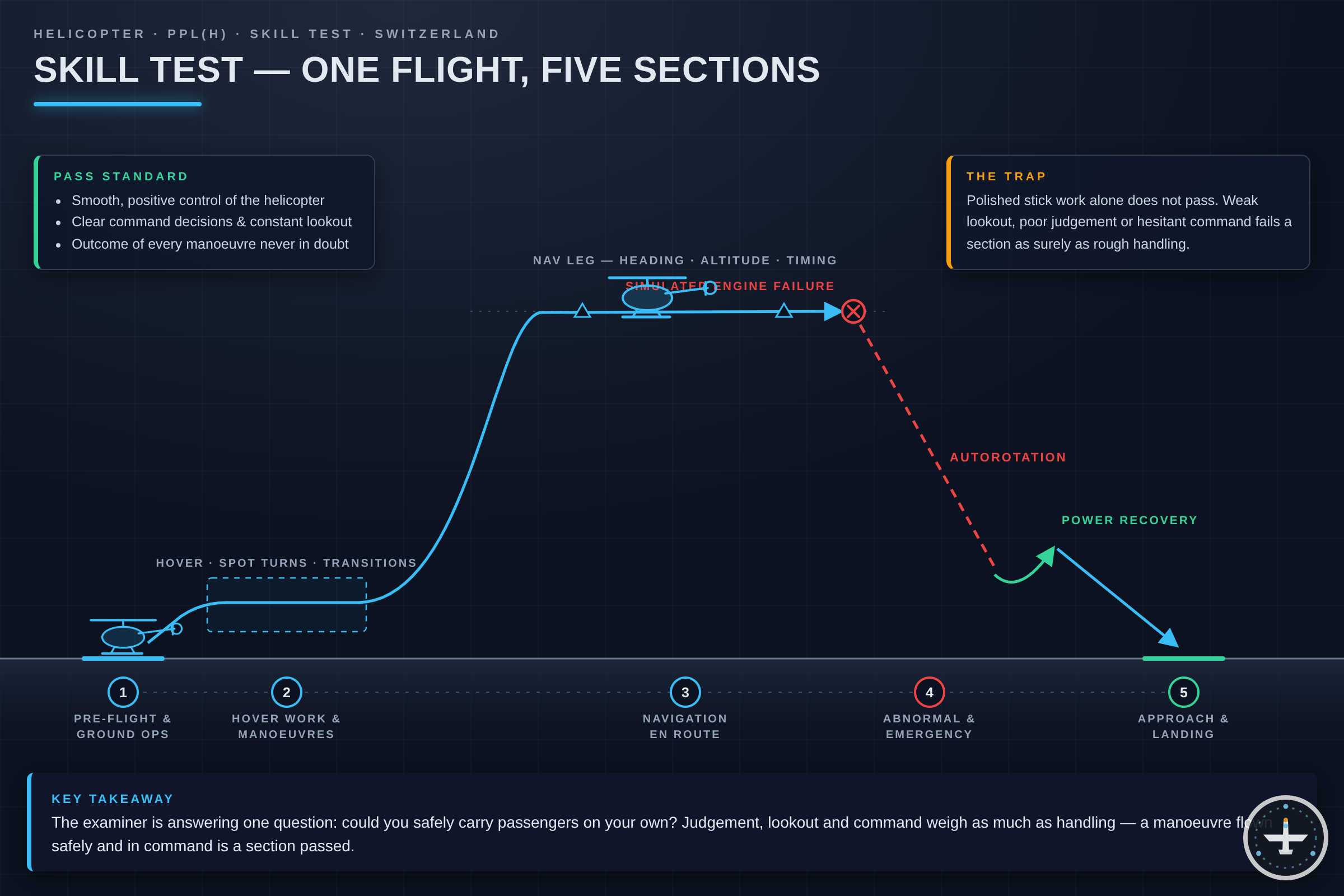
The flight is divided into Sections (as per Appendix 4 to Part-FCL):
- Section 1: Flight preparation, pre-flight inspection, start-up.
- Section 2: Aerodrome traffic and circuit (take-off, approach, landing, radio).
- Section 3: Navigation flight — typically the first leg of your planned route, including a diversion to an alternate aerodrome and a lost procedure.
- Section 4: Flight procedures and manoeuvres — steep turns, slow flight, quick stop, sideways/backwards hover, spot turns.
- Section 5: Abnormal & emergency procedures — autorotation (straight-in and 180°), engine failure in the hover, hydraulic failure (where type-relevant), Settling with Power, stuck pedals, Vortex Ring State (recovery), confined area, sloping ground.
- Section 6: Special operations — e.g. off-aerodrome landing on unprepared terrain (important in Switzerland: mountain flying is not tested in the standard PPL(H) Skill Test — it is part of the mountain rating).
The examiner may combine sections to save time. Allow for 1.5 to 2 flight hours, often split across two sectors (e.g. a navigation flight and a separate training flight at a practice site).
Assessment: What the Examiner Wants to See
Each section is assessed as Pass / Fail. The FE(H) looks for:
- Tolerances: Altitude ± 100 ft, heading ± 10°, speed ± 10 kt, arrival time ± 3 min during navigation.
- Airmanship: Lookout, workload management, decision-making, communication.
- Safety: You are allowed to make mistakes — but you must recognise and correct them. An unrecognised safety-relevant error is a fail.
- Pilot-in-Command behaviour: You fly, you decide. The examiner is a passenger, not a co-pilot.
Preparation — What Really Helps
- Chair flying: Run through manoeuvres mentally, including callouts and checklists. Saves helicopter hours.
- Mock check: Have a different instructor (not your primary FI) fly a complete Skill Test with you. A fresh perspective uncovers blind spots.
- Know the Flight Manual cold: Limitations, memory items for emergency procedures, V-speeds — you must not have to think about these.
- Know the weather minima: VFR minima in Switzerland under VVR (Swiss Air Traffic Rules) and SERA. The examiner likes to ask about this during the briefing.
- Fly the route twice beforehand: Where possible, fly the typical Skill Test route with your instructor so you know the topography.
- Show up rested: You will not fly the test well when tired. Keep the day before free of demanding commitments.
What If You Don't Pass?
This is not a disaster — it happens regularly. Three scenarios apply (FCL.025 / FCL.235):
- Fail in one section: You may repeat the affected section in a partial retest. Sections already passed are retained.
- Fail in two or more sections: You must repeat the entire Skill Test.
- Fail in the partial retest: Also results in a complete retest.
Before each repeat attempt you will generally need additional training with your flight instructor and a new recommendation. If you still have not passed all sections after two attempts, BAZL requires further training before you may sit the test again. There is no fixed maximum number of attempts — but every repeat costs time and money.
Your theory validity (24 months) and your Medical must still be valid at the time of your repeat attempt. This is the most common stumbling block after longer breaks.
After Passing the Test
The examiner records the passed Skill Test in the Flight Test Report and submits the documents to BAZL. With the report and your application, BAZL issues the PPL(H) — typical processing time is 2–6 weeks. In Switzerland, you may not fly until the licence has been physically issued; BAZL does not routinely issue a provisional confirmation.