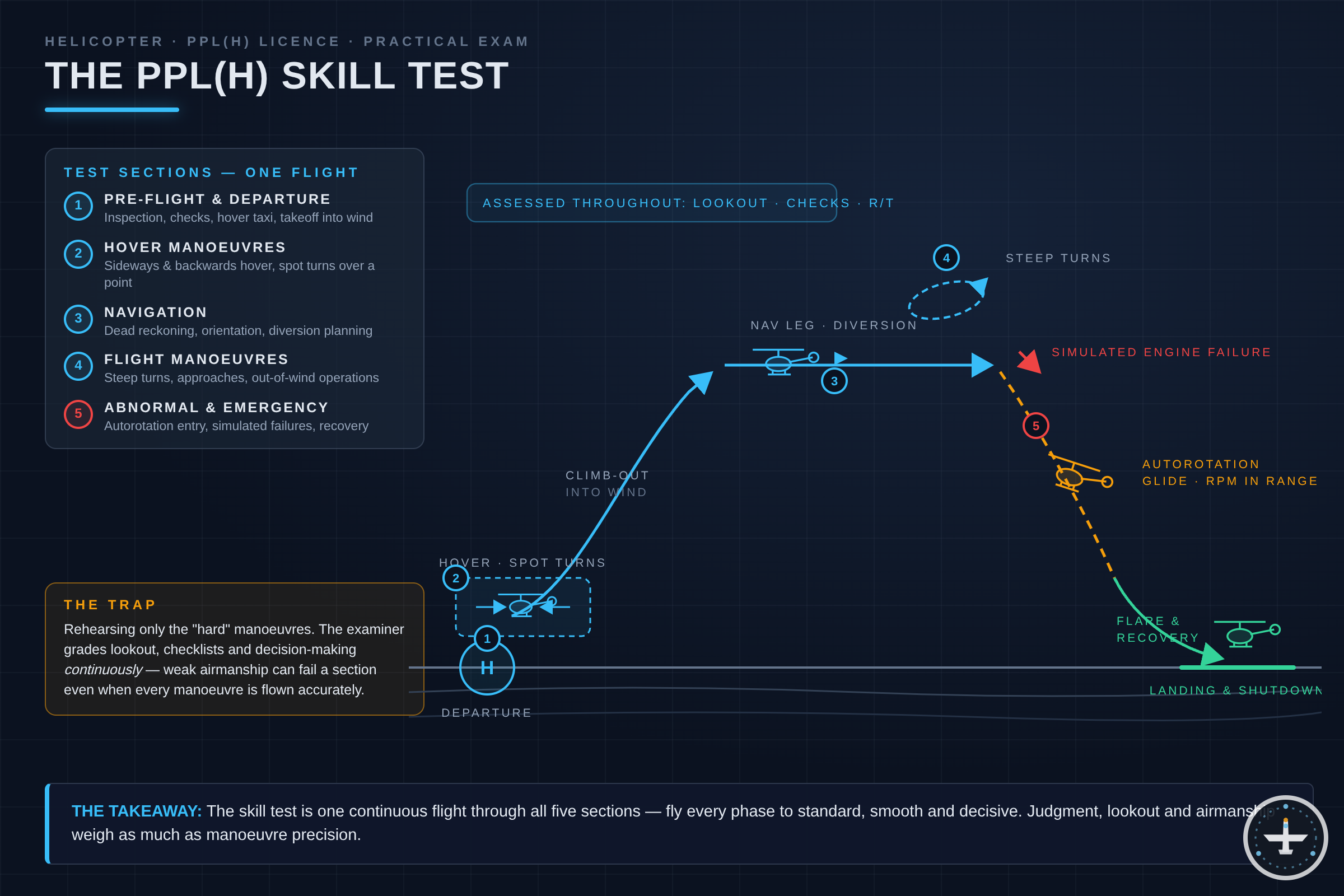
What the Skill Test actually is
The Skill Test is the practical examination at the end of your PPL(H) training. The legal basis is Part-FCL (FCL.235 for PPL) in conjunction with AMC1 FCL.235. You fly with a Flight Examiner for helicopters (FE(H)) authorised by Austro Control. The examiner assesses whether you can operate the helicopter safely as Pilot-in-Command (PIC) — not whether you fly perfectly.
Prerequisites before you may take the test:
- At least 45 hours of flight time on helicopters (of which 25 dual, 10 solo including 5 solo cross-country with one flight ≥ 185 km with two landings at different aerodromes).
- All 9 ATO theory examinations passed with Austro Control (valid for 24 months).
- Recommendation from your ATO/CFI.
- Valid Class 2 Medical and Language Proficiency endorsement.
Structure of the examination day
Plan for six to eight hours. The day is broadly divided into three parts:
1. Briefing and flight preparation (approx. 1–2 h) The examiner assigns you a cross-country route. You carry out:
- Weather briefing (GAFOR, METAR, TAF, SIGMET)
- NOTAM check
- Mass & Balance, performance calculation (Hover IGE/OGE, H/V diagram)
- Navigation planning with map, heading, time, fuel
- ATC planning, frequencies, transponder codes
Expect oral questions on the Tech Log, MEL, limitations, and emergency procedures for the type.
2. Practical ground assessment / Pre-flight (approx. 30 min) You carry out the outside check, explaining what you are checking and why. Cockpit check, start, run-up — all performed using checklists, out loud and in a traceable manner.
3. Flight (approx. 1.5–2 h flight time) The flight is divided into sections (Section 1–5 per Appendix 4 Part-FCL):
- Section 1 — Pre-flight/Departure: Briefing, external check, start-up, radio, hover taxi, take-off.
- Section 2 — General airmanship: Climb, cruise, descent, level flight, radio communication with ATC.
- Section 3 — Navigation: Route tracking per plan, position reports, diversion to an alternate aerodrome, low-level flight (if required), lost procedure.
- Section 4 — Flight manoeuvres and emergency procedures: Steep turns (45°), autorotation (with power recovery, often also to touchdown depending on school), hovering manoeuvres, quick-stop, Vortex Ring State recognition and recovery, engine failure simulations, stuck pedal, hydraulic failure, governor failure, settling with power.
- Section 5 — Approaches and landings: Normal approach, steep approach, shallow approach, running landing, confined area, sloping ground, limited power take-off, quickstop, precautionary landing.
After landing, the debriefing follows with a clear outcome: Pass, Partial Pass, or Fail.
Assessment criteria
The examiner assesses each section. You may briefly exceed tolerances — what matters is that you recognise the error and correct it. Clear fail criteria:
- Loss of helicopter control
- Safety-relevant exceedance of limits (rpm, MAP, VNE)
- Airspace infringement
- Violation of minimum altitudes without justification
- Unsafe handling of emergency procedures
Typical cruise tolerances are ±100 ft altitude, ±10° heading, ±10 kt airspeed — these are not set in stone; the FE assesses in context.
How to prepare
Four weeks before:
- Final solo and dual hours focused on weak areas
- Fly complete Skill Test profiles with your CFI (mock check)
- Revise theory, especially performance, limitations, and emergency procedures
One week before:
- Roughly work through route options for the cross-country
- Know the POH/AFM inside out (memory items!)
- Work through Mass & Balance sheets
The day before:
- No last-minute training; get adequate sleep (at least 8 hours)
- Check the weather; lay out all documents: logbook, licence application, medical, theory pass certificates, photo ID
On the examination day:
- Arrive at the airfield early, stay calm, use checklists consistently
- If in doubt: asking is permitted. Silence appears less confident than a clear question.
- Verbalise your decisions — the examiner must be able to follow your thought process.
If you fail
A fail is not the end of your career. Three scenarios under FCL.235(c):
- Partial Pass: Individual sections not passed. You only need to re-fly those sections, generally within six months. After two attempts, all sections must be repeated.
- Fail: Multiple sections failed or a serious error. You require additional training at your ATO, followed by a complete re-check.
- After four failed attempts: Austro Control may impose additional requirements.
Important: Ask the examiner to document in writing exactly which sections were unsatisfactory. Do not schedule the re-check too soon, but not too late either — two to four weeks of targeted training is realistic.
Costs in Austria (indicative figures)
- Examiner fee: approx. €400–600
- Helicopter hire for approx. 2 h: depending on type €700–1,500 (R22 cheaper, R44/H269 more expensive)
- Austro Control licence issuance fee: approx. €150–250
Budget approximately €1,500–2,500 overall for the Skill Test day including the licence application.