Legal Framework
The Skill Test for the PPL(A) is regulated in Part-FCL, Appendix 3 and 7 (Regulation (EU) No 1178/2011). In Germany, the LBA is the competent authority that recognises the Flight Examiner and subsequently issues the licence. Before the Skill Test you must:
- Have passed all 9 theoretical knowledge examinations (valid for 24 months)
- Have completed at least 45 flight hours, of which 25 with a flight instructor and 10 as solo (including 5 hours of solo cross-country flight with one flight ≥ 270 km / 150 NM and landings at two different aerodromes)
- Hold the recommendation of your flight instructor
- Have completed the Language Proficiency assessment, minimum Level 4
Structure of the Examination
The Skill Test consists of two parts, which usually take place on the same day:
1. Oral Examination / Briefing (approx. 1–2 hours)
The examiner typically gives you a flight assignment the day before or on the morning of the test, including a cross-country route (usually two intermediate landings or a longer leg). You must prepare:
- Navigation planning (wind, heading, time, fuel)
- Weather briefing (GAFOR, METAR, TAF, SIGMET)
- NOTAMs and airspace structure
- Mass & Balance, performance (take-off and landing distances)
- Completed flight plan
During the briefing, the examiner will question you on your planning, the aircraft (systems, limits, emergency procedures), meteorology, air law, and human performance. Expect targeted what-if questions.
2. Practical Flight (approx. 1.5–2.5 hours)
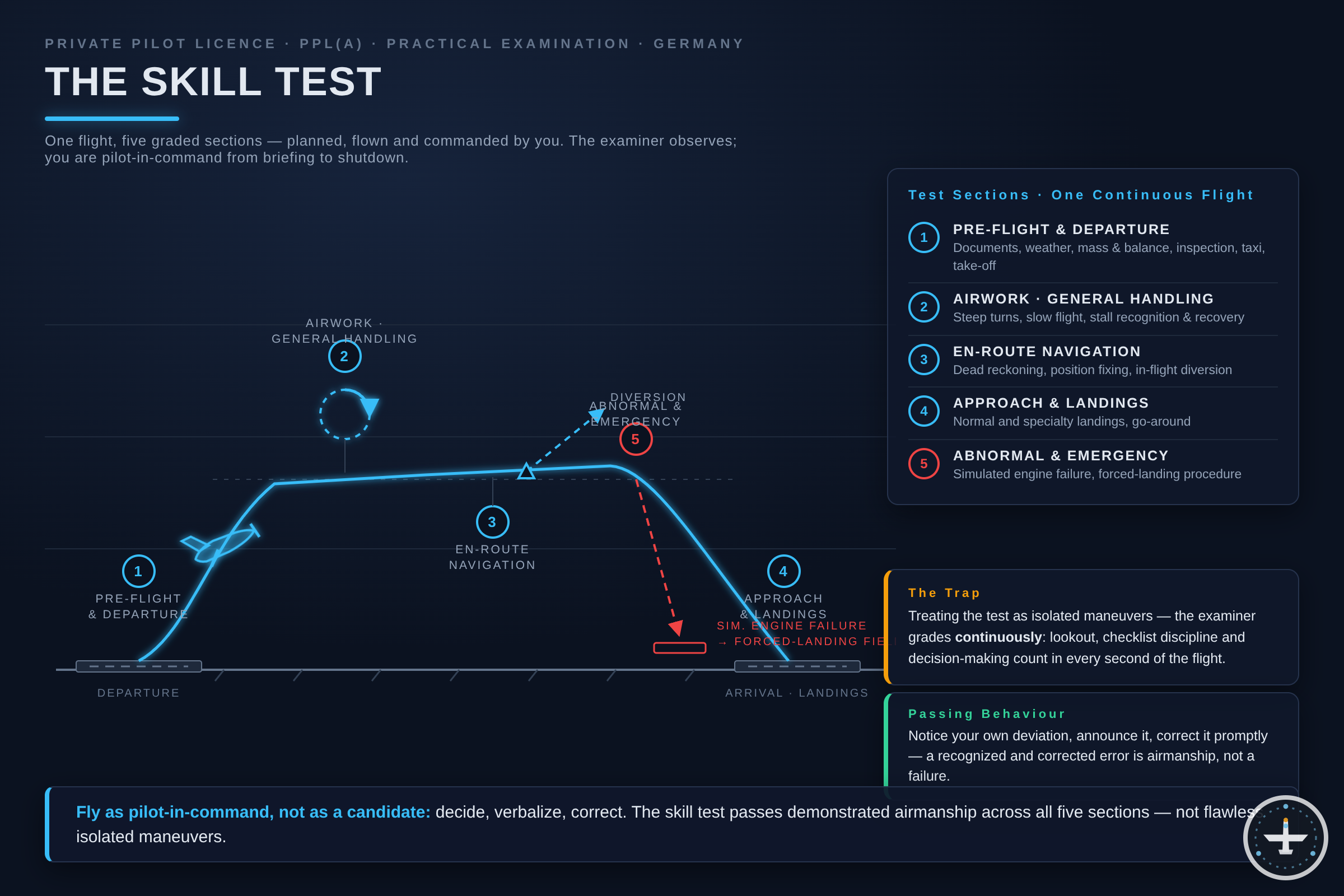
The flight covers all Sections as per Appendix 7 Part-FCL:
- Section 1: Pre-flight operations and departure (pre-flight inspection, engine start, taxiing, take-off)
- Section 2: General airwork (climb, descent, turns; Stalls clean & landing config; steep turns 45°)
- Section 3: En-route procedures (navigation, altitude/heading maintenance, ETA revision, ATC communication, diversion to an alternate aerodrome)
- Section 4: Approach and landing procedures (normal approach, crosswind landing, short-field, touch-and-go, go-around)
- Section 5: Abnormal and emergency procedures (engine failure, forced landing, emergency procedures, simulated radio failure)
- Section 6: Simulated asymmetric flight (MEP only, therefore not applicable for SEP PPL)
Typical Manoeuvres in Detail
- Steep Turns 45° bank: Maintain altitude ±100 ft, roll-out on specified heading ±10°.
- Slow Flight & Stall Recovery: Clean Stall and in landing configuration (flaps/gear), recovery with minimum altitude loss.
- Forced Landing without Power (PFL): Engine failure simulated from cruise altitude. Select a landing field, trim to best-glide speed, complete checklist, transmit Mayday call, plan approach.
- Precautionary Landing: Prepare to land in a field without engine failure (e.g. deteriorating weather).
- Diversion: The examiner assigns a new destination en route. You must calculate heading, time, and fuel in the cockpit.
- Lost Procedures: Procedures to follow in the event of positional disorientation.
Assessment
Each Section is assessed as Pass / Fail. Tolerances are defined in Appendix 7; broadly:
- Altitude: ±150 ft in normal flight, ±100 ft during manoeuvres
- Heading: ±10°
- Airspeed: ±10 kt, on final approach +10 / −5 kt
You pass when all Sections are passed. Safety-critical errors (e.g. failure to identify a traffic situation, exceedance of limits) result in immediate failure.
Preparation: What Really Helps
- Chair-flying: Run through the entire profile mentally — checklists, callouts, frequencies.
- Mock check with your flight instructor: At least one complete practice flight under examination conditions.
- Brush up on theory: Even if the theoretical knowledge examinations are passed — the examiner will ask oral questions. Focus on air law, meteorology, performance, and Aircraft General Knowledge for your type.
- POH/AFM: Know V-speeds, limits, and emergency procedures by heart.
- Local knowledge: Aerodromes in the region, airspace structure, typical weather patterns.
- Sleep & nutrition: Obvious, but critical. A Skill Test often takes 5–6 hours including the briefing.
If You Fail
Not every failure is a catastrophe. There are three scenarios under Part-FCL.030:
- Partial Pass: You have failed one or more Sections but passed the remainder. You only need to re-fly the failed Sections within 6 months and with a maximum of 2 further attempts (i.e. 3 attempts in total for the partial re-check).
- More than one Section failed: You must repeat the entire Skill Test.
- After three unsuccessful attempts, additional training at an ATO/DTO is mandatory before you may attempt the test again.
After a failure, the examiner will give you a debrief identifying your specific weaknesses. Sit down with your flight instructor, train specifically on the critical points, and re-register. Practically every pilot knows someone who needed more than one attempt — what matters is that you close the gap properly.
Costs and Registration
The examiner's fee in Germany is typically between EUR 400 and EUR 700, plus aircraft charter (often 3–4 hours block time). The LBA fee for licence issue is currently approximately EUR 180–250. Registration is handled through your ATO/DTO, which organises the examiner and compiles the required documentation (logbook, theoretical knowledge results, Class 2 medical certificate, recommendation).