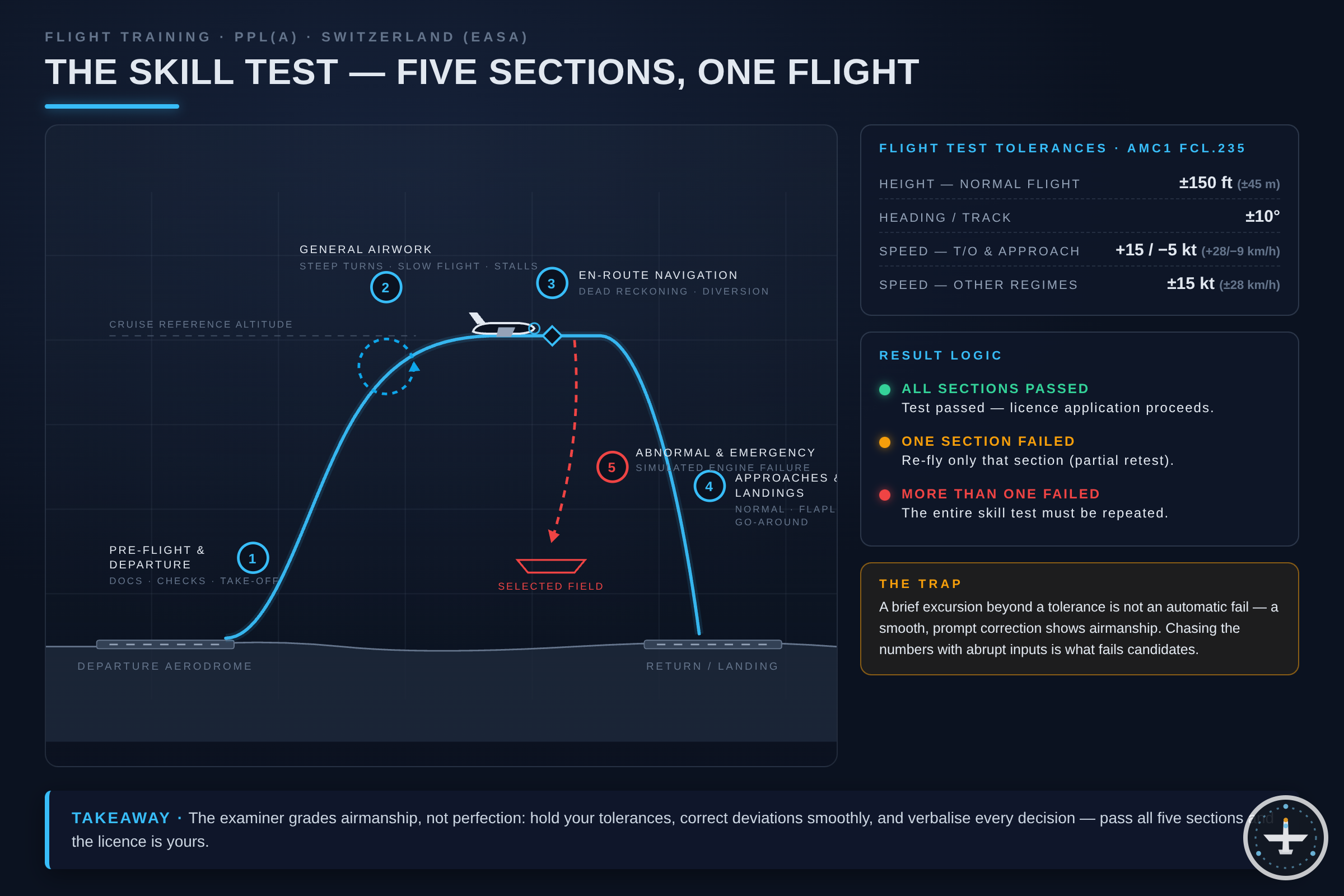
What is the Skill Test?
The Skill Test is the practical examination at the end of your PPL(A) training, regulated under FCL.235 and AMC1 FCL.235. It consists of an oral section and a test flight with a Flight Examiner (FE) authorised by BAZL. The objective: you demonstrate that you can operate an aircraft safely and to standard — as sole responsible PIC.
Prerequisites before the Skill Test:
- All 9 theoretical knowledge examinations passed (valid for 24 months)
- At least 45 flight hours completed (including 25 dual, 10 solo incl. 5 solo cross-country)
- Recommendation from your Head of Training (HT) or flight instructor
- Valid Medical Class 2
- FRTOL (radiotelephony licence) if you intend to communicate in English or German
Structure of the Examination Day
1. Briefing & Oral (approx. 1–2 hours)
The FE begins with a document check: logbook, medical certificate, proof of theoretical knowledge, flight school records. The oral section then covers:
- Flight preparation: Weather (METAR, TAF, GAFOR, SIGMET), NOTAMs, route planning, mass & balance, performance (TODR/LDR), fuel calculation
- Aircraft systems: Systems of your type (engine, electrical, avionics, emergency equipment)
- Regulations: Swiss airspace structure, VFR minima, flight plan, entry procedures
- Emergency procedures: What do you do in the event of engine failure, fire, or radio failure?
Tip: Present your documents in a clear, organised manner — POH, Flight Manual, JeppView/SkyDemon, navlog. A disorganised briefing sets the tone for the entire flight.
2. The Test Flight (approx. 1.5–2.5 hours)
You fly the entire mission as PIC. The FE is a passenger, not a co-pilot. They will only intervene if safety is at risk.
The Sections in Detail
The Skill Test is divided into Sections 1–5 (Section 6 applies only to SEP land with water/complex endorsement). You must pass every section — if you fail one, you may be required to re-sit only that section.
Section 1: Pre-Flight Operations & Departure
- Mass & balance, performance calculation
- Pre-flight inspection
- Engine start, taxi, run-up
- Take-off (normal, short field, soft field at FE's discretion)
- Climb-out, departure procedure
Section 2: General Airwork
- Steep turns (45° bank, left and right)
- Stalls: clean stall, stall in landing configuration, approach-to-landing stall (where applicable)
- Recovery from unusual attitudes (nose-high, nose-low) — sometimes with foggles (simulated IMC)
- Basic instrument flying (minimum 5 minutes under foggles): straight and level, turns, climbs and descents
Section 3: En-Route Procedures
- Flight according to navlog on a pre-planned route
- Position reports, radio communication with FIS/Tower
- Diversion: the FE states "weather ahead, divert to XY" — you must recalculate heading, distance, time, and fuel in flight
- Lost procedure (simulated disorientation — how do you re-establish your position?)
Section 4: Approach & Landing Procedures
- VFR arrival at an aerodrome (possibly unfamiliar)
- Circuit/traffic pattern
- Various landings: normal, short field, flapless, glide approach (engine at idle)
- Go-around from various stages of the approach
Section 5: Abnormal & Emergency Procedures
- Engine failure after take-off (EFATO) — often simulated shortly after lift-off
- Engine failure in cruise → forced landing in a field
- Fire, electrical failure, radio failure
- Precautionary landing
Assessment Criteria
The FE assesses against defined tolerances (AMC1 FCL.235):
- Altitude: ±150 ft in general, ±100 ft on approach
- Heading: ±10°
- Speed: ±10 kt
- Steep turns: altitude ±100 ft, bank ±5°
More important than raw numbers, however, is your airmanship: lookout, checklist discipline, decision-making, and communication. An FE will be lenient on borderline tolerances if you demonstrate clear thinking and good communication. Poor lookout or skipped checks will attract closer scrutiny.
How to Prepare
4–6 weeks before:
- Complete a mock check with your flight instructor (full mission, full sequence)
- Revise theory — especially regulations, performance, and meteorology
- Know your aircraft's POH thoroughly (V-speeds, limitations, emergency procedures)
1–2 weeks before:
- Practise manoeuvres specifically: forced landing, stalls, steep turns
- Train navigation with diversion — on the chart and in the air
- Ensure radio phraseology is fluent and confident
The day before:
- Check weather and NOTAMs
- Organise your documents
- Get to bed early. Flying tired is flying poorly.
On examination day:
- Arrive on time and eat a proper meal
- If you make a mistake: acknowledge it, correct it, and move on. Do not try to hide it.
If You Fail
No drama — it happens. Three scenarios:
- Partial Pass: You passed most sections but failed one. You must re-sit only that section within 6 months; after that, a complete re-test is required.
- Fail: Multiple sections not passed. A complete re-test is required after additional training.
- Fail due to a safety violation: The FE terminates the test. Serious, but recoverable — debrief thoroughly with your FI to understand what went wrong.
After a fail, BAZL and your flight school will typically recommend a number of additional training hours, documented in your logbook, before you sit the test again. There is no fixed waiting period, but three consecutive failed attempts require additional training with a documented recommendation.
Costs (Indicative Figures, Switzerland)
- FE fee: CHF 400–700 for the Skill Test
- Aircraft hire: CHF 250–400/hour depending on type × approx. 2.5 hours
- BAZL licence issuance fee after passing: approx. CHF 200–300
Realistic total: CHF 1,500–2,000 for the examination day including licence application.