What This Is About — and What It Is Not
This article is aimed at helicopter candidates pursuing their PPL(H) in Germany under LBA oversight. The theory syllabus under EASA Part-FCL covers nine subjects: Air Law, Human Performance, Meteorology, Communications, Principles of Flight (Helicopter), Operational Procedures, Flight Performance and Planning, Aircraft General Knowledge, and Navigation. Exams are sat at the LBA or an authorised facility, typically as multiple-choice computer-based tests.
What you will not find here: claims that theory "has to be fun" or that there is a secret shortcut. There is none. What does exist are learning methods that demonstrably outperform others — and those are exactly what we will look at.
When Should You Start?
Rule of thumb: begin the theory before, or at the latest in parallel with, your first flight lesson. Three reasons:
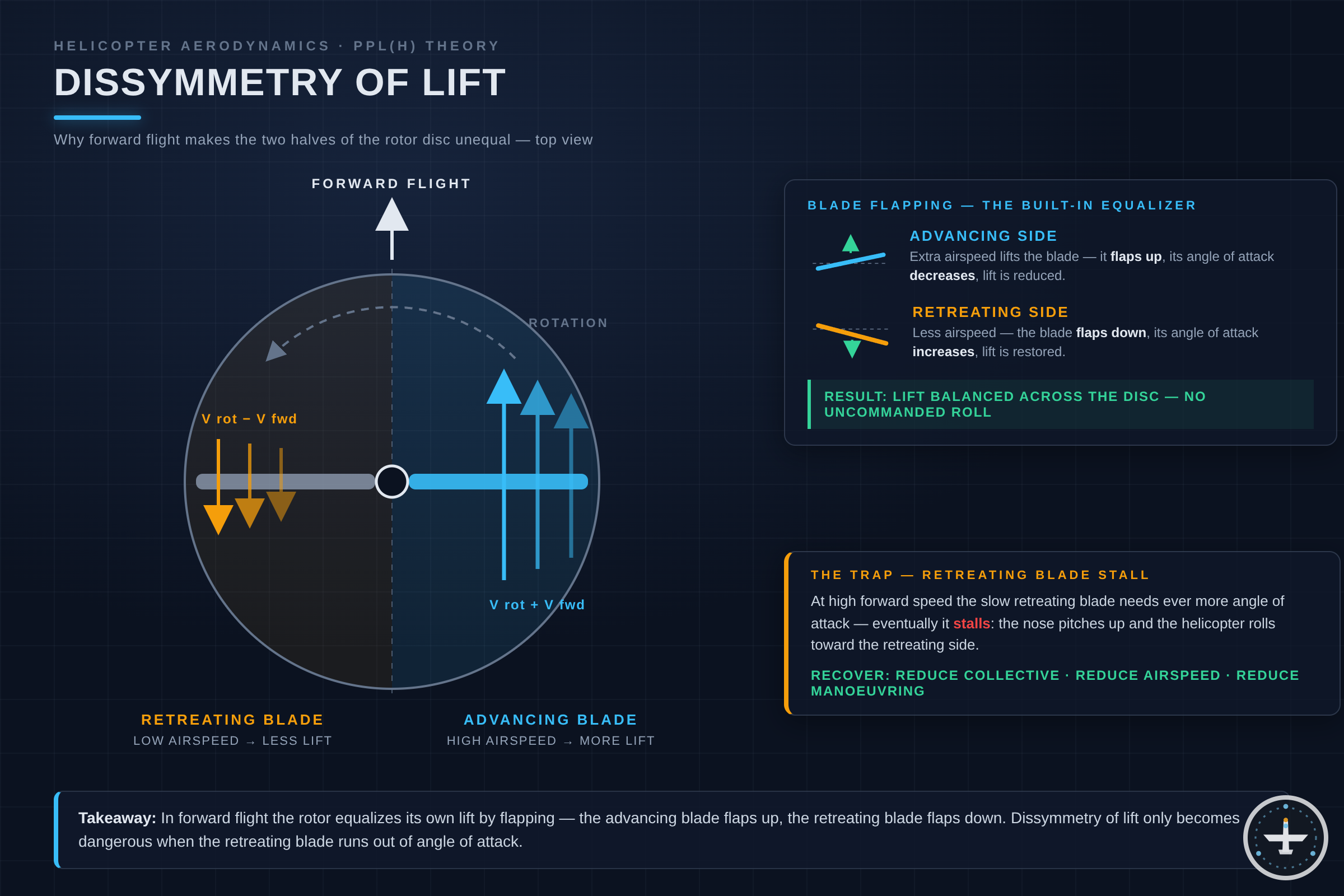
- Subjects such as Principles of Flight (Helicopter), Meteorology, and Air Law make practical flying safer and more meaningful. You will understand Settling with Power or Retreating Blade Stall far better once you have already worked through the theory on the ground.
- EASA requires that all theory examinations are completed before the Skill Test. Starting late blocks your progress towards the practical exam.
- Theoretical knowledge has a half-life. If you learn everything 18 months before the checkride and then never revisit it, much of it will be gone. Better to study continuously, in small doses.
In practice: as soon as you have enrolled at an ATO/DTO, start with Air Law and Human Performance. Both require little prior knowledge and give you the regulatory framework.
How Many Hours Per Week?
EASA requires a minimum of 100 hours of theoretical instruction for the PPL(H) (including self-study as defined by the ATO syllabus). Realistically, most candidates need 150–250 hours to reach exam readiness, depending on their educational background.
Spread over a period of 4–8 months, that works out to:
- Minimum option: 4–5 hours per week over 8 months.
- Standard option: 7–10 hours per week over 5–6 months.
- Intensive option: 15+ hours per week over 2–3 months (e.g. a full-time course).
More important than the total number of hours is frequency. Six sessions of 45 minutes per week beat a four-hour marathon session on Sunday. The brain consolidates knowledge overnight — daily repetition exploits this effect.
Spaced Repetition: The Tool That Makes the Difference
Spaced Repetition (distributed practice) is the most thoroughly researched learning technique for factual knowledge. The principle: you review a piece of information at exactly the moment you are about to forget it. Each successful review extends the interval.
Concretely for PPL(H) theory:
- Day 1: Study new material (e.g. ICAO Annex structure, Air Law).
- Day 2: Short review, 5–10 minutes.
- Day 4: Review again, using questions rather than reading.
- Day 10: Review in an exam-question session.
- After 3 weeks, then after 6 weeks: Refresher review.
Apps such as Anki, or integrated SR systems in learning platforms (Aero.Academy uses this principle as well), handle the interval scheduling for you. You only need to work through the due cards daily — typically 15–25 minutes.
What you should not do: passively re-read textbook chapters multiple times. Decades of research show that re-reading is the least effective widely-used study method. It feels productive because the text looks familiar — but familiarity is not the same as retrievability.
Active Recall Instead of Reading
Active recall means retrieving information from memory rather than merely recognising it. Practical implementation:
- Attempt exam questions before reading the textbook. This sounds counterintuitive, but it works. Try to answer the question first, then look it up. The initial failure anchors the correct answer more deeply.
- Explain it yourself. Explain aloud — to yourself or a fellow student — the translational tendency produced by the tail rotor, or the difference between QNH and QFE. Where you hesitate is where the gap is.
- Sketches from memory. Draw the power-required curve of a helicopter without looking at the original. Compare afterwards.
- Mock exams under exam conditions. At least three complete practice exams per subject, with a time limit and no aids.
Subject Order — A Pragmatic Recommendation
There is no regulatory requirement, but the following order has proven effective:
- Air Law (establish the regulatory framework)
- Human Performance (concise and self-contained)
- Principles of Flight Helicopter (the core of helicopter theory)
- Aircraft General Knowledge
- Meteorology
- Navigation
- Flight Performance and Planning
- Operational Procedures
- Communications (last, so it stays fresh for the radiotelephony exam BZF/AZF)
Common Mistakes
- Starting everything at once. Results in superficial knowledge across the board. Better: two subjects in parallel, finish them, then move on.
- Rote-learning exam questions. The LBA question banks rotate, and a memorised "C" is useless in the aircraft. Understand the concepts.
- No buffer time. Plan 2–3 weeks before the exam date for pure revision — no new material.
- Separating theory from flying. After every flight lesson, ask your FI what the theoretical background behind the manoeuvre is. Linked knowledge lasts longer.
A Realistic Weekly Plan
- Mon/Wed/Fri: 45 min new material + 15 min SR cards
- Tue/Thu: 30 min SR cards + 30 min exam questions
- Sat: 90 min mock exam or in-depth topic
- Sun: rest, or 30 min summary review
That amounts to roughly 7 hours per week. At that pace you will work through all nine subjects in approximately 6 months — provided you stay consistent.