What This Is About
The PPL(H) — the private pilot licence for helicopters under EASA Part-FCL — requires you to pass theory exams in nine subjects at BAZL in Switzerland: Air Law, Human Performance, Meteorology, Communications, Principles of Flight (Helicopter), Operational Procedures, Flight Performance and Planning, Aircraft General Knowledge (Helicopter), and Navigation. The pass mark is 75% per subject. The workload is not enormous compared to the ATPL, but large enough that poor study strategies can cost you months.
When to Start
Rule of thumb: begin theory in parallel with practical training, ideally as soon as you have completed your first flight hours. Two reasons:
- Practical experience anchors theory. Once you have felt Translational Lift, you understand Principles of Flight differently.
- Theory exams must be completed before the Skill Test. If you progress faster in practical training than in theory, you will end up waiting on yourself.
Realistic timeframe: 6 to 12 months for the full theory, depending on weekly hours. If you work full time and study on the side, plan for 9–12 months.
How Many Hours per Week?
Plan for 5–8 hours per week as the minimum for consistent progress. Fewer than 3 hours means you will effectively restart each session — forgetting outpaces learning at that rate.
A proven split:
- 3–4 shorter sessions of 45–60 minutes rather than one marathon session at the weekend.
- 15–20 minutes of daily review (e.g. a question app on the commute) to keep the repetition loop running.
- One longer block (2 hours) per week for new theory chapters.
Spaced Repetition — Why It Works
Spaced repetition is not hype; it is measurably effective. The principle: you review material at increasing intervals — today, in 2 days, in 1 week, in 3 weeks, in 2 months. Each successful repetition extends the interval; each wrong answer resets it.
Applied to PPL(H) theory:
- Use a flashcard or question system that runs the algorithm for you (Aero.Academy, Anki, or equivalent).
- Focus on questions you answer incorrectly. Cards you have answered correctly three times do not need attention again for weeks.
- Mix subjects. Studying only Meteorology for one week and only Air Law the next means you forget Meteorology during Air Law. Daily interleaving is more efficient.
Active Recall Instead of Passive Reading
The most common mistake: read the textbook, highlight it, feel good about it — and know nothing in the exam. Reading builds recognition, not retrieval. Exams test retrieval.
What actually works:
- Answer questions before you look at the solution. Even if you have to guess.
- Self-explanation: close the book and explain Translational Lift, Retreating Blade Stall, or the structure of a METAR out loud or in writing from memory.
- Sketching: vector diagrams, weather charts, angles of attack — drawing it means remembering it.
- Mock exams under time pressure: simulate the exam format regularly, not just in the final days before the date.
Subject-Specific Tips for PPL(H)
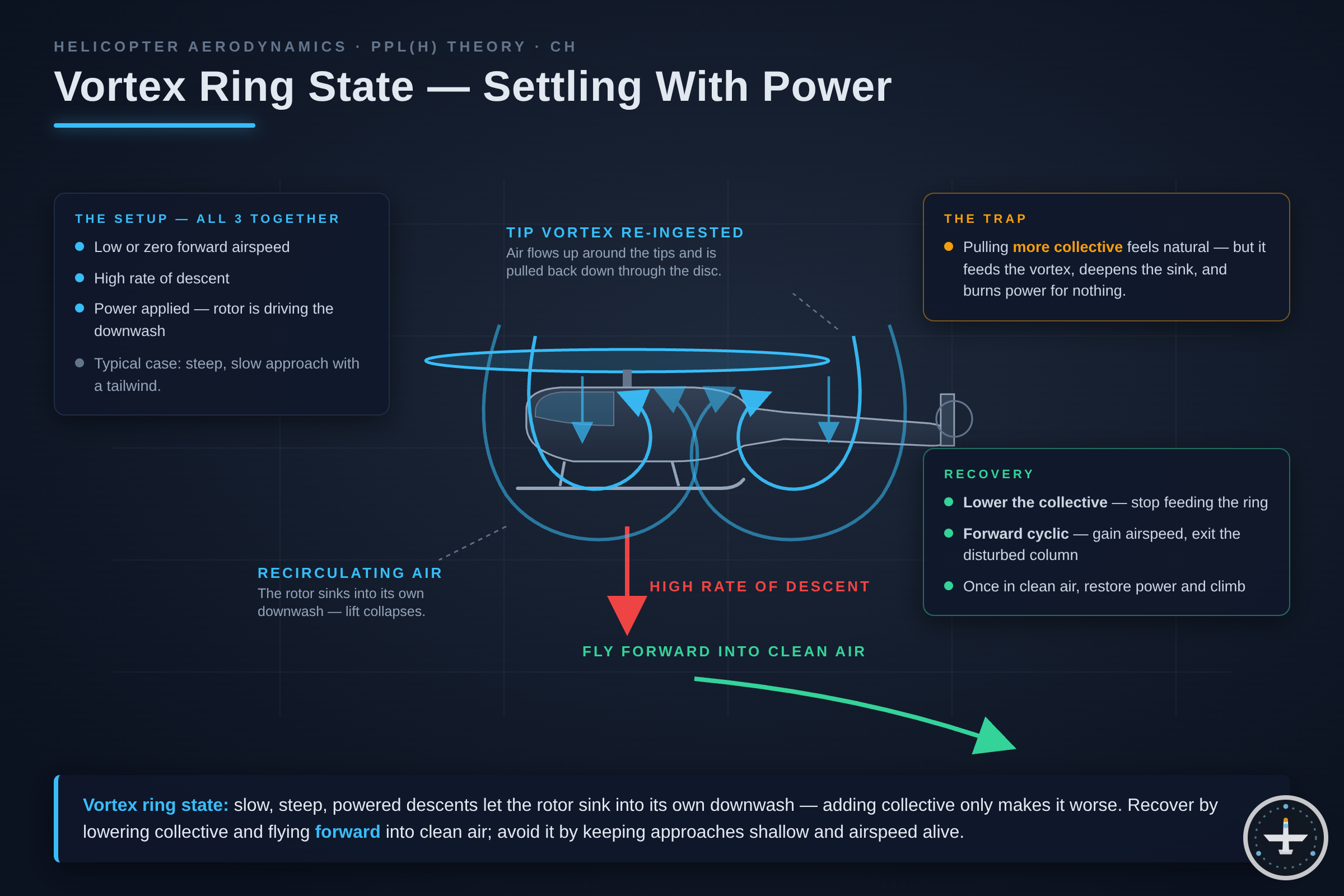
- Principles of Flight (Helicopter): The subject most candidates underestimate. Autorotation, Vortex Ring State, Dissymmetry of Lift — understand the mechanics; do not just memorise answers.
- Aircraft General Knowledge (Helicopter): Focus on the systems of the type your school actually operates (R22, R44, Cabri G2, Schweizer/H269). This also helps in practical training.
- Air Law: Dry, but manageable with flashcards. Practise Swiss-specific content (BAZL, VFR airspace CH, phraseology rules) separately.
- Meteorology: Alpine phenomena — Foehn wind (Föhn), Bise, mountain waves — are exam-relevant in Switzerland and operationally critical in real flying.
- Navigation: Calculation tasks require routine. Pick up the flight computer (CRP-1 / E6-B) regularly; do not just understand it in theory.
A Realistic Weekly Plan
Example for a week with approximately 6 hours of study time:
- Mon/Wed/Fri 20 minutes each: question app, spaced repetition.
- Tue 60 minutes: read new chapter + take notes.
- Thu 60 minutes: actively review the same chapter, work through related questions.
- Sat 90–120 minutes: longer block for calculation subjects (Navigation, Performance) or a mock test.
- Sun rest or a short review.
Before the Exam
Plan the final 2–3 weeks before each exam date as a consolidation phase: no new content, only mock exams and targeted gap-filling. If you are consistently scoring above 85% in practice exams, you have a buffer for exam day. Below 80% — postpone. The effort of registering for and sitting a resit at BAZL costs more than two additional weeks of study.
What to Avoid
- Last-minute cramming: Works for a university test; does not work for nine subjects.
- Watching YouTube only: A good supplement, but no substitute for question-and-answer training.
- Old question banks without understanding: EASA questions are rotated and adapted. Memorising answer patterns alone will fail you on variants.
- Studying in isolation: Connect with other helicopter candidates. Explaining concepts to others is the most effective form of learning.