What This Is About
For the PPL(H) – Private Pilot Licence Helicopter – you must pass nine theoretical subjects with Austro Control in Austria: Air Law, Human Performance, Meteorology, Communications, Aerodynamics (helicopter-specific), Operational Procedures, Flight Performance & Planning, General Aircraft Knowledge, and Navigation. The examinations are multiple-choice, you have 18 months per sitting to complete all subjects, and you must achieve at least 75% in each subject.
This is achievable – but only if you take your study methodology seriously. Helicopter candidates face an additional challenge: the aerodynamic fundamentals differ substantially from fixed-wing (rotor aerodynamics, autorotation, Vortex Ring State, translational lift). These topics require genuine understanding, not just memorisation.
When to Start?
Rule of thumb: begin theory before you start intensive flight training, ideally 2–3 months before your first solo. Reasons:
- Air Law, Meteorology, and Communications are prerequisites for making sense of what you experience in the helicopter.
- Studying in parallel with flight training links theory and practice – reinforcing both.
- The 18-month deadline runs from your first passed examination. Starting examinations too early and then taking breaks puts you under pressure.
Realistic timeline from start to final theory examination: 4–9 months, depending on your weekly workload.
How Many Hours Per Week?
Plan for 6–10 hours per week as a solid baseline. If you work full-time, 6 hours per week gets you through the material in around 8 months. With 10–12 hours you can finish in 4–5 months.
More important than the total number of hours is the distribution:
- 30–45 minutes daily beats 6 hours once a week. The brain consolidates knowledge during sleep – daily repetition takes advantage of this.
- Plan at least four study days per week, preferably five to six.
- One longer block (90–120 minutes) per week for new material, the rest for review.
Spaced Repetition: Tool Number One
Spaced Repetition is well supported by research (Ebbinghaus, later Bjork): you review material at increasing intervals, just before you would forget it. This anchors knowledge in long-term memory rather than just short-term recall.
In practice, this means:
- A new card or question reappears after 1 day, then after 3 days, then 1 week, 2 weeks, 1 month.
- Incorrectly answered cards are pushed back and appear more frequently.
- Cards you answer correctly appear less often – you don't waste time on material you already know.
Platforms such as Aero.Academy automate this. If you use Anki manually, budget around 20–30 minutes per week for card maintenance.
Important: Spaced Repetition works best for facts (frequencies, definitions, limits, ICAO phonetic alphabet, V-speeds). For conceptual topics such as weather interpretation or rotor aerodynamics, you additionally need active practice.
Active Recall Instead of Re-reading
The most common beginner mistake: reading through the script three times and assuming you know it. Re-reading creates a feeling of familiarity – but not retrieval fluency. In the examination you must retrieve, not merely recognise.
Practical techniques:
- Closed-book recall: close the script, write down everything you can remember on a blank sheet of paper, then compare.
- Questions instead of notes: convert learning content into questions. Instead of writing "Density altitude = pressure altitude + (ISA deviation × 120 ft)", write "How do I calculate density altitude?".
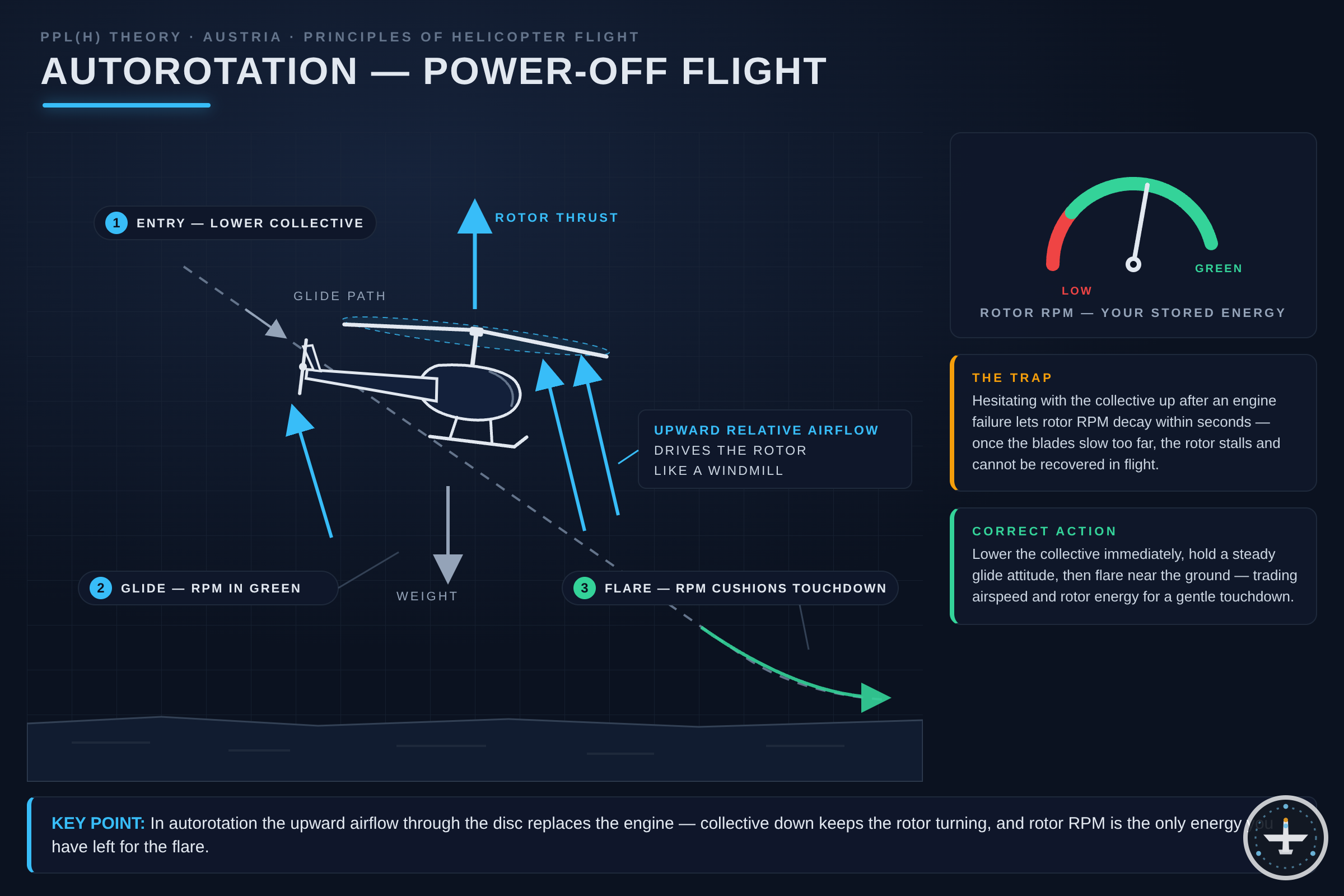
- Self-explanation: explain autorotation to a non-aviation person in three sentences. Where you hesitate, that is your gap.
- Mock examinations under time pressure – at least two per subject before the actual sitting.
Subject-Specific Notes for PPL(H)
- Aerodynamics: invest above-average time here. Concepts such as Dissymmetry of Lift, coning, ground resonance, and Settling with Power are relevant both for the examination and for safety.
- Meteorology: practise reading METAR/TAF daily – ideally real reports from LOWW, LOWS, or your home aerodrome.
- Navigation: even if you fly primarily VFR and by visual reference, plotting on the ICAO chart is mandatory. Only practice with a chart, ruler, and plotter will help here.
- Air Law: dry material, but heavily fact-based – ideal for Spaced Repetition.
Sample Weekly Schedule
- Mon, Wed, Fri: 30 min card repetition + 30 min new material
- Tue, Thu: 30 min card repetition
- Sat: 90 min in-depth review / practice questions / mock examination
- Sun: rest or light review
That comes to around 7 net hours per week. Keep this up and you will be examination-ready in 5–6 months.
What to Avoid
- Multi-subject chaos: study a maximum of two subjects in parallel, otherwise content starts to overlap.
- Sitting examinations before you are ready: Austro Control counts every failed attempt. After three failed attempts per subject you must complete additional remedial instruction hours before you may sit again.
- Drilling the question bank exclusively: you may pass – but in the cockpit you will need the knowledge for real. Understand the why.
Conclusion
Effective theory study is not a matter of talent – it is a matter of method. Spaced Repetition for facts, active recall for understanding, short daily sessions instead of weekend marathons. Stick to this approach and you will get through the Austro Control examinations at 6–10 hours per week without stress – and you will have the foundation in the cockpit on which sound decisions are built.