What This Is About
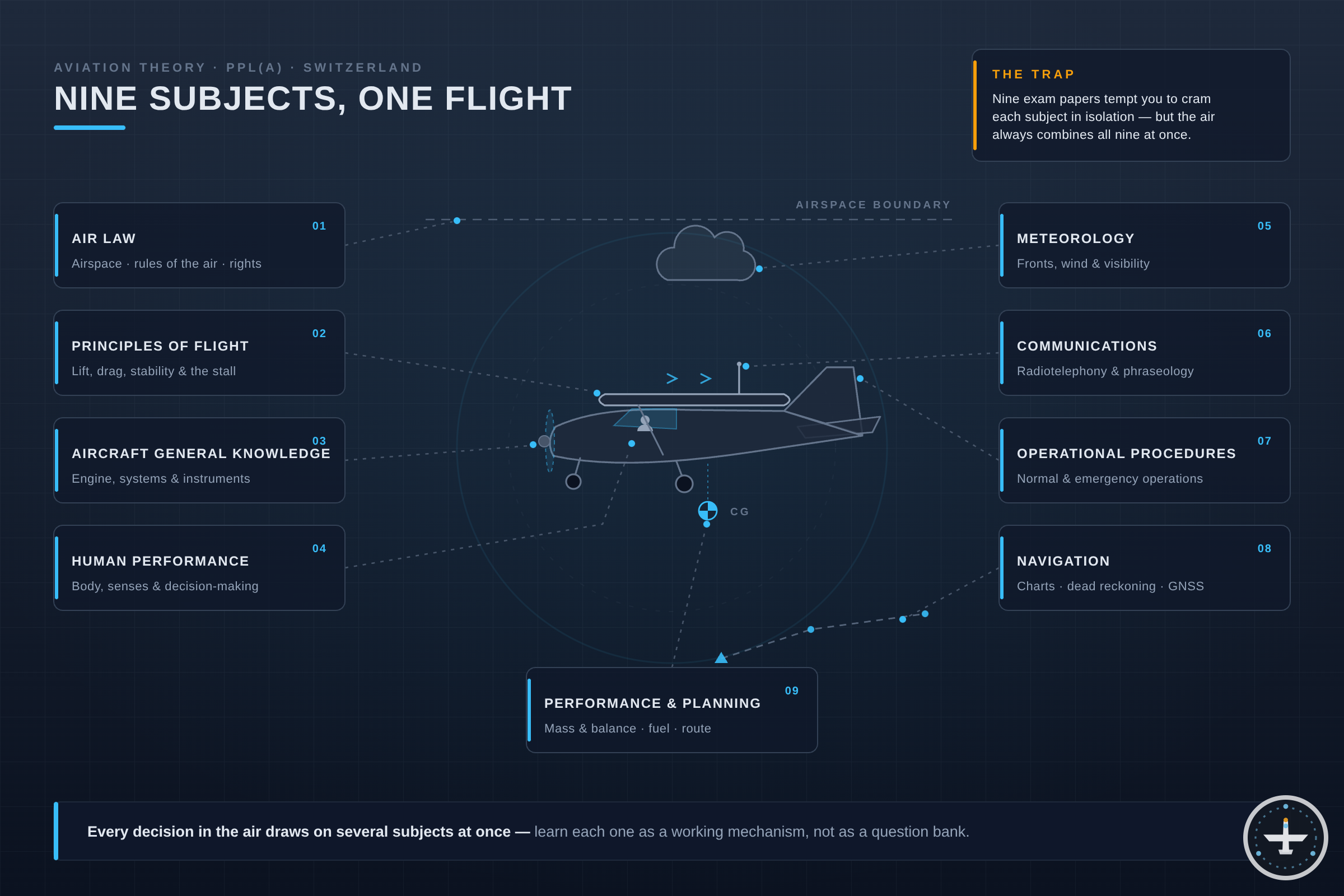
For the PPL(A), BAZL requires exams in nine subjects: Air Law, Human Performance, Meteorology, Communications, Principles of Flight, Operational Procedures, Flight Performance and Planning, Aircraft General Knowledge, and Navigation. Each exam is taken individually on the BAZL exam system, with a passing threshold of 75% per subject. You must complete all nine within 18 months of passing your first exam, and you have a maximum of four attempts per subject.
This means you need a study strategy that anchors knowledge long-term – not just for exam day.
When to Start?
Ideally, begin theory in parallel with your first flight lessons, not after. Reasons:
- Topics such as Principles of Flight, Meteorology, and Navigation become immediately concrete in the cockpit. You understand them faster when you are also flying them.
- Your flight instructor assumes foundational knowledge (e.g. VFR minima, airspace classes) from the very first lessons.
- The 18-month deadline only starts with your first passed exam – so you can study ahead at your own pace.
Realistically: plan for 6 to 12 months for the complete theory, depending on your weekly workload.
How Many Hours Per Week?
A rule of thumb for working students:
- Minimum: 5 hours per week → approx. 12 months to completion.
- Comfortable: 8–10 hours per week → approx. 6–8 months.
- Intensive: 15+ hours per week → 3–4 months, but with a high forgetting rate if you do not study systematically.
More important than total duration is distribution: four sessions of 60 minutes per week clearly outperform a single 4-hour weekend marathon. Your brain consolidates knowledge during sleep and through repetition, not in isolated sessions.
Spaced Repetition – Why It Works
Spaced Repetition uses the forgetting curve identified by Hermann Ebbinghaus: without review, you forget around 70% of what you learned within 24 hours. However, if you retrieve a piece of information just before you would forget it, the memory interval grows exponentially.
In practice, a new question appears:
- on the same day,
- after 1 day,
- after 3 days,
- after 1 week,
- after 2–3 weeks,
- after 1–2 months.
If you answer incorrectly, the question drops back to step 1. If you answer correctly, it advances. These algorithms are standard in tools such as Anki – and on the Aero.Academy platform they are directly tailored to the ECQB/BAZL question bank.
Active Recall Instead of Passive Reading
The most common mistake: read the textbook, tick off the chapter, move on. Passive reading creates the feeling of knowing something – without you actually knowing it. Active recall means:
- Answer questions before looking at the solution. Even if you are unsure: guess, formulate an answer. The retrieval process itself strengthens memory (Testing Effect).
- Explain the concept out loud. If you cannot explain the Bernoulli effect or QNH/QFE/QNE in your own words, you have not truly understood it.
- Sketch it. Airspace structure, cloud types, carburettor diagram – draw from memory, then compare.
- Mix subjects. Interleaving (mixed topics in one session) improves differentiation. 30 minutes of Meteorology + 30 minutes of Navigation beats 60 minutes on a single subject.
A Concrete Weekly Plan
A proven schedule for approximately 8 hours per week:
- Mon/Wed/Fri evenings: 60 minutes each – new content (read theory, understand concepts).
- Tue/Thu evenings: 45 minutes each – Spaced Repetition drill (work through due questions).
- Saturday: 2 hours – mock exam in one subject under exam conditions.
- Sunday: rest, or light review during a walk (audio flashcards).
Order of Subjects
There is no prescribed order from BAZL, but the following sequence makes didactic sense:
- Air Law and Communications first – you need them immediately on the radio and in controlled airspace.
- Meteorology, Principles of Flight, Aircraft General Knowledge – the physical foundations.
- Human Performance and Operational Procedures – shorter subjects, often manageable alongside others.
- Navigation and Flight Performance and Planning last – they build on everything else and are the most demanding exams.
Avoiding Common Mistakes
- Drilling the question bank without understanding. BAZL questions rotate and are updated, and rote memorisation will not help you in the cockpit.
- Weeks of gaps between study sessions. Consistency beats intensity.
- Trying to learn everything at once. Build in buffer time for work and weather-related stress.
- Booking your exam date too late. Set a deadline per subject – without a fixed date, you will keep postponing.
Mental Preparation
Theory is not an end in itself. Every question has an operational background: why does a critical angle of attack exist? What happens if you fly into a TCU? If you always ask "when will I need this in flight?" while studying, the material sticks better – and you will become a safer pilot, not just an exam graduate.