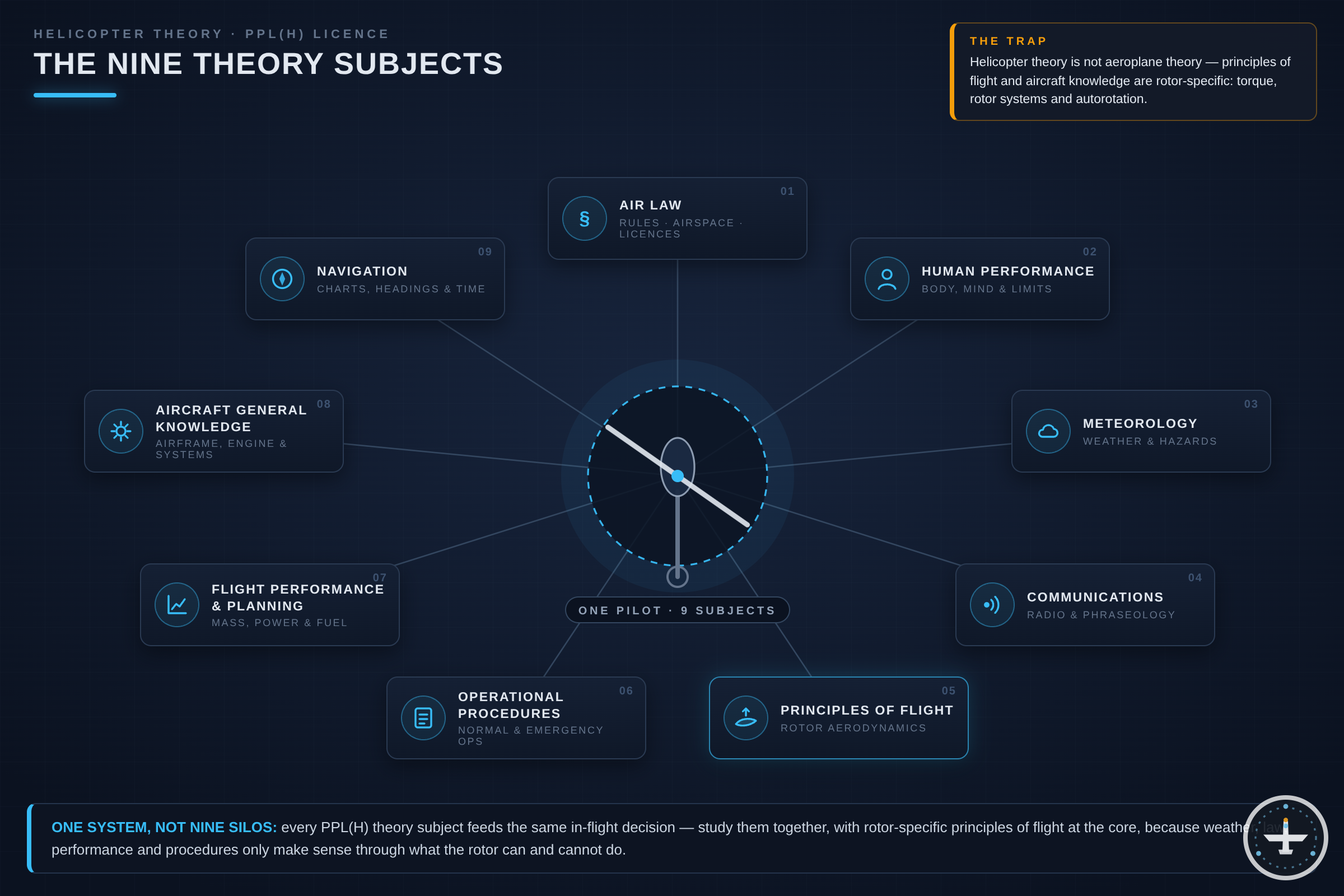
Why nine subjects?
EASA prescribes the same set of subjects for all PPL licences — whether for fixed-wing aircraft, helicopters, or balloons. As a helicopter candidate, this means the subject list is identical to the PPL(A), but the content is in some cases strongly helicopter-specific. Particularly in Principles of Flight, Aircraft General Knowledge, and Performance, the questions differ significantly from the fixed-wing variant.
The LBA exam is typically taken at an approved examination centre as a multiple-choice test. Pass mark per subject: 75 %. You have 18 months from the first examination attempt to complete all subjects, with a maximum of four attempts per subject.
The nine subjects in detail
1. Air Law
This subject covers the regulatory framework: ICAO Annexes, EASA regulations (in particular Part-FCL, Part-NCO, SERA), national LBA requirements, airspace structure, light signals, VFR minima, and pre-flight document checks. Topics such as licence validity, medical requirements, and procedures in emergency situations are also included.
Typical questions: What visibility requirements apply in Class E airspace below FL100? When do you need an air traffic control clearance?
2. Aircraft General Knowledge (AGK)
The technical foundation of your helicopter. For PPL(H) this means: rotor systems (fully articulated, semi-rigid, rigid), tail rotor or NOTAR/Fenestron, powerplant (piston or turbine), gearbox, autorotation from a systems perspective, hydraulics, electrics, and instruments (including gyroscopic instruments and their errors).
Helicopter-specific topics include Mast Bumping, Ground Resonance, and Dynamic Rollover — these appear in both AGK and Principles of Flight.
3. Flight Performance & Planning
Mass and balance calculations, performance charts (Hover IGE/OGE, climb performance, effects of altitude and temperature), fuel planning, and flight preparation. For the helicopter, hover performance is the central topic: Density Altitude, HOGE ceiling, and the effects of wind are all exam-relevant.
You will typically work with real performance charts — the tasks are computational, not purely theoretical.
4. Human Performance & Limitations
Physiology and psychology of flight: hypoxia, hyperventilation, trapped gas, spatial disorientation, the vestibular system, night vision, noise and vibration (particularly relevant for helicopters), G-loading, fatigue, stress, decision-making, and Crew Resource Management at single-pilot level.
Rote memorisation is not enough — you need to understand the underlying mechanisms, as many questions present scenarios.
5. Meteorology
Atmosphere, pressure, wind, cloud formation, precipitation, icing, thunderstorms, fog, frontal systems, mountain weather, reading weather charts, and decoding METAR and TAF. Especially relevant for helicopter pilots: local wind systems, turbulence in the lee of obstacles, whiteout/brownout, and icing risk (because you often fly at low level).
6. Navigation
Chart reading (ICAO charts 1:500,000), dead reckoning, compass and compass turning errors, time calculations, radio navigation (VOR, DME, ADF — even though ADF is becoming obsolete), GNSS fundamentals, terrestrial magnetism, and map projections. In practice you must be able to use a navigation computer (Whiz Wheel) or its electronic equivalent.
7. Operational Procedures
Standard procedures and special cases: ICAO procedures, noise abatement, fuel and oxygen systems in operation, emergency procedures, wake turbulence (including from other helicopters), Search and Rescue, handover to SAR. Helicopter-specific topics such as external load operations are touched upon (level of detail limited for PPL).
8. Principles of Flight (PoF)
For PPL(H) this is a central and often underestimated subject. Content includes: rotor blade aerodynamics, lift distribution, dissymmetry of lift, flapping, lead/lag, coning, translational lift, settling with power (Vortex Ring State), Retreating Blade Stall, autorotation from an aerodynamic perspective, and torque compensation.
This is where the greatest difference from the PPL(A) lies. Allow plenty of study time.
9. Communications (Comms)
VFR radiotelephony: phraseology in German and English, frequency changes, standard calls, emergency procedures (MAYDAY, PAN-PAN), transponder codes, and radio failure. Note: the practical radiotelephony exam (BZF/AZF) is a separate examination at the LBA — the theory here covers the EASA fundamentals but does not replace a radiotelephony certificate.
How to approach your studies
- Order: Many candidates start with Air Law and Comms, as they are quickly digestible. The heavier subjects (PoF, AGK, Performance) require weeks of study.
- Study groups: Met and Nav are easier to learn through discussion and working with real charts and weather products.
- Question banks: Practise with up-to-date tools based on the EASA question bank. Aero.Academy adapts the difficulty level to your weak areas.
- Link theory and practice: Once you start flying, PoF and Performance concepts will consolidate much faster.
Exam format at the LBA
- Multiple choice, typically 3–4 answer options
- Number of questions per subject: between 12 (Comms) and 32 (Met)
- Total duration for all nine subjects: approximately 9 hours, which can be split across multiple sittings
- Pass mark: 75 % per subject
- Validity of passed theory: 24 months for the practical test
Exact examination fees vary by test centre — expect approximately €15–25 per subject. Current rates can be found directly at the LBA or at your ATO.