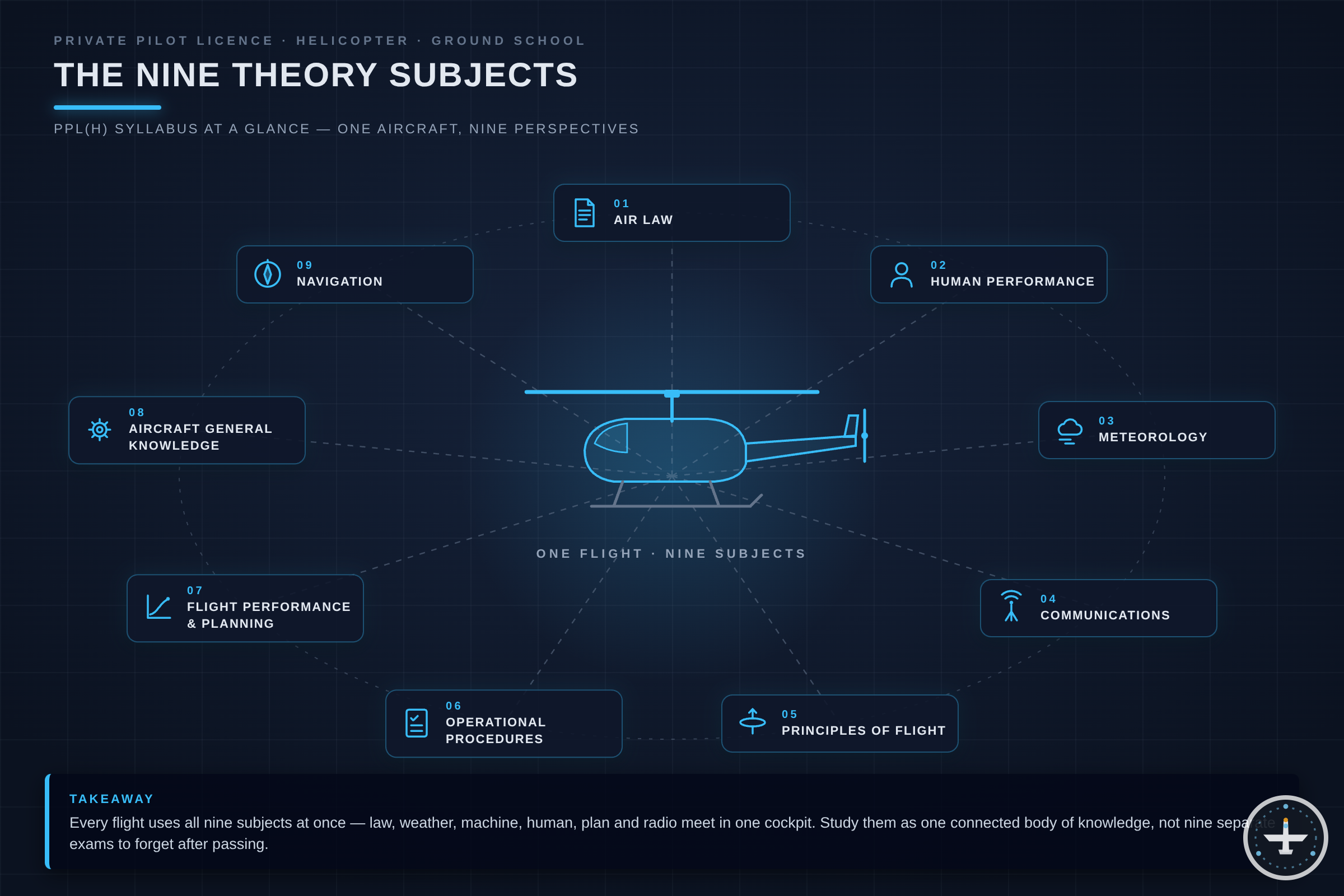
The Nine Subjects at a Glance
EASA Part-FCL defines the following nine theory subjects for the PPL(H), all examined at BAZL as multiple-choice tests:
- Air Law
- Aircraft General Knowledge (AGK)
- Flight Performance and Planning
- Human Performance and Limitations
- Meteorology
- Navigation
- Operational Procedures
- Principles of Flight – Helicopter
- Communications (VFR)
Each subject is examined separately. You must achieve at least 75 % per subject. Once passed, the result is valid for 24 months; within that period you must complete the practical Skill Test.
1. Air Law
This subject covers the legal framework within which you operate: ICAO Annexes (in particular Annex 2 Rules of the Air), EASA Part-FCL for licences, Part-MED for medical fitness, SERA (Standardised European Rules of the Air), airspace structure, ATS services, search and rescue, and accident reporting. For Switzerland, BAZL-specific topics are added – such as VFR minimum heights over populated areas and national rules on off-airfield landings with helicopters (Aussenlandeverordnung).
2. Aircraft General Knowledge (AGK)
AGK covers the technical aspects of your helicopter:
- Airframe & Systems: rotor head types (fully articulated, semi-rigid, rigid), tail rotor vs. Fenestron/NOTAR, hydraulics, control via swashplate.
- Powerplant: piston engine fundamentals (e.g. Lycoming O-360 in the R22/R44) and basic turbine principles.
- Electrics, Instruments & Avionics: pitot-static system, gyroscopic instruments, magnetic compass errors.
- Mass and Balance: permissible CG range, loading diagrams.
Helicopter-specific topics of particular importance include Mast Bumping, low-G behaviour, and the mechanical principles of autorotation at the systems level.
3. Flight Performance and Planning
This subject requires practical calculation:
- Hover performance IGE/OGE (in ground effect / out of ground effect)
- HOGE and HIGE limits as a function of pressure altitude and temperature
- Height-Velocity diagram ("Dead Man's Curve")
- Fuel planning including reserves (minimum 20 minutes final reserve for VFR)
- Mass and balance calculation
Expect calculation tasks using performance charts from the POH of typical training helicopters.
4. Human Performance and Limitations
Physiology and psychology of flight: respiration, hypoxia, hyperventilation, pressure equalisation, the vestibular system and spatial disorientation, visual illusions (particularly relevant during helicopter approaches), stress, fatigue, and decision-making (DECIDE, IMSAFE). CRM fundamentals and the effects of medication and alcohol are also included.
5. Meteorology
One of the most extensive subjects:
- Atmospheric structure, standard atmosphere (ISA)
- Pressure, temperature, humidity, wind
- Cloud types, precipitation, icing
- Fronts and pressure systems
- Mountain weather – central for Switzerland: Foehn wind (Föhn), Bise, slope winds, rotors, lee effects
- Reading weather reports: METAR, TAF, SIGMET, GAFOR, GAMET
Helicopters are especially sensitive to low-level turbulence and to whiteout/brownout conditions – topics you need to understand thoroughly.
6. Navigation
VFR navigation using chart, compass, and clock:
- ICAO chart 1:500,000 (Switzerland)
- Magnetism, variation, deviation
- Dead reckoning, drift angle calculation
- Time-distance-fuel calculation
- GNSS fundamentals, RNAV concepts at VFR level
- Earth geometry: great circle, rhumb line
The navigation computer (CRP-1 / E6B) is required for the exam.
7. Operational Procedures
Procedures in day-to-day operations:
- Wake turbulence (including between helicopters and fixed-wing aircraft)
- Noise abatement procedures
- Emergency procedures: engine failure, hydraulic failure, tail rotor failure, Settling with Power, LTE (Loss of Tail-Rotor Effectiveness)
- Off-airfield landings, mountain flying procedures
- Dangerous goods transport fundamentals
In Switzerland, mountain operations (HEMS, sling loads) are a defining context – some procedures are covered in more detail here than elsewhere.
8. Principles of Flight – Helicopter
The core subject for helicopter candidates:
- Rotor aerodynamics: lift distribution, translational lift, Dissymmetry of Lift
- Blade flapping, coning, lead-lag
- Autorotation: energy balance, rotor RPM management
- Vortex Ring State (Settling with Power)
- Ground resonance and dynamic rollover
- Torque effect and compensation by the tail rotor
This subject is the most significant distinction from fixed-wing theory and is examined in corresponding depth.
9. Communications (VFR)
Radio theory and radiotelephony procedures in English (or the local language where permitted):
- Standard phraseology in accordance with ICAO Doc 4444 and SERA
- Structure of a radio call, Q-codes (QNH, QFE, QDM)
- Emergency procedures: Mayday, Pan-Pan, transponder codes 7500/7600/7700
- Light signals from the tower
The FCL language proficiency check is separate and does not form part of this theory examination.
Exam Format at BAZL
You sit the exams electronically at BAZL. For each subject:
- Multiple choice, three or four answer options
- Pass mark: 75 %
- Maximum four attempts per subject; all nine subjects must be completed within 18 months of the first attempt
- Validity of passed subjects: 24 months for the Skill Test
Current fees and registration procedures are available on the BAZL website – rates change occasionally, so no specific figures are given here.
Study Strategy
A sensible sequence: start with Air Law and Communications – these are the "reading subjects" with clearly defined rules. Then move to Principles of Flight and AGK, as they form the foundation for Performance. Leave Meteorology and Navigation until later, since they require ongoing practice. Operational Procedures and Human Performance can be fitted in flexibly.
Allow at least 100 hours of self-study, and more if you are studying alongside employment.