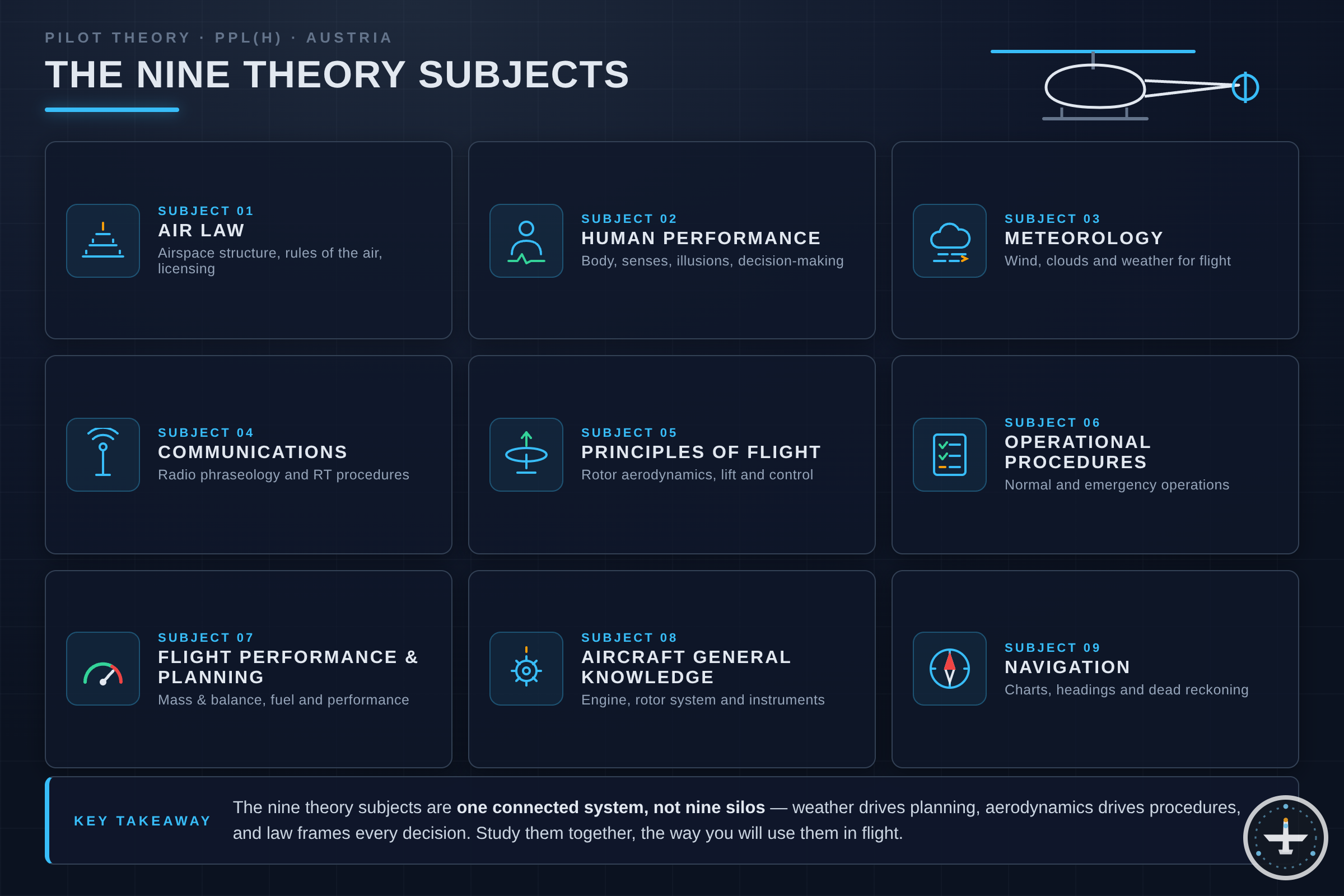
Why nine subjects?
EASA divides the PPL theory syllabus into nine thematic blocks. For the PPL(H) — the private pilot licence for helicopters — the same nine subjects apply as for the PPL(A), but with helicopter-specific content in the technical subjects. Examinations are conducted by Austro Control in multiple-choice format. You must achieve at least 75 % in each subject; failing to do so means the subject is not passed and must be retaken.
All nine subjects must be completed within 18 months of your first attempt. Once you have passed your final theory examination, you have 24 months to complete the practical skills test.
1. Air Law
This subject covers the legal foundations of aviation: ICAO Annexes, EASA regulations (in particular Part-FCL and SERA), airspace structure, VFR rules, licensing, medical requirements, and national specifics in Austria. Air Law is dry but manageable — a lot of memorisation, few comprehension questions. Pay particular attention to VFR minimum visibility requirements, airspace classes C, D, E and G, and ATZ/CTR regulations in Austria.
2. Aircraft General Knowledge (AGK)
AGK is the technical core subject. For the PPL(H) this covers:
- Airframe: rotor head types (fully articulated, semi-rigid, rigid), tail rotor, swashplate, pitch links.
- Engines: piston engine (common on training helicopters such as the R22 and R44) or turbine.
- Systems: hydraulics, electrics, fuel, cooling.
- Instruments: pitot-static system, gyroscopic instruments, engine and rotor instruments.
The subject is broad. If you are training on a Robinson, reading the POH alongside the theory material is well worth your time.
3. Flight Performance and Planning
This subject is calculation-based. Topics include: mass and balance (Weight & Balance), performance charts (HIGE, HOGE — Hover In/Out of Ground Effect), fuel planning, flight planning with wind and climb performance. Particularly relevant for helicopters: the effect of density altitude on hover performance. On a hot summer day in an alpine valley, HOGE may simply no longer be achievable — you need to be able to calculate that.
4. Human Performance and Limitations
Physiology and psychology of flight. Topics include: hypoxia, hyperventilation, spatial disorientation, the vestibular system, night vision, G-loading, fatigue, stress, and decision-making (ADM, Threat & Error Management). Vibration is an additional topic for helicopter pilots. The subject relies heavily on memorisation, but most questions have clear, unambiguous answers.
5. Meteorology (Met)
Met is an extensive subject and essential for practical flying operations:
- Atmosphere, pressure, temperature, humidity
- Wind, local wind systems (in the Alps: Foehn wind (Föhn), valley winds, slope winds)
- Cloud formation, icing, thunderstorms, turbulence
- VFR-relevant phenomena: fog, inversions, whiteout
- Reading weather reports: METAR, TAF, SIGMET, GAFOR
For helicopter candidates in Austria, mountain meteorology and lee waves are especially important.
6. Navigation (Nav)
Classical visual navigation, map reading (ICAO chart 1:500,000), dead reckoning, time-speed-distance calculations, magnetism and compass errors, and the fundamentals of radio navigation (VOR, NDB, GNSS). You need a confident command of the navigation computer (E6B or electronic equivalent). Helicopter navigation does not differ fundamentally from fixed-wing navigation, but typical helicopter routes tend to be flown at lower altitudes and follow valleys — pinpoint navigation therefore becomes more relevant.
7. Operational Procedures
Operational procedures across a wide range of topics: ground operations, fuelling, emergency procedures, wake turbulence, fire and smoke, safety equipment, ELT, Search & Rescue. Helicopter-specific content includes: sling load operations, confined area operations, run-on landings, and emergency procedures such as autorotation (covered theoretically here — you practise it in flight). Safety Management System (SMS) fundamentals and CRM are also included.
8. Principles of Flight (POF)
Aerodynamics. For helicopters, this differs significantly from fixed-wing aircraft:
- Rotor aerodynamics: lift generation on a rotating blade
- Dissymmetry of lift, blade flapping, coning
- Translational Lift, Ground Effect
- Vortex Ring State (Settling with Power), Retreating Blade Stall
- Autorotation: the underlying physical principle
- Torque compensation via the tail rotor, use of pedals
POF(H) is the subject that demands the most genuine understanding — rote memorisation is not sufficient. A solid grasp of this subject will make your practical training considerably easier.
9. Communications (Comms)
Radiotelephony in German and English: standard phraseology, call signs, Q-codes, emergency procedures (Mayday, Pan-Pan), frequency changes, and procedures in controlled and uncontrolled airspace. In Austria, radio is not strictly required for VFR flights outside controlled airspace, but you will need a radiotelephony licence (AFZ/BFZ) regardless — the Comms theory examination covers the subject knowledge, while the practical radiotelephony licence is a separate examination conducted by Austro Control.
Examination Organisation in Austria
Theory examinations are taken at Austro Control in Vienna, typically at computer terminals. Registration is handled through your ATO (Approved Training Organisation). You can sit subjects individually or in sessions — two to three sittings is the common approach. You have a maximum of four attempts per subject; a total of six examination sessions are permitted.
How to Study Effectively
- Start with Air Law and Human Performance — large amounts of material, but little prior knowledge required.
- Study Met and POF alongside your practical flight training; the two reinforce each other.
- Performance and Nav require practice with actual problems, not just reading.
- Question banks (e.g. ECQB-based) are essential, but are not a substitute for genuine understanding.