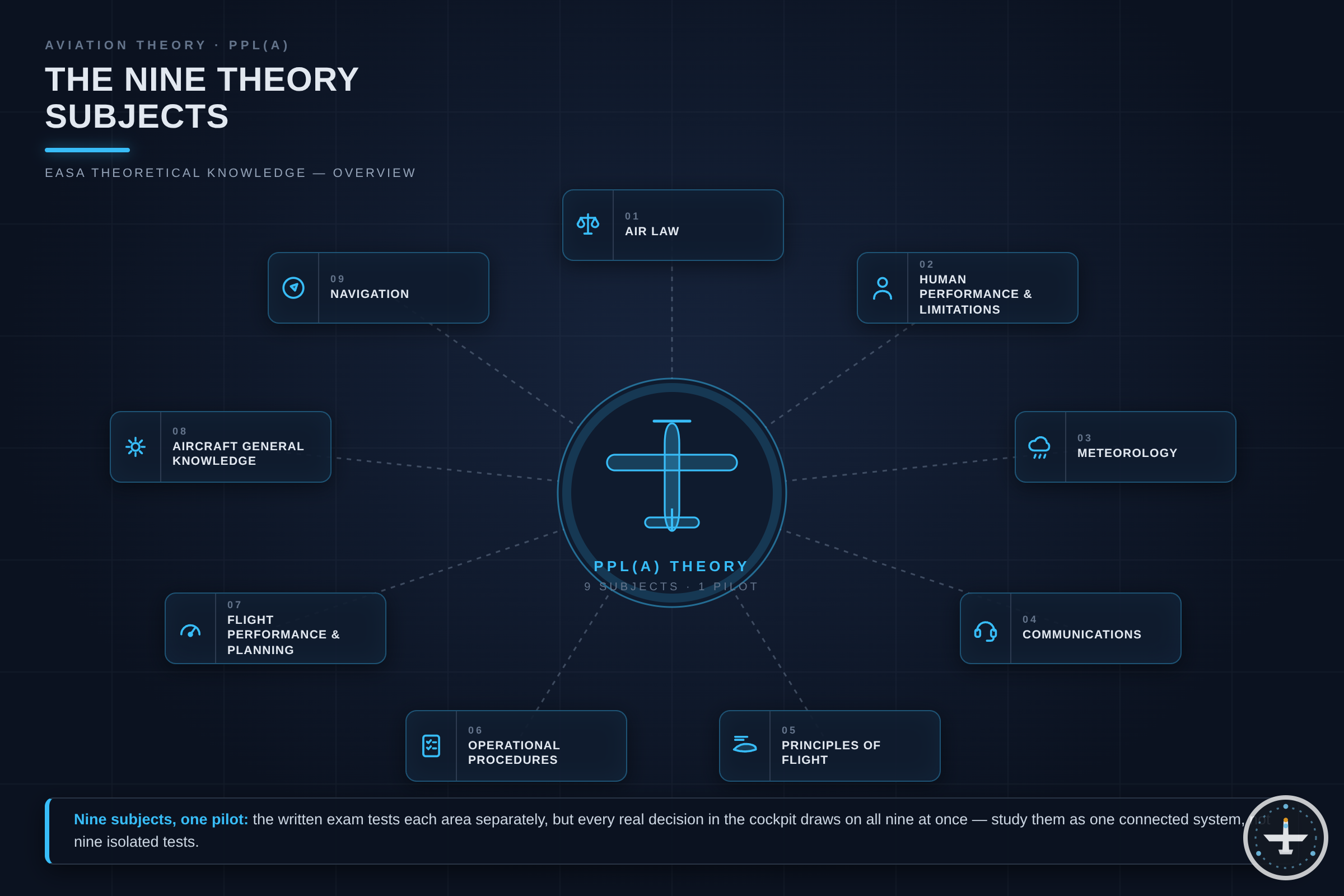
EASA Part-FCL defines which theory subjects you must pass for the PPL(A). In Germany, the LBA administers the examination at an approved test centre – as a multiple-choice test, usually computer-based. There are nine subjects in total, each of which must be passed individually (pass mark: 75 %). Here is a clear overview of what each subject contains.
1. Air Law
This subject covers the legal foundations of aviation: ICAO Annexes, EU regulations (in particular SERA – Standardised European Rules of the Air), airspace structure (Classes A–G), licensing rules under Part-FCL, and German national specifics under the LuftVG and LuftVO.
You will learn right-of-way rules, avoidance rules, VFR minima, minimum flight altitudes, and the consequences of infringements. Primarily rote learning, but highly relevant for the exam and important in the cockpit later on.
2. Aircraft General Knowledge (AGK)
AGK is the technical foundation: airframe construction, engines (piston and turbine engines in overview), propellers, electrical systems, hydraulics, avionics, and flight instruments.
Specifically: how does a four-stroke engine work, what happens during carburettor icing, how do you read a Pitot-static system, what are the limitations of a variometer? Emergency equipment and the mass system (W&B basics) are also included.
3. Flight Performance and Planning (Performance)
This subject is about calculation: reading take-off and landing distances from the POH and applying corrections for wind, temperature, pressure altitude, and runway surface. Also Mass and Balance – centre of gravity calculation using moment arms and loading charts.
You will also learn flight planning: fuel calculation (Trip Fuel, Contingency, Alternate, Final Reserve – minimum 30 minutes VFR day in Germany), climb and descent profiles.
4. Human Performance and Limitations
The human factor: anatomy and physiology as relevant to aviation – hypoxia, hyperventilation, pressure equalisation, spatial disorientation, visual physiology (day/night vision), and hearing physiology.
Additionally psychology: stress, workload management, decision-making, Crew Resource Management (also relevant for single-pilot operations: SRM). Alcohol, medication, and fatigue are fixed examination topics.
5. Meteorology (Met)
One of the most extensive subjects. Topics include: atmospheric structure, pressure and temperature, wind (geostrophic, gradient, surface wind), cloud formation and classification, precipitation, icing, thunderstorms, turbulence, visibility, and types of fog.
Practical component: reading METAR, TAF, SIGMET, and GAFOR, interpreting significant weather charts. Relevant for Germany: DWD products and pc_met.
6. Navigation (Nav)
Navigation covers three areas:
- General Navigation: the Earth, tracks and headings, magnetic variation, deviation, charts (in particular ICAO 1:500,000), dead reckoning, time calculation, the triangle of velocities.
- Radio Navigation: VOR, DME, NDB/ADF, GNSS fundamentals, radar principles.
- Practical Flight Planning: planning a route, calculating headings, completing a flight log.
You need to be confident with the navigation computer (CRP-1 or electronic equivalent).
7. Operational Procedures (Op Procedures)
A combined subject covering operational procedures: ICAO Doc 4444 in outline, wake turbulence separation, bird strike, emergency procedures, in-flight fire, pressurisation emergencies (at least in overview), search and rescue procedures (SAR), transponder codes (e.g. 7500/7600/7700).
Procedures for engine failure, radio failure, and becoming lost are also examined.
8. Principles of Flight (Aerodynamics)
The theory behind flight: lift and drag, polars, aerofoil profiles, angle of attack, stall, and the effects of flaps and slats. Stability (longitudinal, lateral, directional), control about the three axes.
Additional topics: spinning, ground effect, manoeuvre limits (load factor, manoeuvre envelope, Va, Vne).
9. Communications (Comms)
Radio telephony in German and English, examined separately. Topics: standard phraseology (Doc 9432), radio procedures in controlled and uncontrolled airspace, emergency procedures (MAYDAY, PAN PAN), emergency frequency 121.5 MHz, phonetic alphabet.
In Germany you additionally require the BZF I (German + English) or BZF II (German only), or the AZF for IFR – this is a separate examination administered by the Bundesnetzagentur, not the LBA.
Examination Structure in Germany
You sit the theory examination at the LBA or at an examination centre authorised by the LBA. You must complete all nine subjects within 18 months of your first examination attempt. You have four attempts per subject and a maximum of six sittings in total. If you do not succeed, you must repeat the entire theory course.
Once theory is passed, you have 24 months to complete the practical skill test.
How to Study Effectively
The subjects differ considerably in character: Air Law and Op Procedures are primarily rote learning, Performance and Nav require calculation, while Met and Principles of Flight demand genuine understanding. Plan your study time accordingly – treating all subjects equally usually wastes time. Adaptive learning systems such as Aero.Academy adjust the question selection to your weak areas, which makes a noticeable difference in efficiency given the volume of material.