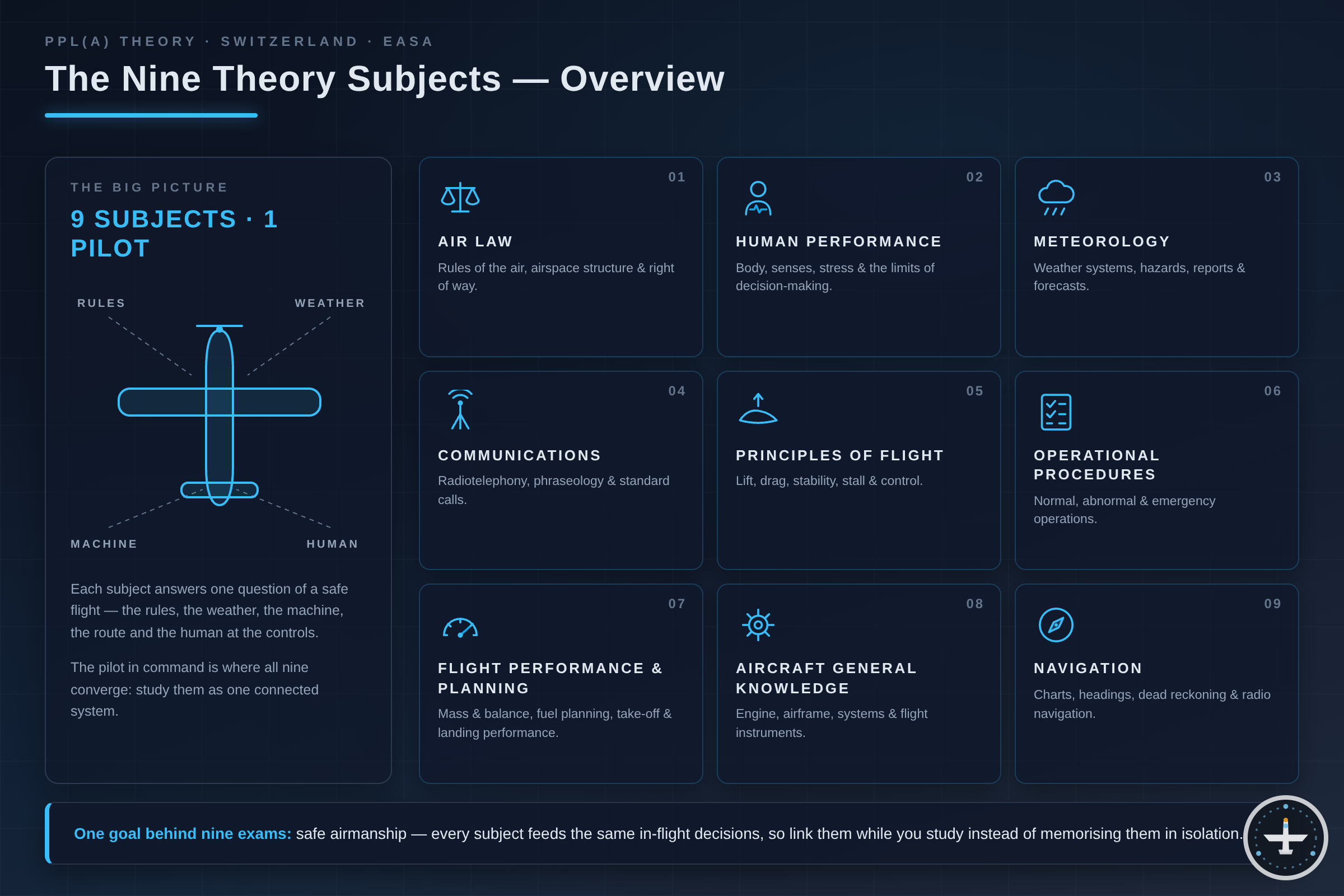
Why nine subjects?
EASA has divided the PPL(A) theory syllabus into nine subjects (Part-FCL, AMC1 FCL.115/.120). BAZL examines each subject individually as a multiple-choice test. You must achieve at least 75 % per subject. All subjects must be passed within 18 months of your first attempt; after that, all progress lapses.
Here is what each subject contains.
1. Air Law
The regulatory foundation. You will study:
- ICAO Annexes (primarily 2, 7, 8, 11, 14) and their transposition into EU law
- EU regulations: Part-FCL (licences), Part-MED (medical), SERA (Standardised European Rules of the Air)
- Airspace classes A–G, classification in Switzerland, VFR minima
- Visual flight rules, minimum altitudes, semicircular cruising levels
- Swiss specifics via BAZL: VFR Manual Switzerland, national NOTAMs, fee framework
A dry subject, but highly relevant in the exam and present in the cockpit every day.
2. Aircraft General Knowledge (AGK)
How the aircraft works technically:
- Airframe and controls: wings, empennage, ailerons, elevator, rudder, trim
- Engine: four-stroke Otto cycle, carburettor vs. fuel injection, magneto ignition, carburettor icing
- Propeller: fixed-pitch, variable-pitch, critical RPM
- Systems: electrical (generator, battery, bus bar), fuel, hydraulics, Pitot-static system
- Instruments: airspeed indicator (IAS, CAS, TAS), altimeter, variometer, gyroscopic instruments
3. Flight Performance and Planning (Performance)
This subject is about numbers and masses:
- Mass and balance (Weight & Balance): centre of gravity calculation, permissible envelopes
- Take-off and landing distances: effect of density altitude, wind, runway surface, slope
- Climb, cruise, descent: fuel consumption, speeds
- Flight planning: route, fuel reserves (minimum 30 min. final reserve under SERA for VFR day), ATC flight plan
- Mass & Balance sheets for specific aircraft types (e.g. C172, DA40)
Arguably the most practically important subject for safe flight operations beyond standard fair-weather flying.
4. Human Performance and Limitations
The pilot as a risk factor:
- Physiology: hypoxia from approximately 10,000 ft, hyperventilation, trapped gases, ear pressure
- Sensory illusions: somatogravic illusions, Black Hole Effect, the leans
- Psychology: stress, fatigue, workload management, situational awareness
- Decision-making: DECIDE and FORDEC models
- IMSAFE checklist before every flight
5. Meteorology (Met)
Understanding and interpreting weather:
- Atmosphere: structure, ISA, temperature and pressure gradients
- Wind: Coriolis effect, geostrophic wind, surface wind, turbulence
- Clouds and precipitation: cloud types, icing, thunderstorms, hail
- Air masses and fronts: warm, cold, and occlusion fronts
- Mountain weather: Foehn wind (Föhn), lee waves, rotors — particularly relevant in Swiss examinations
- Weather documents: decoding METAR, TAF, GAFOR, SIGMET, GAMET
6. Navigation (Nav)
From point A to point B:
- Earth and charts: Lambert projection (ICAO chart 1:500,000), courses, distances
- Compass: variation, deviation, turning error, acceleration error
- Dead Reckoning (DR): heading, track, groundspeed, ETA
- Radio navigation: VOR, DME, ADF/NDB, GNSS fundamentals
- Flight preparation: navigation log, alternate planning
Calculations with the CRP-5/E6B are part of this — permitted in the exam as well.
7. Operational Procedures (Op Procedures)
Operational procedures and abnormal situations:
- Emergency procedures: engine failure, fire on board, pressurisation loss (where applicable)
- Wake turbulence: categories, separation minima
- Icing, windshear, volcanic ash
- SAR: search patterns, distress signals, ELT (121.5 / 406 MHz)
- Apron and runway safety, noise abatement procedures (relevant in Switzerland)
8. Principles of Flight (Aerodynamics)
Why the aircraft flies:
- Aerodynamic forces: lift, drag, thrust, weight
- Aerofoil profiles and polar diagrams, angle of attack, critical angle of attack
- Stall and spin (Spin)
- Stability: longitudinal, lateral, directional — static and dynamic
- Load factors and manoeuvres: V-n diagram, Va, Vno, Vne
- Effect of flaps, slots, and slats
9. Communications (Comms / VFR Radio)
Radio telephony in VFR:
- ICAO phraseology in English (in Switzerland often also in German)
- Standard calls: position reports, traffic information, flight plan activation
- Emergency procedures: Mayday, Pan-Pan, Squawk 7700 / 7600 / 7500
- Radio failure procedures
- Frequencies: Swiss specifics such as the REGA emergency frequency, FIS Switzerland
Comms is often linked to the BZF/AZF radio telephony certificate, which in Switzerland is administered separately by BAKOM — not to be confused with the EASA theory examination.
How extensive is all this?
AMC1 FCL.210.A recommends a minimum of 100 hours of theoretical instruction for the PPL(A). In practice, the self-study component is considerably higher. BAZL examinations can be sat in multiple sessions, typically bundled together. For current fees and registration procedures, refer directly to BAZL.
Recommended study order
A proven study sequence:
- Principles of Flight + AGK (technical foundation)
- Met + Nav (thematically linked for flight preparation)
- Performance + Op Procedures
- Air Law + Comms
- Human Performance (can run concurrently throughout)
Important: the subjects overlap. A solid understanding of Met makes Op Procedures easier. Mastering AGK pays dividends in Performance.