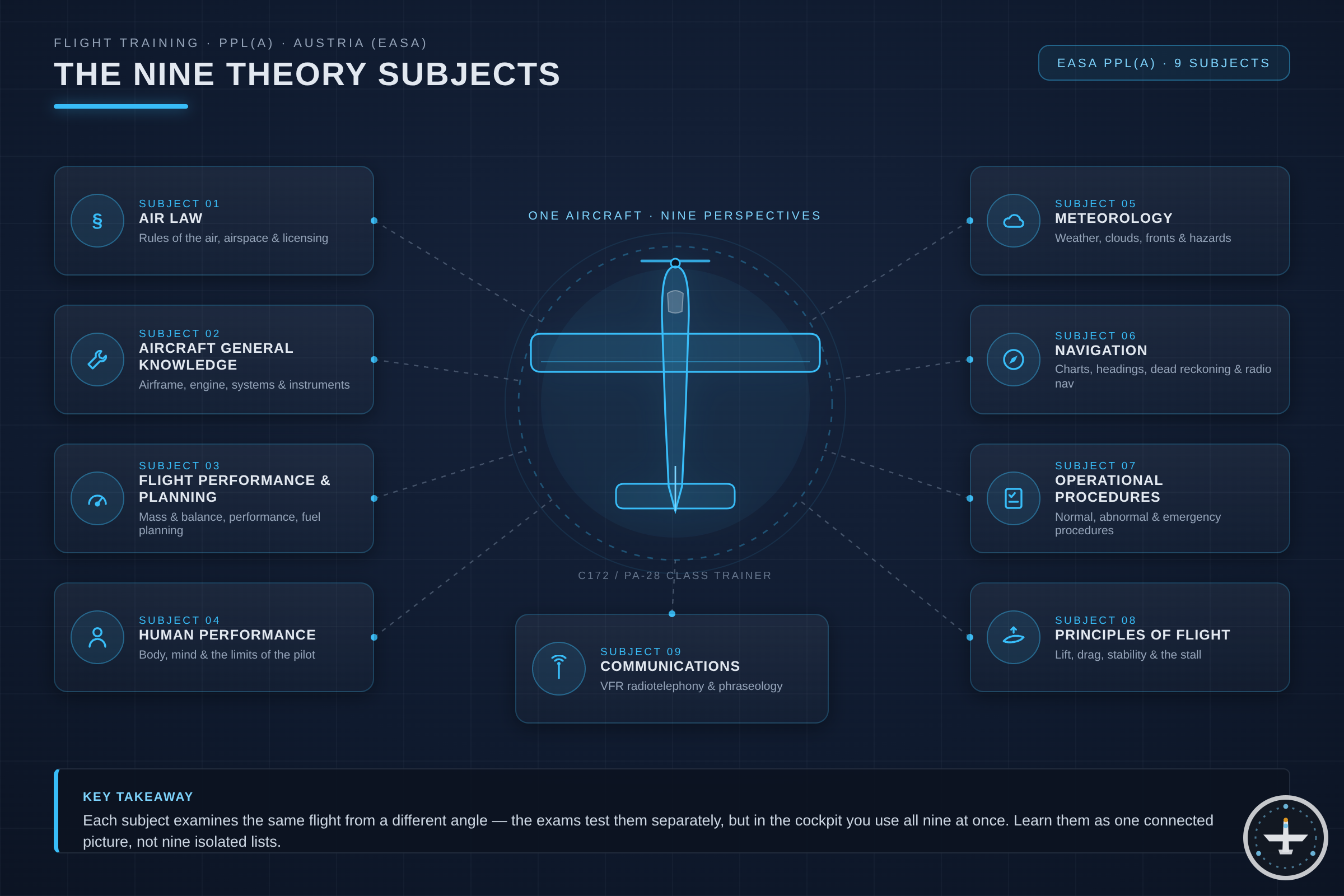
Why nine subjects?
EASA has divided the PPL(A) theory syllabus under Part-FCL into nine subject areas. In Austria, each subject is examined individually by Austro Control (multiple-choice, typically 12–24 questions per subject, 75 % pass mark per subject). From your first passed exam you have 18 months to complete all nine subjects, and after passing the last theory exam you have 24 months to complete the Skill Test.
Below you will find what each subject contains – without unnecessary padding.
1. Air Law
This covers the regulatory framework: ICAO Annexes, EU regulations (Part-FCL, Part-MED, SERA), national regulations of Austro Control, airspace structure (Class A–G), light signals, right-of-way rules, VFR minima, formal flight planning, pilot licences and medical requirements.
Typical pitfalls: VMC minima in the various airspace classes, documents required to be carried on board, light signals from the tower.
2. Aircraft General Knowledge (AGK)
The technical side of the aircraft. Content:
- Airframe and systems (wing structure, control surfaces, undercarriage)
- Engine (predominantly piston engine, carburettor vs. fuel injection, magneto ignition)
- Propeller (Fixed Pitch, Constant Speed)
- Electrical, hydraulic and pneumatic systems
- Instruments: Pitot-static system, gyroscopic instruments, magnetic compass
- Emergency equipment
You should understand why the engine must be warmed up, what causes carburettor icing and how an artificial horizon works.
3. Flight Performance and Planning (Performance)
Two parts: Performance (take-off and landing distances, climb performance, effect of altitude, temperature, wind and mass) and Mass and Balance (centre-of-gravity calculation using loading and trim diagrams).
In practice: you calculate take-off and landing roll distances using POH charts, verify that the centre of gravity is within the envelope, and plan fuel requirements including reserves (minimum 30 min. VFR day).
4. Human Performance and Limitations
The human as a system component. Topics:
- Respiratory and circulatory system, hypoxia, hyperventilation
- Vestibular system, spatial disorientation, visual illusions
- Auditory system, noise protection
- Stress, fatigue, workload, attention
- Decision-making, Threat and Error Management
- Effects of alcohol, medication and diving before flights
Little mathematics, a lot of understanding required. Often underestimated.
5. Meteorology (Met)
For many students, the most extensive subject. Content:
- Atmosphere, standard atmosphere, pressure and altimetry (QNH, QFE, QNE)
- Wind: pressure gradient, Coriolis, friction, local winds (Foehn wind is particularly relevant in Austria)
- Cloud formation, precipitation, icing
- Air masses, fronts, thunderstorms, turbulence
- Visibility, fog
- Reading weather reports: METAR, TAF, SIGMET, GAFOR
- Interpreting weather charts
Particularly relevant for Austria: mountain weather, lee effects, valley fog.
6. Navigation (Nav)
Classically divided into:
- General Navigation: the Earth, charts (ICAO 1:500 000), magnetism, variation and deviation, heading/track, wind triangle, time-speed-distance calculations using the navigation computer (CRP-1, E6B).
- Radio Navigation: VOR, NDB, DME, ILS basics, GNSS (GPS).
In the exam you must solve flight planning problems: headings, groundspeed, fuel, ETA. Practise, practise, practise.
7. Operational Procedures (Op Procedures)
Procedures in day-to-day operations:
- ICAO Doc 9432 procedures
- Noise abatement, fuelling procedures
- Wake turbulence and separation minima
- Emergency procedures: fire, engine failure, forced landing
- Special operations: mountain flying, overwater procedures
- Search and Rescue (SAR), ELT
- Accident investigation basics
8. Principles of Flight (Aerodynamics)
The physics of flight:
- Fluid dynamics, Bernoulli, lift, drag
- Polar curve, glide ratio, best rate of climb (Vy) vs. best angle of climb (Vx)
- Stall: causes, symptoms, recovery, stall in turns
- Stability (longitudinal, lateral, directional)
- Controls, trim, secondary control effects
- Load factors, manoeuvring envelope (Vne, Va, Vno)
- Propeller theory, torque effects
9. Communications (Comms)
Radiotelephony in VFR:
- ICAO phonetic alphabet, number pronunciation
- Standard phraseology (English and German)
- Frequency changes, read-back requirements
- Position reports, arrival and departure calls
- Emergency and urgency procedures (MAYDAY, PAN PAN)
- Transponder codes (7500, 7600, 7700)
Note: for English-language radio communications you additionally require the Language Proficiency Endorsement (minimum ICAO Level 4).
How to approach the subjects
Three practical tips:
- Order: Air Law and Human Performance can be tackled early, as they require little prior knowledge. Leave Navigation and Performance until you have completed your first solo navigation exercises – by then the material will make sense.
- Link to practice: Met and Op Procedures become clear in the cockpit. Do not treat the briefing as just textbook content.
- Question bank vs. understanding: The ECQB (European Central Question Bank) questions are the basis. Memorising them is sufficient for the exam, but not for actual flying. Invest time in genuine understanding.
If you are sitting your exams in Austria: registration is through Austro Control, and exams take place in Vienna. Fees are in the low two-digit euro range per subject (as of 2024 – check current rates directly with Austro Control).