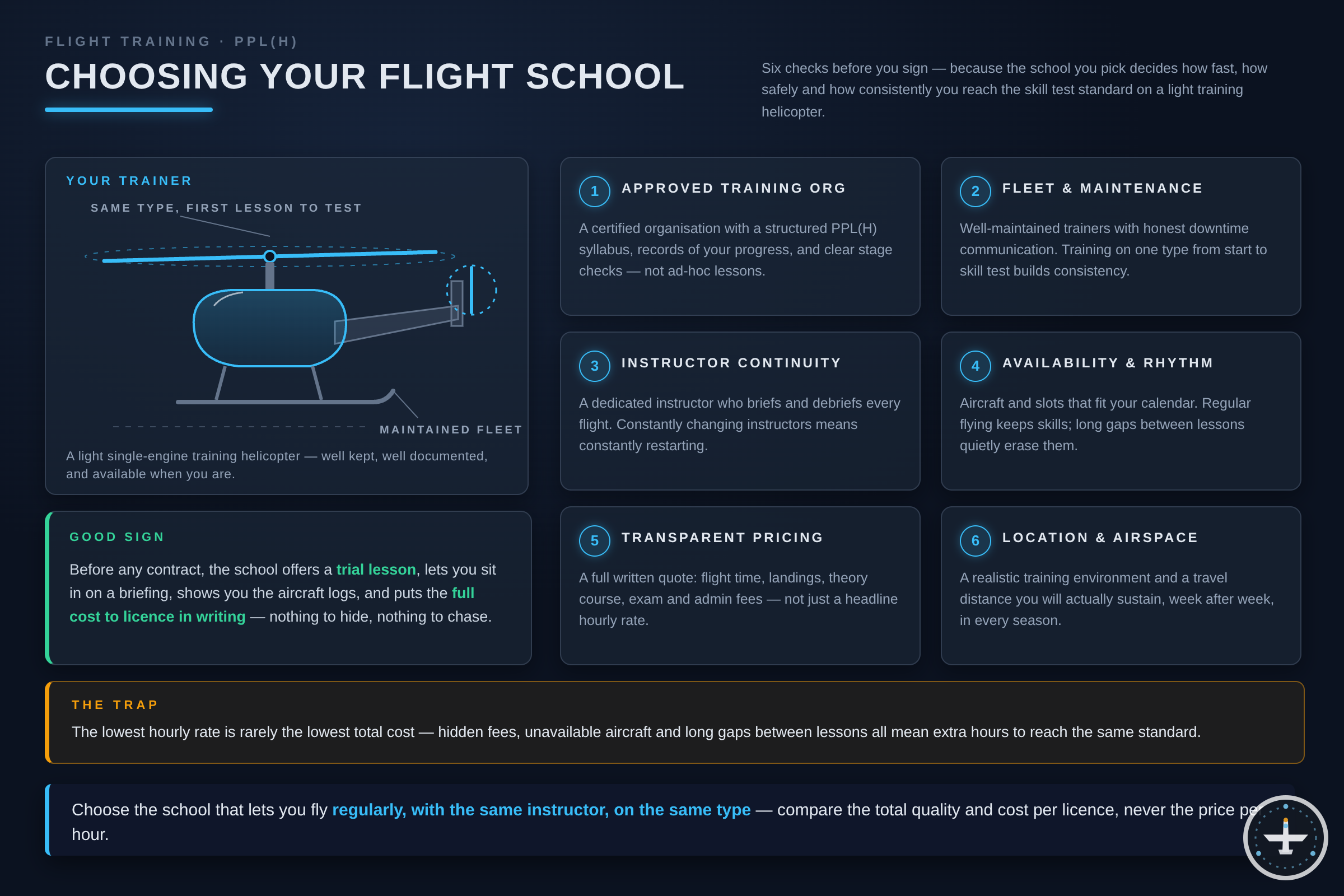
ATO or DTO — Who Is Authorised to Do What?
For the PPL(H) in Germany you have two options: an ATO (Approved Training Organisation) or a DTO (Declared Training Organisation). Both are overseen by the LBA, but they differ significantly in scope.
- ATO: Authorised to train for all pilot licences — PPL(H), CPL(H), ATPL(H), type ratings, instrument rating. Subject to stricter requirements, must maintain its own management system and a documented quality system.
- DTO: Authorised to train only for the LAPL and PPL, including night, towing, and aerobatic ratings. Simpler structure, no formal approval required — only a declaration to the LBA.
For candidates who only want the PPL(H), a DTO is often cheaper and less bureaucratic. If you are working towards a CPL(H) or a professional pilot career in the long term, an ATO is worthwhile — you can continue seamlessly and theory hours remain creditable.
Local or National — Where Should You Train?
Helicopter schools are more thinly spread across Germany than fixed-wing schools. There are broadly three types:
- Small regional schools with one or two helicopters (often R22/R44). Personal contact, one or two flight instructors, short distances if you live nearby. The weak point: if the only helicopter is in maintenance, you can be grounded for weeks.
- Medium-sized ATOs with three to six aircraft and multiple FIs. Better availability, often also turbine types (EC120, AS350) for later type ratings.
- National providers with multiple locations. Advantage: you can log hours at different aerodromes. Disadvantage: more impersonal, frequent changes of FIs.
If you are employed and only fly at weekends, proximity is invaluable. A one-hour commute twice a week costs you months.
Realistic Assessment of Hourly Rates
Gross hourly rates (including VAT, fuel, and landing fees at the home aerodrome) fall roughly within the following ranges for 2024/2025:
- R22: EUR 380–480/h (solo) — the most widely used training type
- R44: EUR 580–720/h — more comfortable, but more expensive
- Cabri G2: EUR 450–550/h — a modern training type
- Flight instructor: EUR 80–120/h in addition
- Ground school: EUR 1,500–2,500 as a package, or modular
- Examination fees LBA + examiner: approx. EUR 600–900
A realistic total budget for the PPL(H) on the R22, based on the minimum 45 flight hours (of which 25 dual with an FI, 10 solo, plus theory and examinations): EUR 18,000–25,000. Completing the course in exactly 45 hours is the exception — budget for 55–60 hours to be safe.
Beware of "teaser" offers: some schools advertise low hourly rates but charge maintenance, landing fees at off-site aerodromes, or FI hours separately. Always ask for a full cost breakdown in writing.
Assessing Fleet Quality
The helicopter is your working tool. Inspect it before you sign a contract.
- Age and total time: An R22 with 12,000 hours is not necessarily bad, but ask about upcoming overhauls (Robinson: 2,200 h or 12 years — after which SLEP or retirement applies).
- Availability: How many days per year is the aircraft technically serviceable? Ask directly. Fewer than 250 days becomes tight.
- Avionics: A Garmin G500H is nice, but you do not need it for the PPL(H). More important is that the standard instruments are correctly calibrated.
- Maintenance: In-house or contracted out? In-house maintenance facilities typically have shorter ground times.
- Cleanliness and condition of the cabin: A well-kept helicopter reflects how the school looks after its equipment.
Evaluation Criteria — Your Checklist
Before committing, work through these points:
- Check LBA status: The list of approved ATOs/DTOs is available online from the LBA. Pay attention to the exact scope of authorisation.
- Meet the flight instructors: At least two FIs should be available. Ask to see their experience and hours. An FI(H) with 200 hours of teaching experience is not automatically a good instructor — ask about teaching style and methodology.
- Theory format: In-person, online, or self-study? Aero.Academy supplements your practical school for the theory component, but verify that the school will confirm the 100 hours of theory required under FCL.210.H.
- Examiner access: Does the school have a dedicated flight examiner (FE/CRE)? An external examiner incurs travel costs.
- Contract and refund terms: What happens if you discontinue? How is pre-paid money refunded? Do not pay a block advance of more than EUR 5,000 without insolvency protection.
- Trial lesson: Take an introductory flight — 30 minutes are enough to assess the helicopter, the FI, and the general atmosphere.
- References: Speak to two or three graduates from the past twelve months. Ask specifically: how long did it take, how many hours did you end up with, what went wrong?
Red Flags
- No written cost breakdown provided
- FI changes constantly or is only available at weekends
- Helicopter frequently "in maintenance" (ask other students)
- Pressure to make large advance payments
- No clear statement on theory credit
- School insists on its own examiner with no alternatives offered
Conclusion
The cheapest school is rarely the most economical choice. Calculate total costs, aircraft availability, and FI quality together — and visit at least two schools before deciding. You do the PPL(H) once; the foundations it gives you will carry you through your entire flying career.