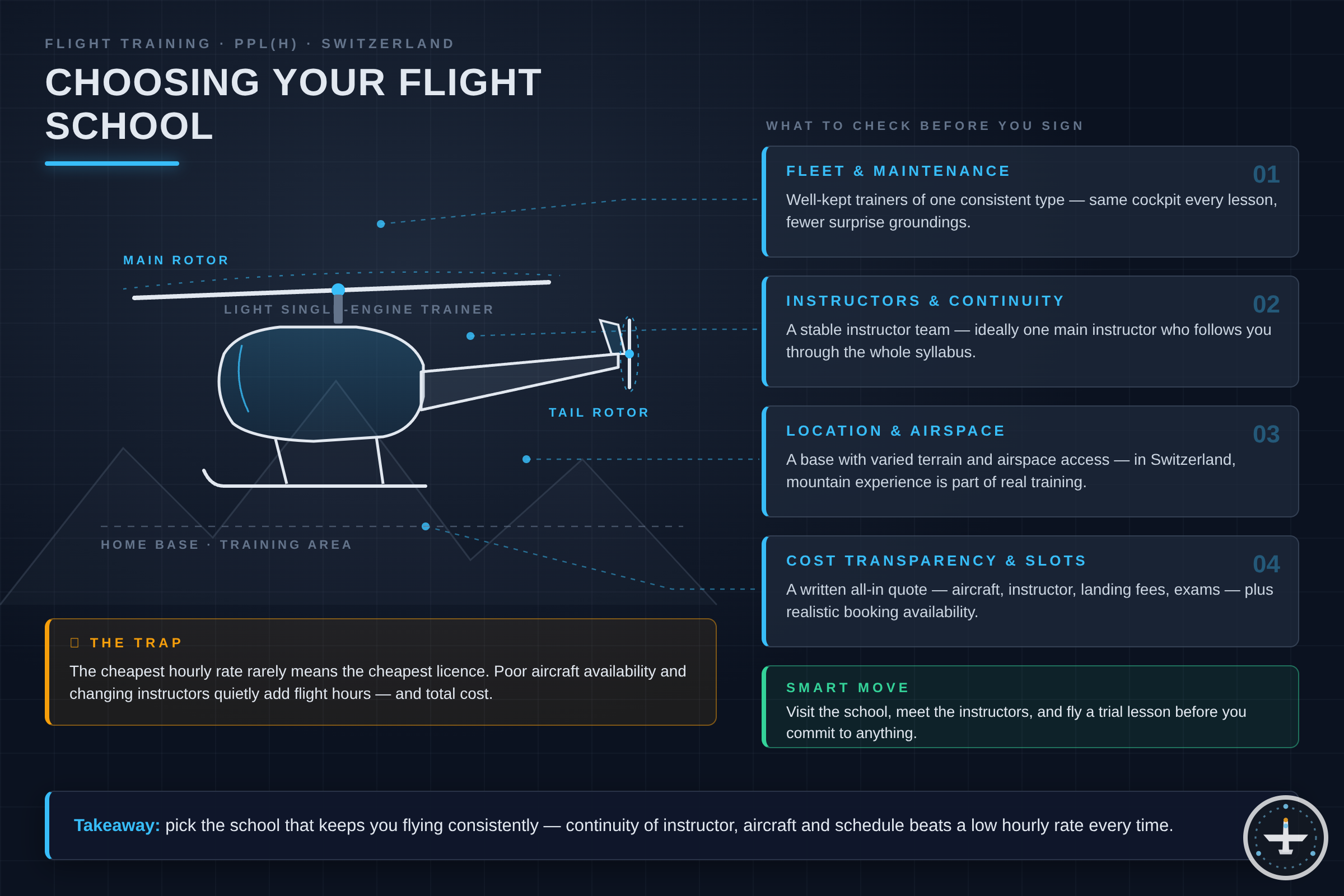
ATO or DTO – What Is Permitted for the PPL(H)
In the EASA world there are two types of training organisations: ATO (Approved Training Organisation) and DTO (Declared Training Organisation). For the PPL(H) the answer is clear: you need an ATO. Under Part-DTO, DTOs are only permitted to train LAPL, PPL(A), glider, balloon, and certain ratings – helicopter training is not included.
In practice this means: every Swiss flight school that legally trains you for the PPL(H) must be a BAZL-approved ATO. You can find the list of approved ATOs on the BAZL website. Before signing any contract, verify that the approval status is current and check which courses the school is actually authorised to offer (PPL(H), Type Rating, Night Rating, etc.).
Regional or Nationwide – The Location Question
Switzerland has a manageable number of helicopter ATOs, spread across locations such as Grenchen, Belp, Buochs, Birrfeld, Lugano-Agno, Sion, Gruyères, Balzers, and others. The choice comes down to three practical factors:
- Commute: One hour of helicopter flying costs more than the drive there. But if you are commuting 90 minutes each way, you will cancel or shorten sessions. Do the math honestly.
- Weather and topography: A school in the Mittelland gives you different experience than one in the Valais. Mountain flying is not mandatory for the PPL(H), but if you plan to obtain a Mountain Rating later, a school with mountain-flying DNA is worth considering.
- Availability of instructor and aircraft: Small schools with one helicopter and two instructors are appealing, but maintenance or illness can leave you grounded. Larger operations buffer against this.
Hourly Rates and Realistic Total Costs
The PPL(H) requires a minimum of 45 flight hours under Part-FCL, of which at least 25 must be dual and 10 solo (including 5 hours of solo cross-country). In practice, most students need 50–60 hours.
Approximate Swiss reference figures (as of 2024, no guarantee):
- Robinson R22: approx. CHF 550–750 per flight hour (dual, including instructor and fuel)
- Robinson R44: approx. CHF 900–1,300 per flight hour
- Cabri G2: approx. CHF 700–900 per flight hour
- Ground school course: CHF 2,500–4,500 depending on format (classroom / online / blended)
- BAZL examination fees: several hundred francs for theory and practical tests
- Class 2 Medical: CHF 300–500 initial cost at an AeMC/AME
Realistic total budget: CHF 35,000–55,000 for the PPL(H) on an R22, significantly more on an R44. Ask the school for a written cost breakdown and explicitly inquire about: landing fees, briefing time charges, cancellation fees, fuel surcharges, and skills test surcharges.
Fleet: Condition, Age, Availability
The helicopter is your training tool. Check the following:
- How many helicopters does the school have? One is a risk, two is standard, three or more is comfortable.
- How old are the airframes? For the R22 with its 12-year overhaul requirement – when is the next one due? A school facing a major overhaul could lose its aircraft mid-training.
- Avionics: Glass cockpit (Garmin G500H or equivalent) vs. conventional round instruments. Either is sufficient for the PPL(H), but if you intend to fly more modern types later, glass cockpit experience is invaluable.
- Maintenance organisation: In-house CAMO/Part-145 or outsourced? In-house maintenance typically means faster turnaround.
Ask directly: "How many AOG days did you have in the last 12 months?" A reputable school will answer honestly.
Flight Instructors and Training Methodology
Not all FI(H)s are equal. Look for:
- Experience in hours and years – not just total time, but actual instructional hours.
- Full-time or part-time? Full-time instructors tend to be more available and consistent.
- Briefing culture: Are there structured pre- and post-flight briefings, or do you just get in, fly, and go home?
- Theory integration: Is ground school linked to practical flying, or do the two run in isolation?
Theory Format
The PPL(H) ground school covers 9 subjects (Air Law, Human Performance, Meteorology, Communications, Principles of Flight, Operational Procedures, Flight Performance & Planning, Aircraft General Knowledge, Navigation). Examinations are taken at BAZL.
Schools offer different formats: full classroom attendance, evening courses, blended learning, or fully online. If you are employed full-time, a flexible online format – combined with targeted exam preparation such as on Aero.Academy – is usually more practical than a fixed classroom course running over six months.
Evaluation Criteria – Your Personal Checklist
Before you sign, work through these points:
- ATO approval verified with BAZL?
- Written cost breakdown including all ancillary costs received?
- Trial lesson completed – good chemistry with instructor and aircraft?
- At least two current students contacted and interviewed?
- Fleet availability and maintenance downtime statistics clarified?
- Contract terms for discontinuation or school transfer understood?
- Location checked for weather statistics (fog days, Foehn (Föhn) conditions)?
- Training plan provided in writing with a realistic timeline?
A reputable ATO will have clear answers to all of these questions and will not hide anything. If you encounter evasiveness, treat it as a warning sign.
Conclusion
You do not choose a flight school based on first impressions – you choose it on hard criteria: BAZL ATO status, fleet quality, transparent costs, instructor availability, and location logistics. Invest two to three trial flight hours at different schools before committing. That is CHF 1,500–2,000 well spent against the risk of a CHF 40,000 mistake.