ATO or DTO — which is permitted for PPL(H)?
In the EU, PPL(H) training may only be conducted by ATOs (Approved Training Organisations). The simplified form DTO (Declared Training Organisation) is not permitted for helicopter licences — under Part-DTO, DTOs cover only LAPL, PPL(A), glider and balloon training, as well as associated class and type ratings for single-engine piston aeroplanes.
In practice, this means: if a school offers you PPL(H) training as a DTO, this is not compliant with regulations. Always verify ATO status — Austro Control maintains the list of approved organisations on its website.
Regional vs. national — the location question
Helicopter schools in Austria are limited in number. Training sites are concentrated around Wiener Neustadt, St. Johann/Tirol, Zell am See, Spitzerberg, Linz/Hörsching, and a few smaller aerodromes. This creates two distinct realities:
- Regional: Short travel times, more flexibility around weather windows, often more personalised instruction. Downside: smaller fleet, fewer flight instructors, longer delays when someone is sick or unavailable.
- National/larger: Multiple aircraft, multiple flight instructors, often an in-house maintenance facility. You are less dependent on a single person or a single helicopter. Downside: less individual attention, possibly higher hourly rates.
A rule of thumb: with at least 45 flight hours of training spread over several months, you will be spending a lot of time at the airfield. A 90+ minute commute per session drains both motivation and money. Do the honest maths.
Hourly rates — realistic figures for 2024/2025
Prices vary considerably depending on aircraft type and operator. Approximate reference values for Austria (gross, fuel included):
- Robinson R22: €350–450/h
- Robinson R44: €550–750/h
- Guimbal Cabri G2: €450–550/h
- Flight instructor: €80–120/h additional (some schools include this)
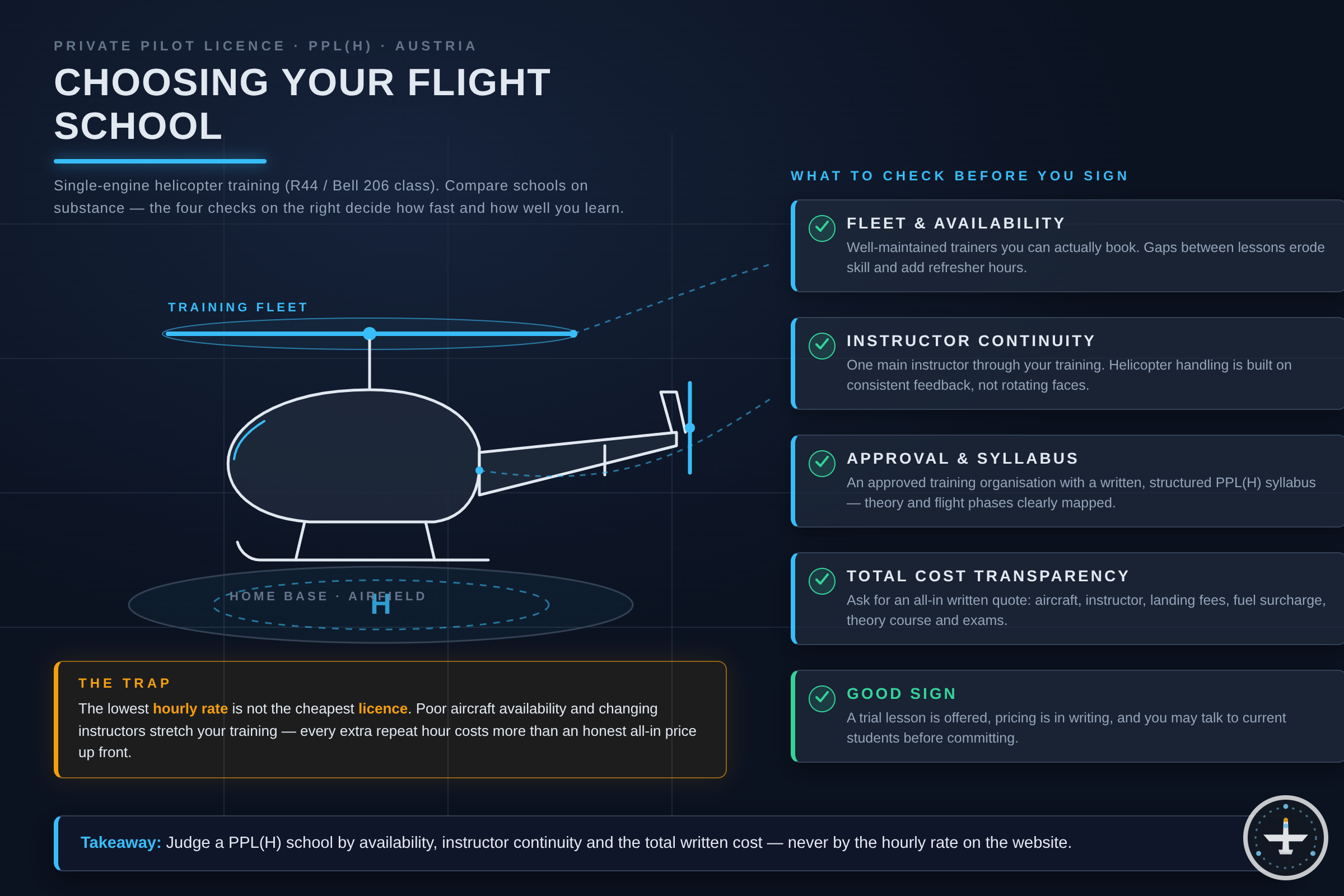
Realistic total cost for PPL(H): €18,000–30,000, depending on aircraft type, actual hours flown (45 h is the minimum; the average tends to be 50–60 h), and the theory package. Always request a written cost breakdown covering all line items:
- Flight hours (aircraft and instructor listed separately)
- Ground school / theory course
- Study materials
- Austro Control examination fees (theory per subject, Practical Skill Test)
- Class 2 Medical
- Landing fees, fuel surcharges
- Insurance / excess liability in the event of damage
Fleet quality — what to look for
The helicopter is your learning environment. A poorly maintained aircraft will cost you nerves and flight hours.
- Age and total time: R22s are often 20+ years old — this is not a problem in itself, provided maintenance is properly documented. Ask to see the last 100-hour and annual inspection records.
- Number of aircraft: At least two aircraft of the same type is ideal — if one is grounded for maintenance or damage, training continues.
- Avionics standard: GPS, 8.33 kHz radio (mandatory), Mode S transponder. Glass cockpits are rare on R22/R44, but not necessary for basic training.
- Cleanliness and overall condition: Visit in person and inspect the aircraft. Cracked plexiglass, worn pedals, oil-soaked engine compartment — all of these indicate maintenance culture.
- Robinson 12-year / 2,200-hour overhaul: Ask when the next overhaul is due. Availability can become restricted as the deadline approaches.
Evaluation criteria — the pre-enrolment checklist
Visit at least two schools in person. Allow half a day per visit and clarify the following:
- ATO approval number and scope (is PPL(H) explicitly listed?)
- Head of Training and CFI: Who is responsible? What is their experience and background?
- Flight instructor pool: How many active FI(H)s are on staff? Full-time or part-time?
- Student-to-instructor ratio: What is the average duration of training courses?
- Theory format: In-person, online, or hybrid? You can supplement theory efficiently with Aero.Academy — but the ATO must formally conduct and certify the ground training.
- Cancellation policy: What happens in the event of weather cancellation, your own cancellation, or a technical unserviceability?
- Payment model: Advance payment in instalments is standard practice, but never pay the full amount upfront. Ask about insolvency protection for package prices.
- References: Talk to current students or recent graduates — not the ones the school suggests. Find them yourself in forums or at the airfield.
- Trial flight: A 30-minute flight with your prospective flight instructor tells you more than any sales pitch.
Red flags
- Pressure to sign a contract or pay in full quickly
- No written cost breakdown provided
- Unclear ATO affiliation, or "we do it through a partner ATO"
- Only one flight instructor, only one helicopter
- Maintenance "done by a friend" — for helicopters, insist on a Part-145 or Part-CAO approved maintenance organisation
- No clear answer to how many PPL(H) graduates the school produces per year
Treating theory separately
Ground school training (9 subjects, examination with Austro Control) can be completed at many ATOs as an in-person course — or you can use structured self-study supported by AI-assisted question banks. Important: the ATO must formally confirm completion of ground training before you are eligible to sit the examinations. Clarify in advance whether your chosen school accepts distance learning or requires in-person attendance.
Conclusion
Choose rationally: ATO status, fleet size, transparent costs, personal impression. The cheapest provider is rarely the most economical if you end up needing 70 hours instead of 50. Invest two or three days in thorough research — at a €25,000 investment, it is well worth it.