ATO or DTO – What Is the Difference?
Since the EASA reform of 2018, there are two types of training organisations for PPL(A) training in Germany:
- ATO (Approved Training Organisation): The classic flight school model, approved by the LBA with a comprehensive scope of authorisation. ATOs are permitted to train for all licences and ratings – from PPL through to ATPL, including IR, CPL, and MEP.
- DTO (Declared Training Organisation): A simplified school model introduced in 2018. A DTO declares its training activity to the LBA rather than seeking formal approval. Permitted training includes PPL(A), LAPL(A), class ratings for single-engine piston aircraft (SEP), night flying, towing, and aerobatics – exactly the range most club pilots need.
For a standalone PPL(A), a DTO is sufficient. It is usually less expensive, as the administrative overhead is smaller. However, if you are planning to pursue an IR or CPL later on, an ATO may make more sense, since you avoid having to change schools.
Club School or Commercial School?
The German market is broadly divided into two worlds:
Club-based DTOs (often at regional or special aerodromes):
- SEP hourly rates typically EUR 150–200 gross for members, plus membership fees and a possible joining fee.
- Flight instructors often work voluntarily or for a modest expense allowance.
- Ground school usually delivered as block lessons at weekends, spread over 6–12 months.
- A social environment, but a longer overall training duration (12–24 months is realistic).
Commercial ATOs/DTOs:
- SEP hourly rates more typically EUR 220–320 gross, depending on aircraft type and region.
- Flight instructors are employed full-time, with greater availability.
- Ground school offered as a full-time intensive course (4–6 weeks) or a structured distance-learning programme.
- Faster training is achievable (4–9 months), but total costs are higher.
Total budget for PPL(A) in Germany: realistically EUR 10,000–16,000, including the ground school course, minimum flight hours (45 h), training materials, Class 2 Medical, examination fees, and LBA licence issuance. Anyone budgeting for only the minimum hours is planning too tightly – 50–55 hours is the average before reaching practical test readiness.
Local Proximity vs. National Brands
The most important practical decision: How far away is the school? PPL training depends on continuity. If you are driving two hours to the airfield, you will fly less frequently, lose more between sessions, and significantly extend your training duration.
Rule of thumb: the school should be within 45 minutes' drive. A solid local school beats the "best" school two states away.
National brands with multiple locations (e.g. large ATO chains) often offer standardised ground school content and online tools, but that does not automatically make them better. Look at the specific location – quality depends on the local Head of Training, not the logo.
Fleet: What to Look For
The training fleet is a hard quality indicator:
- Aircraft type: Cessna 152/172, Piper PA-28, Aquila A210, Diamond DA20/DA40 are standard. Glass cockpit (G500/G1000) is a bonus, but not a requirement for PPL.
- Number of aircraft: A minimum of 2–3 serviceable aircraft; otherwise you will struggle to find slots in summer.
- Maintenance condition: Look at the aircraft. Clean cockpits, well-maintained airframes, and up-to-date technical logs are non-negotiable. Ask about the average unserviceability rate.
- Booking system: Online booking with transparent availability is standard. Schools still operating by phone and paper calendar often have bottlenecks.
- Hangared or outside: Hangared aircraft last longer and have fewer frost-related issues in winter.
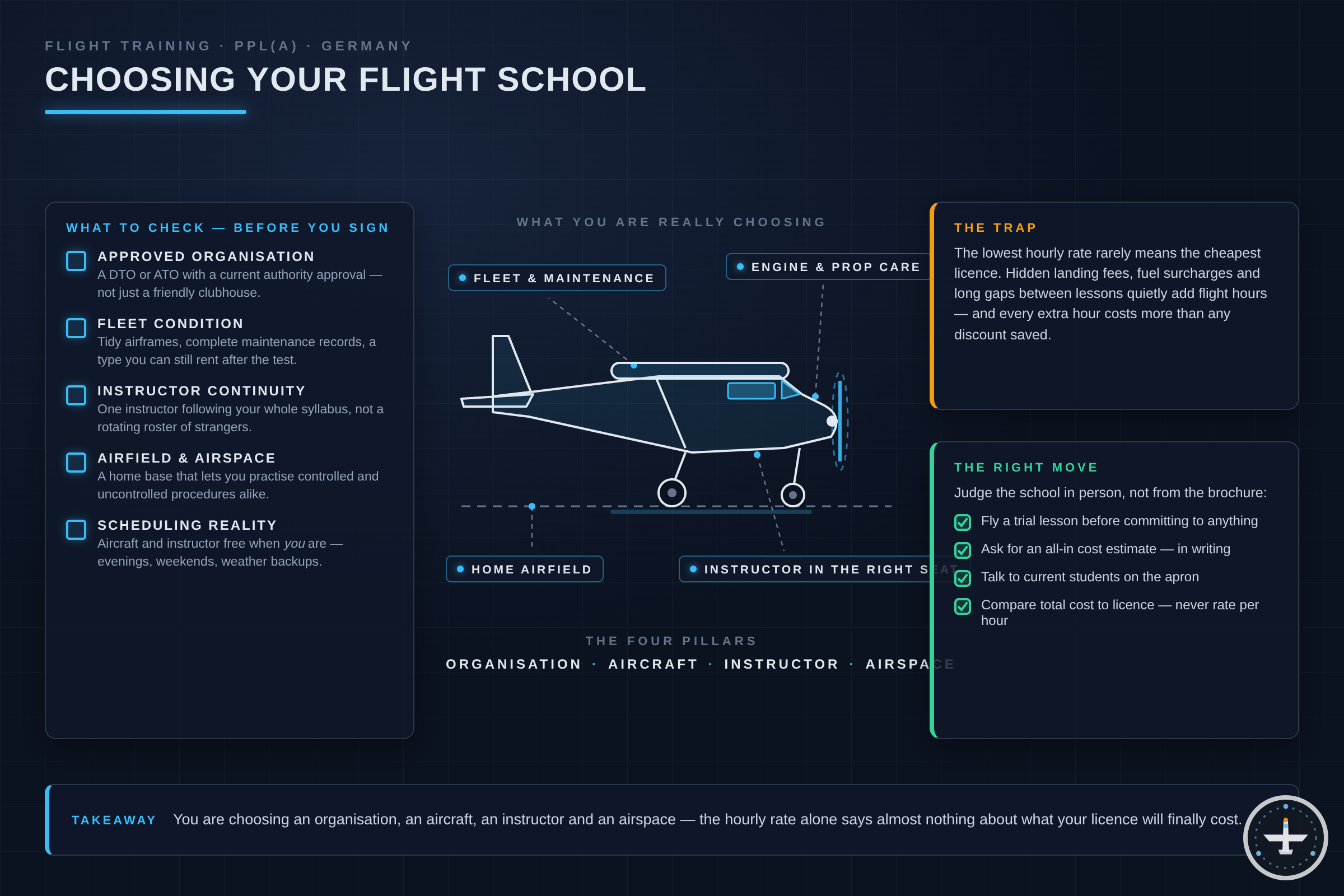
Evaluation Criteria – The Checklist Before You Sign Up
Visit the school, arrange a consultation, and check the following:
- LBA status: Ask to see the ATO approval number or DTO declaration reference in writing. If in doubt, verify directly with the LBA.
- Head of Training: Who holds this role, how experienced are they, and how accessible are they?
- Instructor pool: How many active Flight Instructors (FIs) are there? If there is only one, you are grounded whenever they are sick or on leave.
- Ground school concept: In-person, blended learning, or pure distance learning? When is the next LBA theoretical knowledge examination scheduled?
- Contract model: Fixed package price or pay-as-you-fly? Package prices are tempting but carry risk if the school becomes insolvent. Pay-as-you-fly is generally more transparent.
- Cancellation terms: What happens if you drop out or transfer to another school? Will hours already completed be recognised?
- Student references: Talk to two or three current students – not only those referred to you by the school.
- Average training duration and practical test failure rate: Reputable schools will give you figures.
- Aerodrome choice: A controlled aerodrome with a tower (e.g. EDLN, EDFE) gives you valuable radio communication practice. Purely glider aerodromes without radio will delay your FRTOL training later.
Ground School: In-House or Outsourced?
The LBA theoretical knowledge examination covers 9 subjects. Many schools cooperate with external ground school providers or recommend online platforms. A modern learning platform such as Aero.Academy can be a valuable complement to in-person instruction – especially if you are working full-time and need to study at your own pace. The key point: the school must formally certify your theoretical knowledge, regardless of where you studied.
Red Flags
- Payment of the entire training fee upfront with no insolvency protection.
- Vague answers to questions about LBA status or the identity of the Head of Training.
- No written contracts.
- A "guaranteed" training duration of 6 weeks without a full-time commitment.
- Hourly rates significantly below market level (below EUR 140 for SEP) – usually a sign of hidden costs or poor maintenance standards.
Take your time, visit two or three schools, and make a clear-headed decision. Your flight school will accompany you intensively for 6–18 months – that justifies spending an afternoon doing your research.