ATO or DTO — What Is the Difference?
In Switzerland, you may complete your PPL(A) at two types of organisation, both under BAZL oversight:
- ATO (Approved Training Organisation): A fully certified flight school with an approved training manual, Safety Manager, and Compliance Monitoring. ATOs are authorised to train all EASA licences — from LAPL and PPL through to CPL/ATPL and ratings (IR, ME, FI).
- DTO (Declared Training Organisation): A simplified form available since 2018. A DTO registers with BAZL via a Declaration rather than going through an approval process. It may only train a limited scope: LAPL, PPL, and class ratings for SEP/TMG, Night Rating, Aerobatic Rating, as well as sailplane and balloon licences.
For pure PPL(A) training, both are equally authorised. DTOs are typically smaller club-based schools with lower overhead — which can translate into lower prices. ATOs often provide more structure, parallel ground school courses, and a clearer pathway if you later want to add a CPL or IR.
Practical tip: If you already know you are heading towards a professional pilot career, start at an ATO from the outset. Switching schools mid-training costs time and sometimes money (check flights, adapting to new procedures).
Local or National — Where Should You Train?
Switzerland has a dense network of flight schools: from Birrfeld, Grenchen, Bern-Belp, Lausanne-La Blécherette, Sion, and Locarno to smaller aerodromes such as Buttwil, Schänis, and Bad Ragaz.
Arguments for the local school:
- Short commute — with 45+ flight hours plus ground school, travel time adds up quickly.
- You learn local procedures, airspaces, and weather phenomena (Bise, Foehn wind, valley winds) first-hand.
- Personal contact with instructors and club members.
Arguments for a larger, national school:
- Multiple aircraft of the same type → less waiting time during unserviceabilities.
- Multiple instructors → you can switch if the working relationship is not a good fit.
- Structured ground school courses on site (rather than pure self-study).
- Year-round operations even in poor weather (alternatives, IFR runways).
Rule of thumb: If you are training alongside work and need maximum flexibility, a mid-sized school at your home aerodrome usually works best. If you want to complete the PPL in 6–9 months, you should look at a larger organisation with reliable fleet availability.
Hourly Rates and Realistic Total Costs
The EASA minimum requirement for the PPL(A) is 45 flight hours. Realistically, in Switzerland you will need 50–60 hours to reach the Skill Test — weather, breaks, and the learning curve rarely compress the training.
Typical ranges (as of 2024, Switzerland):
- Cessna 152 / Piper PA-28-140: CHF 250–320 per flight hour (wet, including fuel)
- Cessna 172 / DA20: CHF 290–380 per hour
- DA40 / modern glass cockpit: CHF 380–480 per hour
- Flight instructor: CHF 80–130 per hour (sometimes included in the hourly rate)
- Ground school course: CHF 1,500–3,500 depending on format
- Landing fees, approach charts, headset, medical, BAZL examination fees: an additional CHF 1,500–3,000
Realistic total budget: CHF 18,000–28,000. Anyone budgeting less than CHF 15,000 will almost certainly be surprised.
When comparing schools, pay attention to:
- Wet rate vs. dry rate: Some schools advertise the hourly rate excluding fuel. At current AVGAS prices, this is a difference of CHF 50–80 per hour.
- Block time vs. flight time: Is billing from engine start or from take-off?
- Club membership: At club schools, often CHF 200–800 per year, offset by lower hourly rates.
Fleet Quality — What You Need to Check
A 40-year-old PA-28 can be in perfect technical condition; a 5-year-old aircraft can be poorly maintained. What matters is not the year of manufacture, but:
- Maintenance status: Ask who carries out maintenance (a Part-145 organisation?) and how often AOG situations occur.
- Avionics: At minimum a Mode S transponder, ideally ADS-B Out. A second COM radio and GPS (Garmin GNS/GTN or G1000) are today's standard and simplify the later transition to IFR.
- Availability: How many aircraft per active student? A school with 2 aircraft and 40 PPL students means waiting times.
- Consistency: Ideally the same type throughout basic training, so you can focus on flying rather than on differences in aircraft handling.
Evaluation Criteria — Your Pre-Enrolment Checklist
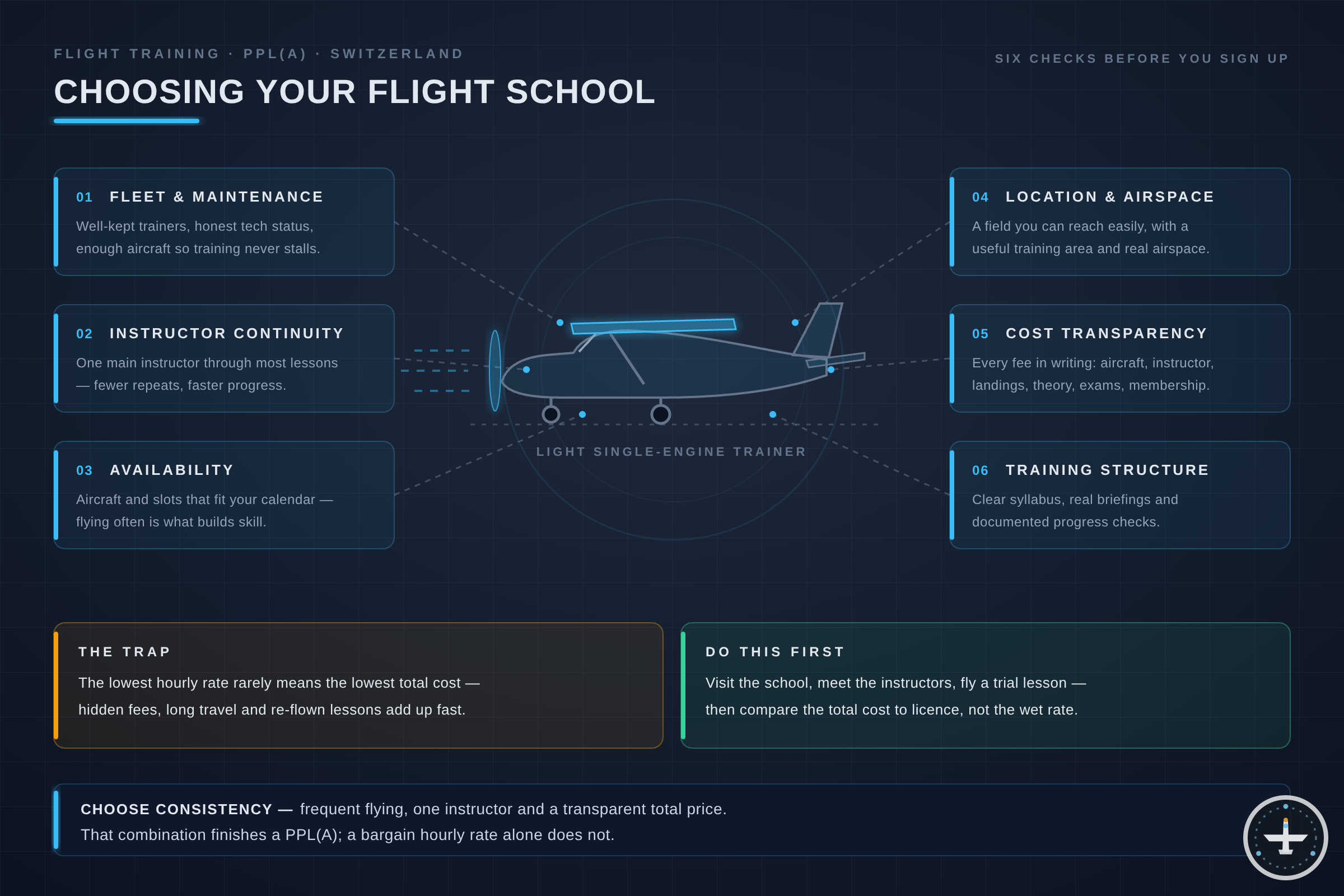
Visit at least two schools (introductory flight + discussion) and clarify the following specifically:
- BAZL status: ATO or DTO? Is the approval/declaration number published on the website?
- Skill Test pass rate: How many candidates pass on the first attempt? A reputable school will give you figures.
- Instructor continuity: Are instructors employed full-time or only freelancers at weekends? How many FI(A) are available?
- Ground school format: Classroom, online, or blended? Is a learning portal available?
- Realistic training duration: How long do students take on average from start to licence?
- Contract structure: Advance payments, refund policy upon withdrawal, price guarantee?
- Maintenance downtime: How often was the primary aircraft AOG last year?
- Radiotelephony training language: Is training available in both German and English? Is the English radiotelephony certificate trained concurrently?
Conclusion
The cheapest school is rarely the most cost-effective — waiting times, school transfers, and lost training time ultimately cost more than a CHF 30/h higher hourly rate. Find an organisation with transparent communication, an adequate fleet, and instructors you enjoy sharing the cockpit with. The rest comes down to your own commitment.