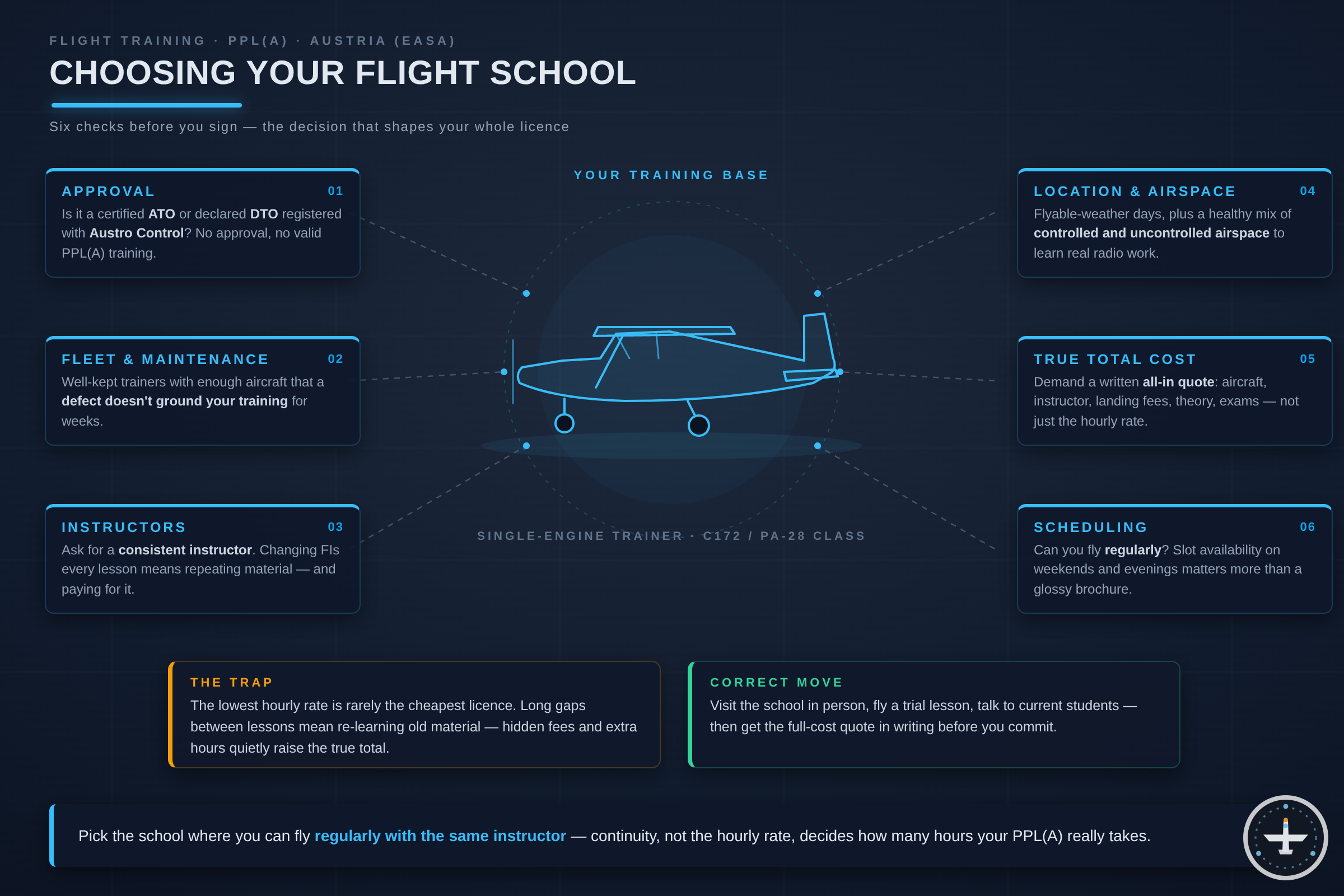
ATO or DTO — What Is the Difference?
In Austria, you may complete your PPL(A) at either an ATO (Approved Training Organisation) or a DTO (Declared Training Organisation). Both are registered with Austro Control and both are authorised to provide PPL(A) training — the difference lies in the approval process and organisational structure.
- ATO: A fully approved school with a documented management system, Safety Manager and Compliance Monitoring. In addition to the PPL, it may train for CPL, IR, MEP and further ratings. Tends to be larger, often located at controlled aerodromes with a tower.
- DTO: A simplified model for non-commercial basic training (LAPL, PPL, class ratings SEP/TMG, night and towing ratings). The school "declares" its training programme to Austro Control rather than having it formally approved. Club structures are common at aerodromes such as Wiener Neustadt-Ost, Stockerau, Spitzerberg, Punitz or Mauterndorf.
For a straight PPL(A), there is no qualitative difference — the syllabus is identical. In practice, a DTO often means lower hourly rates, a more personal environment and less bureaucracy. An ATO, on the other hand, offers clearer structures and makes it easier to progress to higher licences without changing schools.
Local Club School vs. National ATO
The landscape in Austria is divided into two camps:
Regional DTOs / club schools can be found at almost every grass-strip aerodrome. Advantages: short travel distances, personal contact with instructors, often lower hourly rates (aircraft wet from approx. €180–230/h for C152/PA-28). Disadvantages: small fleet (often 1–2 aircraft), limited theory session availability, instructors mostly part-time — which costs flexibility when the weather changes.
National ATOs at controlled aerodromes (LOWW Schwechat is barely practical for training, but LOAN Wiener Neustadt-Ost, LOWG Graz, LOWS Salzburg, LOWI Innsbruck and LOWL Linz are) offer larger fleets, full-time instructors and structured theory blocks. Hourly rates are typically €230–320/h wet, but you can realistically reach your Skill Test within 12–18 months.
Assessing Hourly Rates Realistically
Do not be misled by headline prices. Always ask:
- Wet or dry? "Wet" = fuel included. "Dry" = you pay AVGAS separately (currently approx. €3.20–3.80/litre; a C172 burns ~32 l/h).
- Block time or flight time? Block time starts from engine start; flight time from lift-off. The required 45 hours for PPL(A) are flight time, but billing is usually based on block time.
- Instructor fee included? Some schools add €50–80/h on top.
- Landing fees at other aerodromes, fuel surcharges, club membership (often €200–600/year at DTOs).
Realistic total cost for PPL(A) in Austria 2024/25: €12,000 to €18,000, including theory, Class 2 Medical, radio telephony licence (BZF/AFZ), books, Austro Control examination fees and materials.
Fleet: What to Look For
A school with a single 40-year-old C152 is not an automatic disqualifier — but it is a risk. Check:
- Number of aircraft: At least 2, preferably 3+ of comparable type. If the only aircraft is in its 100-hour check, you will not fly for four weeks.
- Maintenance status: Ask to see the aircraft log. Frequent technical defects (snags) indicate neglected maintenance.
- Avionics: A classic six-pack is perfectly adequate for the PPL. A glass cockpit (G500/G1000) is nice, but more expensive and more relevant for later CPL/IR training.
- Type variety: If the school operates a C152, C172 and PA-28, you can complete differences training without difficulty after your Skill Test.
Evaluation Criteria for Your Decision
Before you sign anything, clarify the following:
- Theory: In-person, online or hybrid? How many modules, which provider? Self-study plus consultations is cost-effective; traditional classroom instruction is more expensive but more structured. Aero.Academy covers all nine EASA PPL subjects in full — ask whether the school accepts this as a theory substitute.
- Instructor availability: How many students per CFI? When can flights realistically be booked? Ask explicitly about waiting times in summer.
- Examiner: Does the school have its own Flight Examiner FE(A) in-house, or does an external examiner have to be brought in? External examiners cost extra.
- Contract and refund policy: What happens if you discontinue training or change schools? Are prepaid packages refunded on a pro-rata basis?
- Language: Theory and radio communication in German or English? For later English Language Proficiency (ELP Level 4+), conducting radio work in English from the start is worthwhile.
- References: Talk to current students, not just management. Ask how many students have actually passed the Skill Test in the last two years.
Trial Lesson as a Mandatory Check
Before committing, take an introductory flight at at least two schools (approx. €150–250). Pay attention to:
- How does the instructor brief you — briefing quality, checklist discipline, radio technique?
- What is the atmosphere in the hangar? Clean aircraft, tidy premises, current NOTAM postings?
- Are you treated as a customer or just ticked off as a club trainee?
The right flight school is the one where you turn up regularly, fly regularly, and look forward to every session. Everything else — hourly rate, glass cockpit, brand name — is secondary.