What Is the Language Proficiency Check?
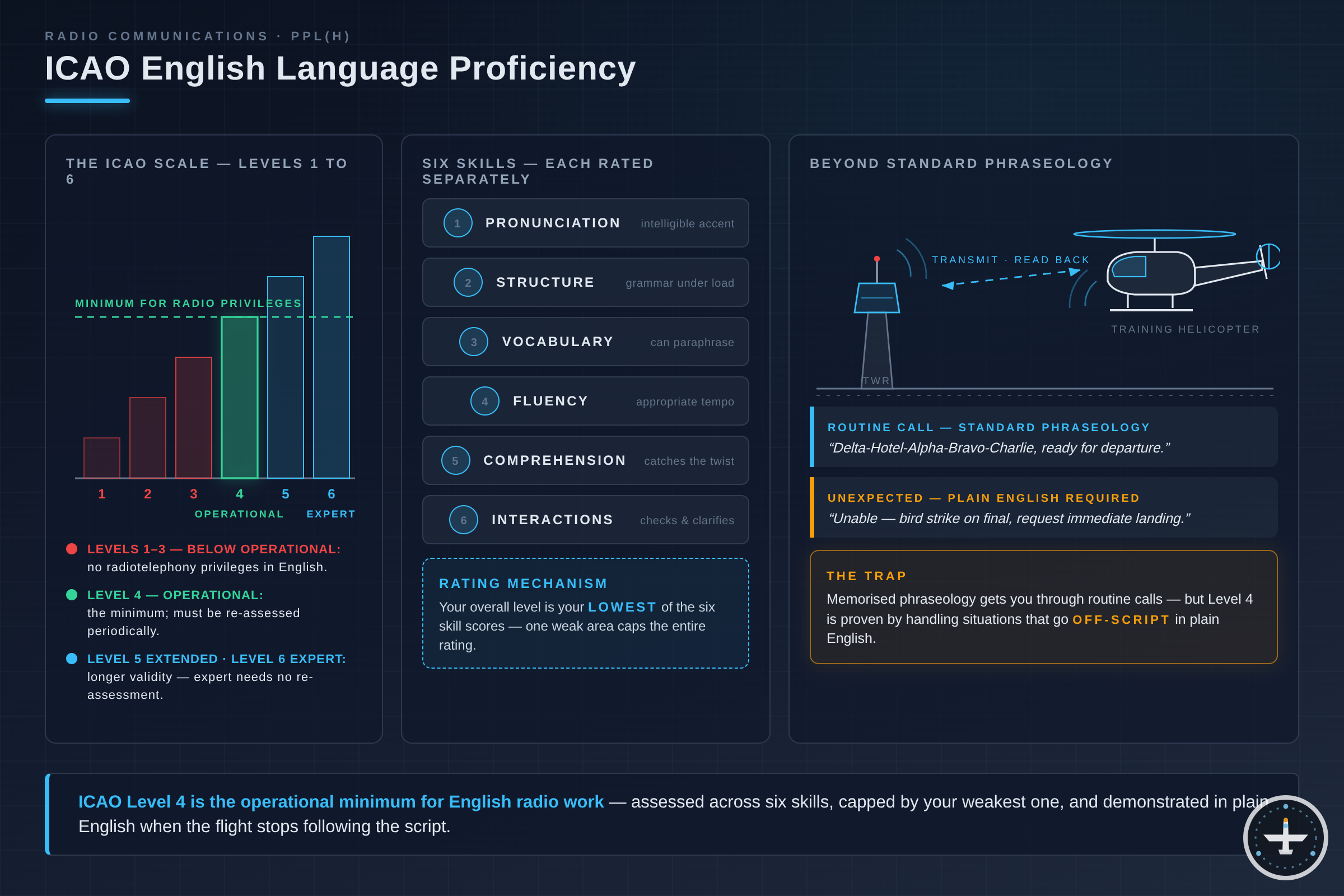
The Language Proficiency (LP) endorsement is an entry in your pilot licence certifying that you meet a defined level of competency in a language — specifically the language you use for radio communications. The legal basis is ICAO Annex 1 in conjunction with Part-FCL (FCL.055). The LBA implements these requirements in Germany.
As a PPL(H) applicant, this means: you need at least Level 4 (Operational) in the language you use on the radio. Without this entry, your BZF/AZF is worthless — and without a radio licence, you cannot operate in controlled airspace.
Which Level Do You Need and When?
There are two separate language endorsements that are often confused:
- German LP: required if you want to communicate by radio in German within Germany (BZF I or BZF II).
- English LP: required if you communicate in English (BZF I, AZF, or generally in international operations).
As a helicopter pilot, you will typically need both. As soon as you fly abroad, approach an international airport, or use IFR-relevant frequencies, English is mandatory.
ICAO Levels at a Glance
| Level | Designation | Validity |
|---|---|---|
| 1–3 | Pre-Operational / Elementary | not sufficient |
| 4 | Operational | 4 years |
| 5 | Extended | 6 years |
| 6 | Expert | unlimited |
Levels 1–3 do not authorise you to use radio communications. Level 4 is the minimum standard but must be renewed regularly. Level 6 is the gold standard — obtained once, valid for life.
What Is Assessed?
ICAO evaluates six skills, each rated individually on a scale of 1–6. Your final level is the lowest score across all six areas. If you perform at Level 6 in five areas but only reach Level 4 in one, you will be awarded Level 4.
The six skills:
- Pronunciation — accent is acceptable as long as it does not impair intelligibility.
- Structure — grammatical structures, appropriate to the situation.
- Vocabulary — range of vocabulary, both aviation-specific and general.
- Fluency — flow of speech, no excessively long pauses.
- Comprehension — listening comprehension, including unexpected situations.
- Interactions — responsiveness, asking clarifying questions, resolving misunderstandings.
Skills 5 and 6 are the most common stumbling blocks. Anyone can recite standard phraseology — the test specifically checks whether you can communicate meaningfully in English during a non-standard event (bird strike, technical problem, sudden weather deterioration).
How Does the Test Work?
In Germany, language tests are administered by approved Language Assessment Bodies (LABs) registered with the LBA. Typical format:
- Duration: 20–40 minutes, usually as a one-on-one assessment.
- Format: typically three parts.
- Pilot Interview: general questions about your flying, experience, and background.
- Picture Description / Aviation Topic: you describe a picture or discuss an aviation-related topic.
- Listening / Roleplay: audio clips with ATC communications, sometimes with interference; you are expected to ask for clarification, summarise, and resolve problems.
- Cost: approximately 150–250 EUR, depending on the examiner.
- Result: usually within a few days; the endorsement is entered into the licence via the LBA (separate entry fee applies).
Some flight schools offer the LP check as part of the practical radio training programme. Clarify this early — otherwise you may end up in a holding pattern after passing your BZF.
Renewal and Re-examination
- Level 4: re-examination required every 4 years.
- Level 5: re-examination required every 6 years.
- Level 6: assessed once, never again.
Renewal means a complete re-check — there is no simple sign-off. If you hold Level 4 and do not keep practising, you may fail the next check. Until you pass the re-examination, you are not permitted to use radio communications.
Tips for Non-Native Speakers
Most German PPL(H) applicants start somewhere between Level 4 and 5. The following will help you reach Level 4 confidently or push higher:
- Listen to live ATC: LiveATC.net, particularly busy towers such as EDDF, EGLL, or KJFK. Start with 15-minute sessions, then try to speak along.
- Standard phraseology is not enough on its own. Practise plain English for emergencies: "smoke in the cockpit", "engine vibration", "unsure of position".
- Talk to yourself out loud during VFR flights: describe what you see, in English.
- Read NOTAMs and METARs in English rather than in translation — vocabulary grows as a side effect.
- Aero.Academy provides radio communication scenario training with an AI sparring partner, including unexpected situations.
An accent is not a problem. You are assessed on intelligibility, not on sounding like a native speaker. However, if you need to say "say again?" every third exchange, you will land on Level 3 — and that is simply not sufficient.
Special Case: Helicopter Operations
As a helicopter pilot you often operate in uncontrolled airspace, but you also fly to off-aerodrome landing sites, hospital approaches, and offshore operations. If you have ambitions in HEMS or police aviation, English at Level 5 or higher is practically expected, as Crew Resource Management is conducted in English. Factor this in from the start — taking the LP check immediately after PPL(H) and working up to Level 5 later is a sensible strategy.