What is it about?
The Language Proficiency (LP) endorsement is an entry in your pilot licence confirming that you have reached a defined level in a given language (usually English) for aeronautical radiotelephony. The basis is the ICAO Language Proficiency Requirements (Annex 1), implemented in EU law through Part-FCL (FCL.055). In Switzerland, the competent authority is the BAZL.
The entry appears on the last page of your EASA licence and states the language, the level (4, 5 or 6), and an expiry date.
When do you need LP as a PPL(H) candidate?
In short: practically always, as soon as you operate a radio.
- English Level 4 or higher is required whenever you want to communicate on English-language radio frequencies. This applies to every flight outside Switzerland, all IFR frequencies, many controlled airspaces, and effectively every skill test conducted with English radiotelephony.
- German (or the local language) Level 4 is required if you intend to operate solely on German-language frequencies. In Switzerland this has limited applicability, as many sectors are bilingual or English-only.
- For the PPL(H) practical skill test, the examiner requires a valid LP endorsement in the language used for radio communications. Without the entry, the licence will not be issued.
Rule of thumb: schedule your LP test before the skill test – ideally alongside your theoretical knowledge training or shortly before the practical examination.
The three relevant levels in detail
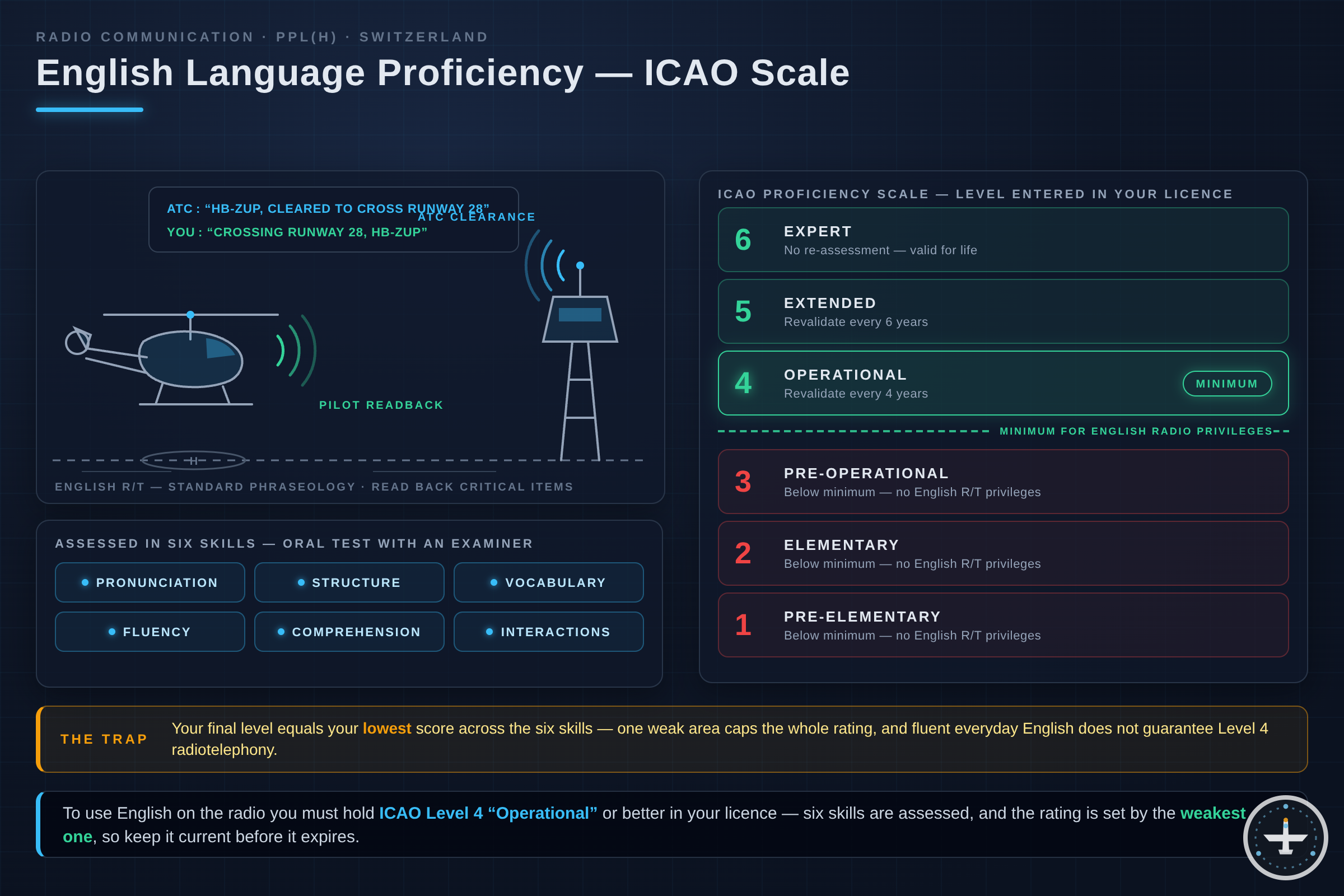
ICAO defines six levels; the relevant ones for you are 4, 5 and 6:
| Level | Designation | Validity | Renewal |
|---|---|---|---|
| 4 | Operational | 4 years | Test every 4 years |
| 5 | Extended | 6 years | Test every 6 years |
| 6 | Expert | Unlimited | No renewal required |
Level 4 is the minimum for radio operations. You understand standard phraseology reliably and can describe non-routine situations (e.g. a technical malfunction, a weather diversion) in an understandable manner.
Level 5 demonstrates significantly higher fluency, fewer accent-related issues, and a broader vocabulary.
Level 6 corresponds to native-speaker proficiency or equivalent. It is rarely awarded at the first attempt – examiners in Switzerland tend to be conservative in this regard.
The six assessment criteria
The examiner assesses you in six categories, and your overall level is the lowest of the six:
- Pronunciation – articulation that is intelligible to the international aviation community
- Structure – grammatical accuracy in radio-relevant structures
- Vocabulary – range of vocabulary, including paraphrase when a technical term is unavailable
- Fluency – natural speaking pace, no lengthy pauses
- Comprehension – understanding, including accented speech or background interference
- Interactions – appropriate responses, asking clarifying questions, resolving misunderstandings
This means: if you achieve Level 5 in five criteria but only Level 4 in one, your overall rating is Level 4.
How does the test work in Switzerland?
The BAZL accepts tests from recognised Language Assessment Bodies (LAB). An up-to-date list is available on the BAZL website. Common providers include AECG, ELPAC-accredited bodies, and individual FTOs/ATOs holding LAB status.
Typical test procedure:
- Duration: 30–45 minutes, usually an individual assessment
- Format: interview + listening comprehension tasks (often using audio recordings of ATC communications) + role-play with aviation-typical scenarios
- Content: personal aviation experience, description of images/charts, abnormal situations, ATC readbacks
- Assessment: by two independent assessors (linguist + operational expert) or a single accredited examiner
- Cost: approx. CHF 200–400 depending on the provider and level
After passing the test, the LAB issues a certificate. You submit this to the BAZL, which enters it into your licence (licence amendment fee applies, currently approximately CHF 100).
Tips for non-native speakers
- Master phraseology first. Standard radiotelephony phraseology is not the test content itself, but it is the foundation. Candidates who are confident here automatically sound more fluent.
- Train with real ATC recordings. LiveATC.net or YouTube channels covering helicopter operations (HEMS, offshore) train your ear for a wide range of accents.
- Talk about your helicopter experience. Prepare answers to typical topics: your training progression, a demanding flight, differences between the R22/R44/H125, autorotation, actions in the event of tail rotor failure.
- Practise non-routine scenarios. A classic test item: "Describe a forced landing following an engine failure over unfamiliar terrain." Practise this out loud.
- Paraphrase rather than give up. If a word escapes you, describe it. "The thing that measures the rotor RPM" is better than silence.
- An accent is acceptable. What is assessed is intelligibility, not Oxford English. Swiss-accented English is perfectly fine as long as an international air traffic controller can understand you.
Renewal and ongoing practice
At Level 4 you must retest every four years. Many pilots schedule the test alongside their class rating revalidation period. If you actively communicate in English in the interim (international flights, training abroad), maintaining the standard is not a problem in practice.
Achieving Level 5 buys you six years without retesting – the more demanding test often pays off. Level 6 is awarded in German-speaking countries only at very high language proficiency, and frequently not at the first attempt.
Summary
LP is not an obstacle – it is a safety standard. Plan the test early, take Level 4 as your minimum, aim for Level 5 where possible, and practise non-routine situations verbally. Without a valid entry, your PPL(H) cannot be used for radio operations.