What is the Language Proficiency Endorsement (LPE)?
The Language Proficiency Endorsement is an entry in your pilot licence confirming that you are able to communicate safely by radio in a given language. The legal basis is set out in the ICAO standards (Annex 1) and EU regulation (Part-FCL, FCL.055). Without this entry you are not permitted to operate the radio in the relevant language — including in uncontrolled airspace whenever radio communication is required.
For PPL(H) applicants in Austria this means specifically: you need at minimum an entry for German (for domestic radio communication) and, in virtually all cases, an additional entry for English (for international flights, IFR-style procedures in certain TMAs, and international aerodromes).
The Six ICAO Language Levels
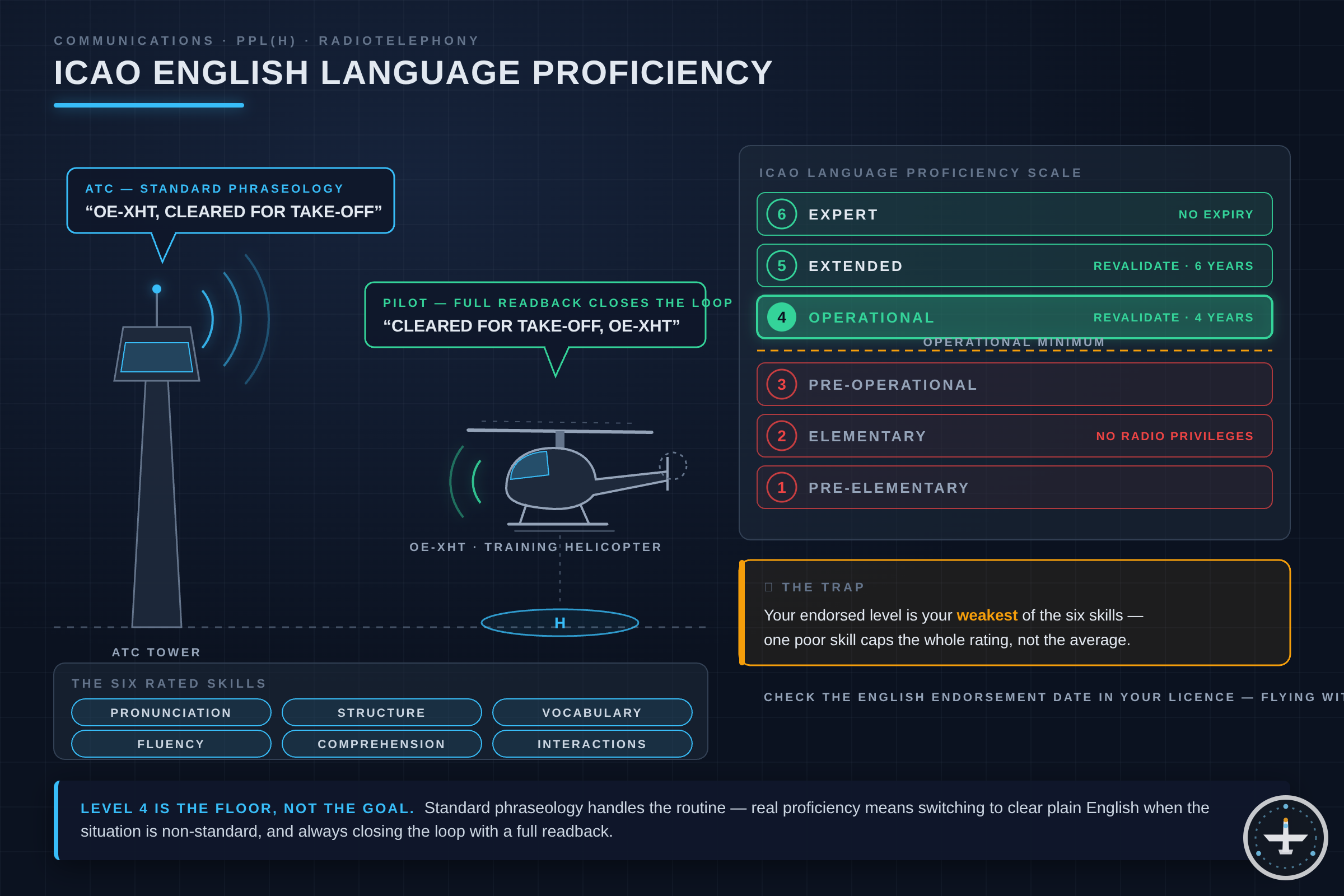
ICAO defines six levels; in practice only Levels 4, 5 and 6 are assessed:
- Level 1–3: Insufficient. No radio communication permitted.
- Level 4 (Operational): Minimum standard. Valid for 4 years, then re-check required.
- Level 5 (Extended): Advanced. Valid for 6 years.
- Level 6 (Expert): Native-speaker level or equivalent. Valid indefinitely.
Six categories are assessed individually: pronunciation, structure, vocabulary, fluency, comprehension and interaction. Your overall level is always the lowest individual result — if you score Level 6 in five categories but only Level 4 in pronunciation, your overall result is Level 4.
When Do You Need the Endorsement?
At the latest before your first radio call as pilot-in-command. In practice this means: before your first supervised solo involving radio, and no later than the PPL(H) skill test. Austro Control will not register the licence as fully usable without an LPE.
If you only have German entered, you can technically obtain an Austrian PPL(H), but as soon as you intend to fly to Germany, Switzerland, Italy or Slovenia, you will need English. Most flying schools recommend obtaining entries for both languages at the same time.
Test Procedure in Austria
The language test is conducted by a Language Assessment Body (LAB) approved by Austro Control. A current list is available on the Austro Control website under "Sprachprüfung Luftfahrtpersonal" (language examination for aviation personnel).
The test typically takes 20–40 minutes and consists of three parts:
- Interview / General section: Questions about your flying experience, training and licences.
- Listening / Response to audio recordings: You listen to real or simulated radio transmissions — often featuring non-native speakers and background noise — and respond accordingly.
- Picture description / Non-routine scenario: You describe an image or are presented with an emergency situation that you must respond to as PIC — for example an engine failure, a weather problem, or a medical emergency on board.
The third part is precisely where many candidates fail. Standard phraseology is not enough — you must also be able to improvise in plain English when standard phrases no longer suffice.
Costs typically range from 150 to 300 EUR depending on the provider; some schools offer the test as part of a training package.
Practical Tips for Non-Native Speakers
- Listen to real radio traffic. LiveATC.net is free and unbeatable. Search for Austrian and German TMAs (LOWW, LOWS, EDDM), but also English-speaking hubs (EGLL, KJFK) — the latter to expose yourself to a broader range of accents.
- Train phraseology and plain English separately. Phraseology can be memorised (CAP 413, ICAO Doc 9432). Plain English is what you need when something unexpected happens.
- Speak along out loud. Shadowing radio recordings simultaneously trains fluency and pronunciation.
- Actively learn emergency vocabulary. Terms such as engine failure, fuel starvation, vibration, smoke in cockpit, unable, standby and say again must be instantly accessible.
- Pay attention to numbers. Frequencies, altitudes, headings — numbers are the most common source of errors. "Fife", "Niner" and "Tree" are ICAO standard, not optional.
- Do a mock test. Many Aviation English language schools offer practice sessions. 90 minutes of targeted practice with feedback is worth more than 20 hours of self-study.
Re-validation and Upgrade
Level 4 expires after 4 years, Level 5 after 6 years. Keep an eye on the expiry date in your licence — flying with an expired LPE means flying illegally, even if all other ratings are valid.
If you feel your proficiency has improved, you can sit the test again at any time and upgrade to Level 5 or 6. This is particularly worthwhile if you plan to fly long-term — Level 6 never needs to be renewed.
Helicopter-Specific Considerations
In terms of content, the language test is not differentiated between helicopter and fixed-wing — it assesses Aviation English in general. However, during the practical section it is advantageous if you are able to describe helicopter-specific scenarios in English (off-airport landing, hover taxi, Vortex Ring State, tail rotor issues). Examiners frequently ask questions directly related to your licence category.