What Is the Language Proficiency Check?
Following several accidents in which language misunderstandings played a role (including Tenerife 1977 and Überlingen 2002), ICAO decided in 2003 that anyone conducting radio communications in international aviation must formally demonstrate their language competency. EASA adopted this requirement into Part-FCL — specifically in FCL.055.
As a PPL(A) pilot, this means your licence must include a Language Proficiency Endorsement stating the language (e.g. English, German) and level (Level 4, 5, or 6). Without this entry, you are not permitted to communicate by radio in that language — full stop.
When Do You Need English?
Strictly speaking, a German Language Proficiency endorsement is sufficient for purely domestic flights within Germany. In practice, however, the picture is different:
- VFR flights abroad: As soon as you fly towards the Netherlands, Czech Republic, Poland, or through FIS sectors in border areas, you need English.
- Controlled airspace with English phraseology: Some German towers (e.g. Frankfurt, Munich) operate primarily in English — even if you rarely land there as a VFR pilot, you may find yourself within their TMA.
- IFR: IFR radio communications are in practice always conducted in English. For a later IR rating, Level 4 English is mandatory in any case.
- Situational awareness: ATIS, NOTAMs, and AIP charts are largely in English. Without language proficiency, you lack the informational foundation to operate safely.
Bottom line: practically every PPL pilot will sit the English LP check sooner or later. Many do it in parallel with their PPL training.
ICAO Levels 1 to 6
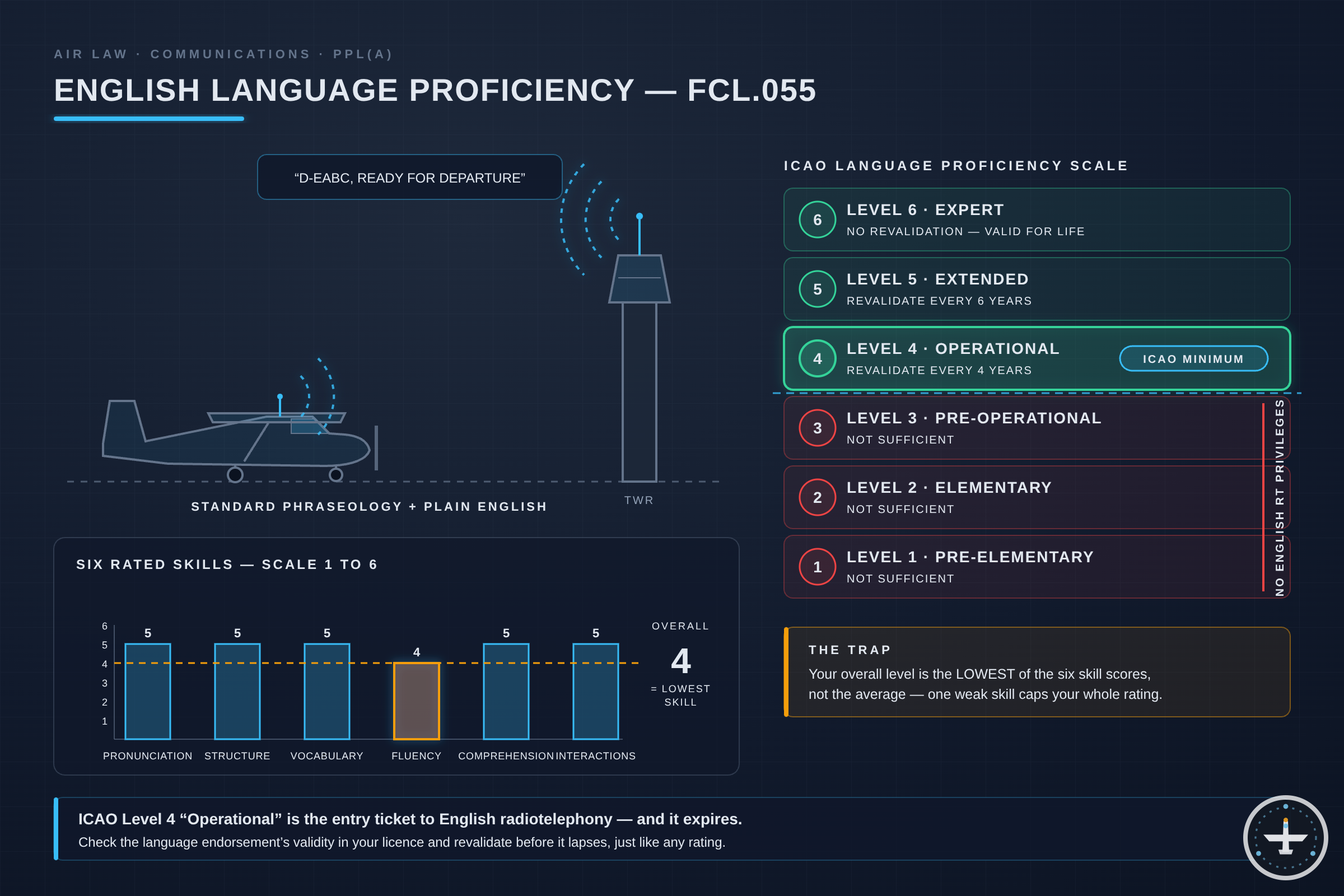
Assessment is carried out across six dimensions: Pronunciation, Structure, Vocabulary, Fluency, Comprehension, and Interactions. The overall level is always determined by the lowest of the six individual scores.
| Level | Designation | Validity |
|---|---|---|
| 1–3 | Pre-Operational | insufficient — no licence entry |
| 4 | Operational | 4 years |
| 5 | Extended | 6 years |
| 6 | Expert | unlimited |
- Level 4 is sufficient for all PPL activities. You must be able to apply standard phraseology reliably and communicate clearly in unexpected situations (e.g. emergencies, diversions) — even if your pronunciation and grammar are not perfect.
- Level 5 is considerably more demanding. You must remain fluent, precise, and clear in more complex situations.
- Level 6 is typically awarded to native speakers or individuals with extended residence in English-speaking countries. In Germany, Level 6 is awarded very restrictively.
How Does the Test Work in Germany?
The LBA does not conduct assessments itself — it approves Language Assessment Bodies (LABs) and individual examiners. You can find the list of approved bodies on the LBA website under "Licences for Aviation Personnel → Language Proficiency Tests".
Typical providers include Austro Control-approved examiners, ELPAC assessments through DFS-affiliated organisations, and private LABs at flying schools. Most flying schools either have at least one examiner in-house or cooperate with one.
Format of a typical examination (approx. 30–45 minutes):
- Interview / Warm-up: Personal questions and aviation background. This serves to calibrate the examiner's assessment.
- Picture Description: You describe an image with an aviation context (e.g. an accident scene, a weather situation).
- Listening Comprehension: You listen to radio transmissions or ATIS recordings and summarise them or respond accordingly.
- Unusual Situations / Role Play: The examiner acts as ATC and you must handle an emergency or unusual situation — engine failure, fuel emergency, radio failure, etc.
- Open Discussion: Discussion of an aviation topic (e.g. weather minima, airspace classification).
Costs: Typically €150–250 for the examination, depending on the provider and level. Renewal checks (Level 4) are often cheaper than initial assessments.
Renewal and Documentation
- Level 4 must be renewed every 4 years.
- Level 5 every 6 years.
- Level 6 is lifetime — once entered, no renewal is required.
Do not let your renewal lapse. An expired LP Endorsement means you are not permitted to communicate by radio in that language until you have been re-examined. The LBA enforces this strictly, and a radio violation can be costly (fines and regulatory proceedings).
Tips for Non-Native Speakers
If English is not your native language and you are aiming for Level 4:
- Standard phraseology first. Learn ICAO Doc 9432 or the German AIP radio procedures by heart. Standard phrases will carry you through 80% of the examination.
- Listen to real radio traffic. LiveATC.net with Frankfurt Tower, EDDM Approach, or London Heathrow — 15 minutes a day is enough to train your ear.
- Practise plain English. Examiners explicitly test whether you can communicate outside of standard phraseology. Practise describing situations: "I have an engine roughness, request priority handling."
- Numbers, phonetic alphabet, frequencies: These must be second nature. Confusion between "fife" and "five" or "niner" and "nine" are common stumbling blocks.
- Pronunciation before grammar. Level 4 is forgiving of grammatical errors — poor pronunciation less so. Slow and clear is always better than fast and mumbled.
- Avoid direct translations from German. "I am going around" rather than "I make a go-around" — small details like these mark you as uncertain.
A Common Mistake: Leaving It Too Late
Many students postpone the LP check until after their practical PPL examination. This is technically possible — however, the endorsement must be entered in the licence before initial licence issue by the LBA, otherwise issuance will be delayed. Plan the check at the latest in parallel with your theoretical knowledge examination.