What This Is About
The Language Proficiency Assessment (LPA) is a mandatory language test for pilots who wish to use radio communications in the respective language. The legal basis is ICAO Annex 1 (Personnel Licensing), implemented in the EU/Switzerland via Part-FCL (FCL.055). A passed test is entered into your licence — without this entry, you are not permitted to communicate by radio in that language.
For the PPL(A) in Switzerland, you will almost always need English in practice, because:
- You frequently communicate in English in controlled airspace.
- English is mandatory for flights abroad.
- Many Swiss towers (Zurich, Geneva) operate in English.
If you communicate exclusively in German (e.g. only local VFR flights at an uncontrolled aerodrome with a German-speaking air traffic controller), a language endorsement in German is theoretically sufficient. Realistically: you will need both, or at least English.
When You Need the Endorsement
You must have the language proficiency entry in your documents no later than before the practical PPL examination (Skill Test) — the examiner records the result in the licence afterwards, or the licence is issued accordingly by BAZL. In practice:
- Before your first solo, you do not yet need a formal entry, but you do need a restricted radiotelephony licence (Flight Radiotelephony Operator's Licence, FRTOL).
- You can sit the language test in parallel with your theoretical knowledge and practical training.
- The entry must be in place no later than when BAZL issues the PPL licence.
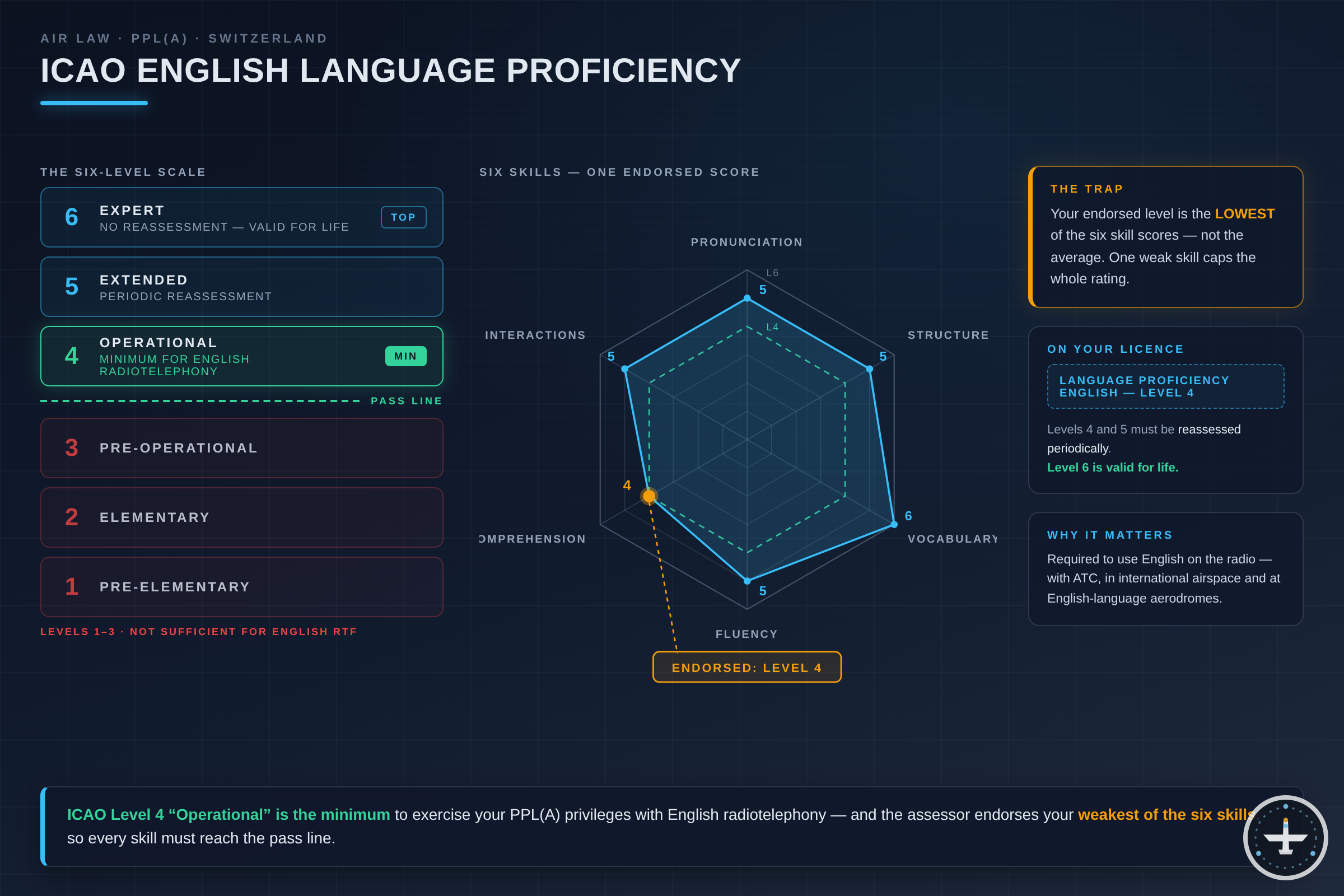
The Six ICAO Levels
ICAO defines six levels across six criteria (Pronunciation, Structure, Vocabulary, Fluency, Comprehension, Interactions):
- Level 1 — Pre-elementary: not functional.
- Level 2 — Elementary: insufficient.
- Level 3 — Pre-operational: insufficient.
- Level 4 — Operational: minimum required for radio communications. Valid for 4 years, then re-assessment required.
- Level 5 — Extended: Valid for 6 years.
- Level 6 — Expert: Effectively native-speaker level. Valid indefinitely — no re-assessment required.
You therefore need at least Level 4. Students who invest the effort to reach Level 5 or 6 will save themselves repeat assessments and fees later on.
How the Test Works
In Switzerland, BAZL accepts tests from authorised language assessors (Language Assessment Bodies, LAB). Providers include AECC, ELPAC, EALTS, as well as various schools and examiners recognised by BAZL. The test typically takes 30–45 minutes and usually consists of three parts:
- Interview / General English: General questions about your flying, training and experience. Here you demonstrate fluent speaking and comprehension beyond standard phraseology.
- Listening / Comprehension: You listen to ATC recordings or pilot reports and answer questions or summarise what was said. Often includes imperfect recordings (accents, background noise).
- Picture Description / Unusual Situations: You describe pictures (weather, aerodrome scenes, technical equipment) and respond to unexpected scenarios — e.g. an engine fire, a stuck undercarriage, a radio failure. This section assesses whether you can communicate beyond standard phraseology.
All six ICAO criteria are assessed individually. Your overall level is the lowest individual score — if you achieve Level 5 in five areas but only Level 4 in Pronunciation, the final result is Level 4.
Fees and Providers in Switzerland
Costs vary by provider, typically CHF 200–400 for the initial test, with re-assessments somewhat cheaper. You can find providers on the BAZL website (list of recognised LABs) or through your flight school, which can usually recommend an examiner. Some schools integrate the assessment directly into the training programme.
Tips for Non-Native Speakers
If English is not your first language (which applies to most people in Switzerland):
- Phraseology and English are not the same thing. The test explicitly assesses your ability outside standard phraseology. "Negative, copy that, request vectors" is not enough.
- Listen to live ATC. LiveATC.net (Zurich, Geneva, London Heathrow) is free. 15 minutes a day will do more for you than any textbook.
- Practise picture descriptions aloud. Take any aircraft photo and describe it for two minutes without stopping — in English. It sounds simple; it is not.
- Learn emergency vocabulary. "Smoke in the cockpit", "bird strike", "fuel leak", "hydraulic failure" — you need to be able to produce these terms actively, not just understand them passively.
- Train your ear for accents. ATC sounds different all over the world. French, Indian, Brazilian — get your ear used to the variety.
- Aim for Level 5 or 6. The extra effort required for Level 5 is modest, but the benefit (6 years' validity instead of 4) is significant. Level 6 is worthwhile if you are genuinely proficient — you will never need a re-assessment again.
Re-Assessment
When your Level 4 entry expires after 4 years, you must repeat the test. Plan ahead — if the entry lapses in your licence, you are no longer permitted to use the radio and therefore effectively cannot fly in controlled airspace. BAZL updates the licence after a successful re-assessment.
Summary
- A minimum of ICAO Level 4 English is mandatory for realistic PPL(A) operations in Switzerland.
- The test takes 30–45 minutes and consists of three parts: Interview, Listening, Picture/Scenario.
- Level 4 = 4 years, Level 5 = 6 years, Level 6 = unlimited validity.
- Train outside standard phraseology — this is the most common stumbling block.